Solve each equation. Give solutions in exact form. See Examples 5–9. log x + log(x - 21) = log 100
Table of contents
- 0. Review of Algebra4h 18m
- 1. Equations & Inequalities3h 18m
- 2. Graphs of Equations1h 43m
- 3. Functions2h 17m
- 4. Polynomial Functions1h 44m
- 5. Rational Functions1h 23m
- 6. Exponential & Logarithmic Functions2h 28m
- 7. Systems of Equations & Matrices4h 5m
- 8. Conic Sections2h 23m
- 9. Sequences, Series, & Induction1h 22m
- 10. Combinatorics & Probability1h 45m
6. Exponential & Logarithmic Functions
Solving Exponential and Logarithmic Equations
Problem 71
Textbook Question
Solve each logarithmic equation in Exercises 49–92. Be sure to reject any value of x that is not in the domain of the original logarithmic expressions. Give the exact answer. Then, where necessary, use a calculator to obtain a decimal approximation, correct to two decimal places, for the solution. log2(x+2)−log2(x−5)=3
Verified step by step guidance1
Recall the logarithmic property that states \( \log_b A - \log_b B = \log_b \left( \frac{A}{B} \right) \). Apply this to the equation \( \log_2 (x+2) - \log_2 (x-5) = 3 \) to combine the logs into one: \( \log_2 \left( \frac{x+2}{x-5} \right) = 3 \).
Rewrite the logarithmic equation in its equivalent exponential form. Since \( \log_b y = x \) means \( y = b^x \), rewrite \( \log_2 \left( \frac{x+2}{x-5} \right) = 3 \) as \( \frac{x+2}{x-5} = 2^3 \).
Simplify the right side of the equation: \( 2^3 = 8 \), so the equation becomes \( \frac{x+2}{x-5} = 8 \).
Solve the resulting rational equation by cross-multiplying: \( x + 2 = 8(x - 5) \). Then, distribute and collect like terms to isolate \( x \).
Check the domain restrictions for the original logarithmic expressions: \( x + 2 > 0 \) and \( x - 5 > 0 \), which means \( x > -2 \) and \( x > 5 \). Only values of \( x \) greater than 5 are valid. Verify that your solution satisfies this domain before finalizing your answer.
Verified video answer for a similar problem:This video solution was recommended by our tutors as helpful for the problem above
Video duration:
4mPlay a video:
Key Concepts
Here are the essential concepts you must grasp in order to answer the question correctly.
Properties of Logarithms
Understanding the properties of logarithms, especially the subtraction rule log_b(A) - log_b(B) = log_b(A/B), is essential for simplifying and solving logarithmic equations. This allows combining multiple logarithmic terms into a single logarithm, making the equation easier to solve.
Recommended video:
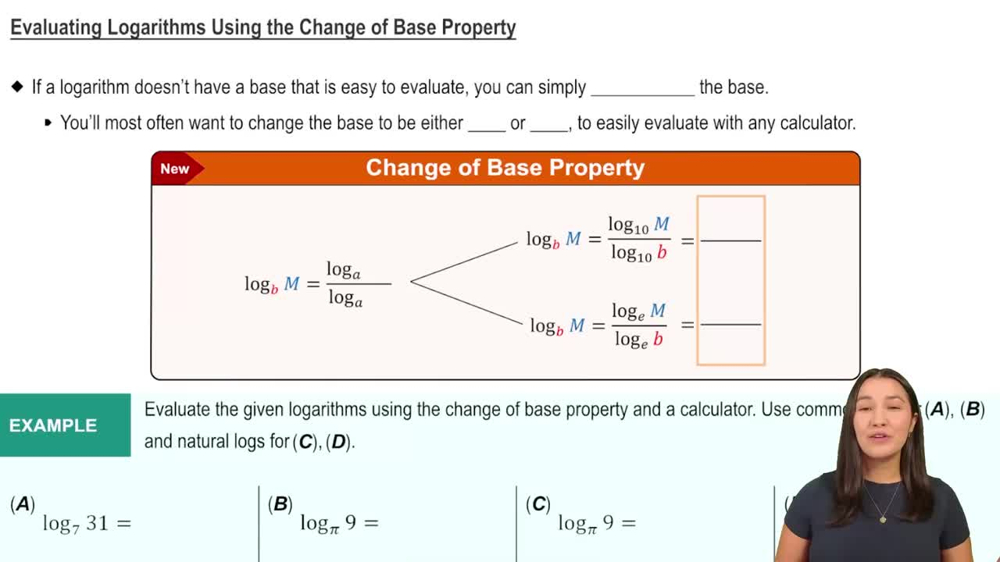
Change of Base Property
Domain of Logarithmic Functions
The domain of a logarithmic function log_b(x) includes only positive values of x. When solving logarithmic equations, it is crucial to identify and exclude any solutions that make the arguments of the logarithms non-positive, ensuring the solution is valid within the function's domain.
Recommended video:
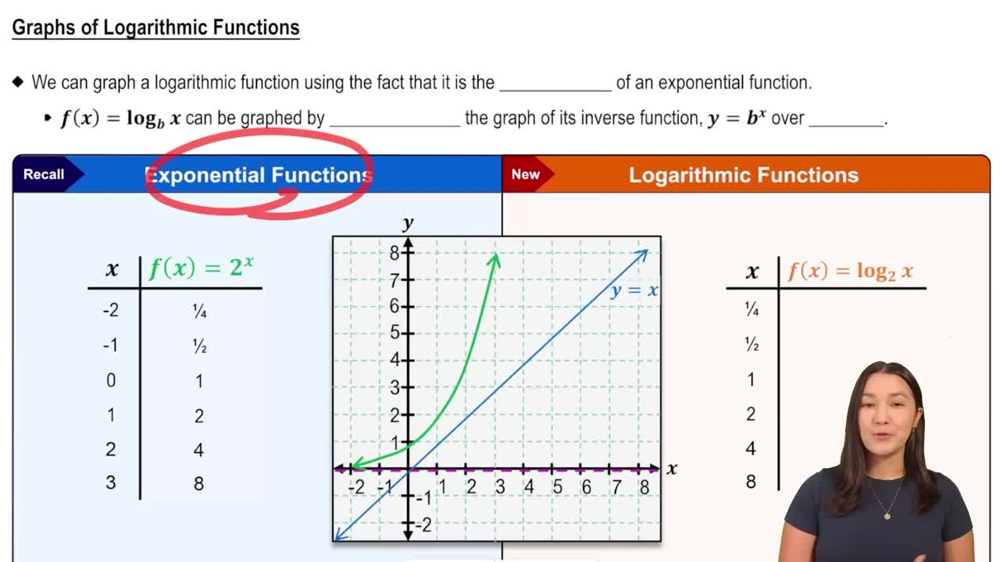
Graphs of Logarithmic Functions
Converting Logarithmic Equations to Exponential Form
To solve logarithmic equations, converting the equation from logarithmic form to exponential form is often necessary. For example, log_b(A) = C can be rewritten as A = b^C, which allows solving for the variable algebraically.
Recommended video:
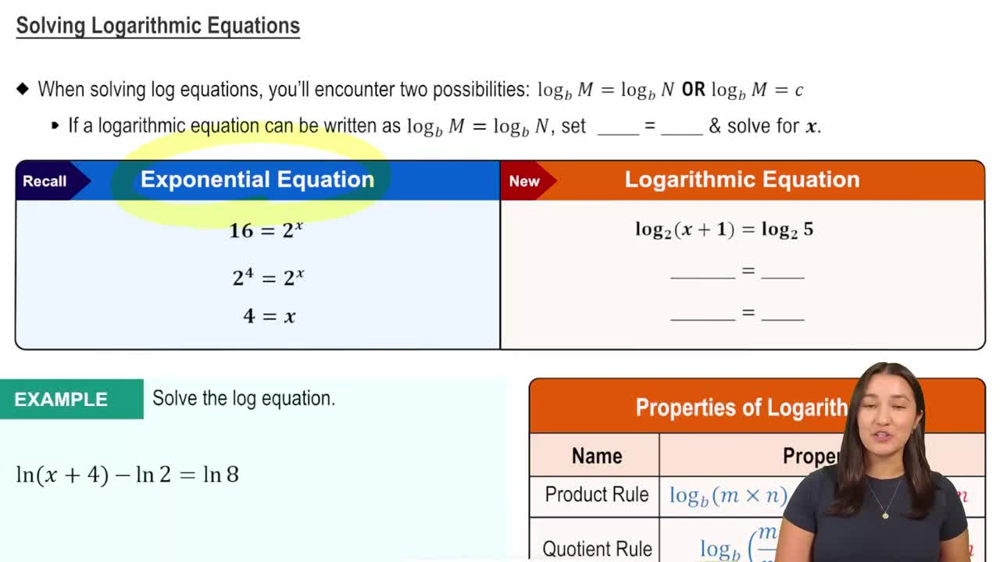
Solving Logarithmic Equations
Watch next
Master Solving Exponential Equations Using Like Bases with a bite sized video explanation from Patrick
Start learningRelated Videos
Related Practice
Textbook Question
652
views