Solve each nonlinear system of equations. Give all solutions, including those with nonreal complex components. See Examples 1–5.
Verified step by step guidance
1
Start by writing down the system of equations:
\[x^2 + 2y^2 = 9\]
\[x^2 + y^2 = 25\]
Subtract the second equation from the first to eliminate \(x^2\):
\[ (x^2 + 2y^2) - (x^2 + y^2) = 9 - 25 \]
which simplifies to
\[ y^2 = -16 \]
Solve for \(y\) by taking the square root of both sides:
\[ y = \pm \sqrt{-16} \]
Recall that \(\sqrt{-1} = i\), so
\[ y = \pm 4i \]
Substitute each value of \(y\) back into the second original equation to solve for \(x^2\):
\[ x^2 + y^2 = 25 \]
Replace \(y^2\) with \(-16\) to get
\[ x^2 - 16 = 25 \]
Solve for \(x^2\) and then find \(x\) by taking the square root:
\[ x^2 = 25 + 16 \]
\[ x = \pm \sqrt{41} \]
Thus, the solutions include complex \(y\) values and real \(x\) values.
Verified video answer for a similar problem:
This video solution was recommended by our tutors as helpful for the problem above
Video duration:
10m
Play a video:
0 Comments
Key Concepts
Here are the essential concepts you must grasp in order to answer the question correctly.
Nonlinear Systems of Equations
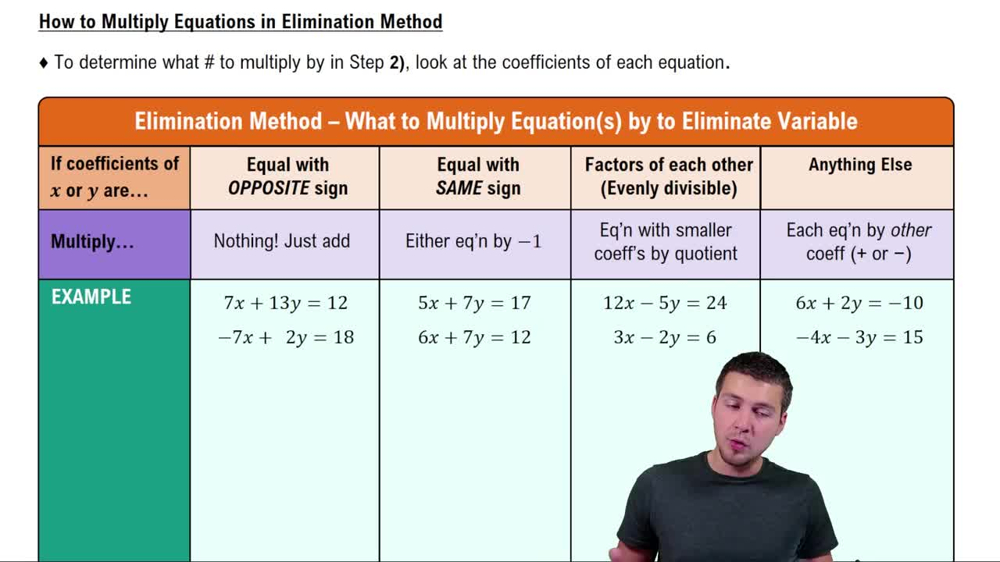
A nonlinear system consists of two or more equations where at least one equation is nonlinear, such as involving variables raised to powers other than one. Solving these systems requires methods beyond simple substitution or elimination used for linear systems, often involving algebraic manipulation or substitution to reduce the system to solvable forms.
These are algebraic techniques used to solve systems of equations. Substitution involves solving one equation for a variable and substituting into the other, while elimination involves adding or subtracting equations to eliminate a variable. Both methods help reduce the system to a single equation in one variable, facilitating the solution of nonlinear systems.
When solving nonlinear systems, solutions may include complex numbers, especially if the equations represent curves that do not intersect in the real plane. Complex solutions involve imaginary numbers and are valid solutions in algebra, expanding the solution set beyond real numbers and providing a complete understanding of the system.