Express each repeating decimal as a fraction in lowest terms.
Verified step by step guidance
1
Let the repeating decimal be represented by the variable \(x\), so \(x = 0.5555\ldots\) where the digit 5 repeats indefinitely.
Multiply both sides of the equation by 10 to shift the decimal point one place to the right: \(10x = 5.5555\ldots\)
Subtract the original equation from this new equation to eliminate the repeating part: \(10x - x = 5.5555\ldots - 0.5555\ldots\)
Simplify the subtraction: \$9x = 5$
Solve for \(x\) by dividing both sides by 9: \(x = \frac{5}{9}\). This fraction is already in lowest terms.
Verified video answer for a similar problem:
This video solution was recommended by our tutors as helpful for the problem above
Video duration:
4m
Play a video:
0 Comments
Key Concepts
Here are the essential concepts you must grasp in order to answer the question correctly.
Repeating Decimals
A repeating decimal is a decimal number in which a digit or group of digits repeats infinitely. For example, 0.555... has the digit 5 repeating endlessly. Understanding this pattern is essential to convert such decimals into fractions.
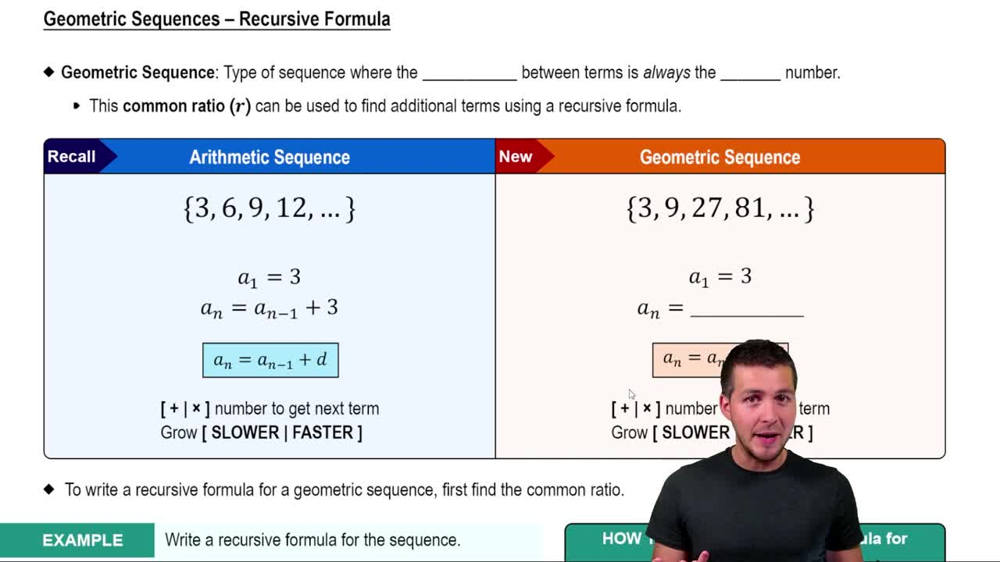
A geometric series is the sum of terms where each term is a constant multiple (common ratio) of the previous one. In repeating decimals, the infinite sum of the repeating digits can be expressed as a geometric series, which helps in finding the fractional equivalent.
After expressing the repeating decimal as a fraction, simplifying it to lowest terms involves dividing numerator and denominator by their greatest common divisor (GCD). This ensures the fraction is in its simplest and most understandable form.

 4:59 minutes
 Verified step by step guidance
 8:19
8:19