Write each number in decimal notation without the use of exponents.
Verified step by step guidance
1
Identify the given number in scientific notation: \(-3.14 \times 10^{-3}\).
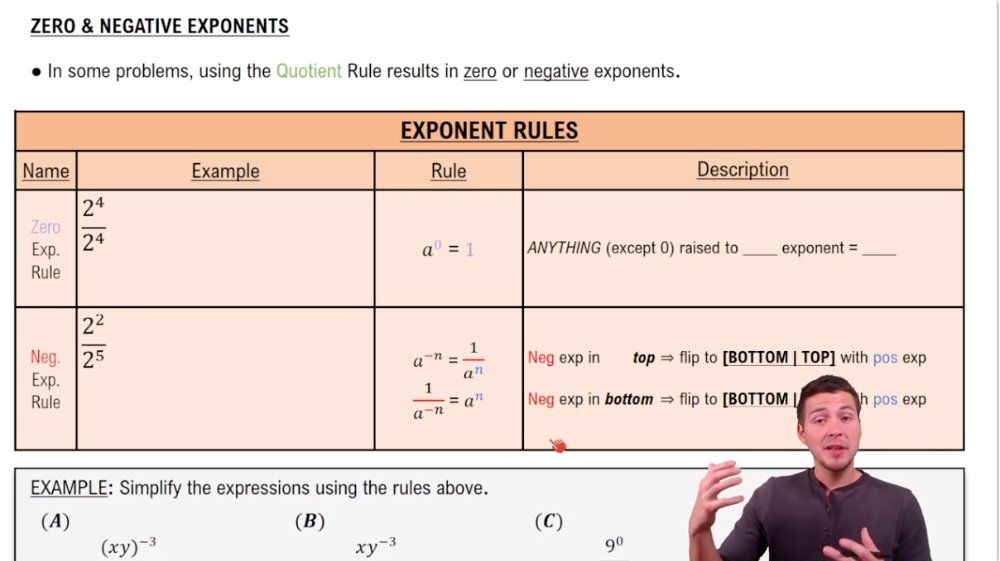
Recall that \$10^{-3}$ means \(\frac{1}{10^3}\) or moving the decimal point 3 places to the left.
Start with the number 3.14 and move the decimal point 3 places to the left to convert from scientific notation to decimal notation.
Since the number is negative, keep the negative sign in front of the decimal number after moving the decimal point.
Write the final number in decimal form without exponents, ensuring the decimal point is correctly placed after moving it 3 places to the left.
Verified video answer for a similar problem:
This video solution was recommended by our tutors as helpful for the problem above
Video duration:
1m
Play a video:
0 Comments
Key Concepts
Here are the essential concepts you must grasp in order to answer the question correctly.
Scientific Notation
Scientific notation expresses numbers as a product of a decimal number and a power of ten, making very large or small numbers easier to read and work with. For example, 3.14×10^−3 means 3.14 multiplied by 10 raised to the power of -3.
A negative exponent indicates the reciprocal of the base raised to the positive exponent. For instance, 10^−3 equals 1 divided by 10^3, or 1/1000, which helps convert numbers from scientific notation to decimal form.
Converting Scientific Notation to Decimal Notation
To convert a number from scientific notation to decimal notation, multiply the decimal part by 10 raised to the given exponent. For negative exponents, move the decimal point to the left accordingly, turning 3.14×10^−3 into 0.00314.

 1:33 minutes
 Verified step by step guidance
 05:18
05:18