If 5 times a number is decreased by 4, the principal square root of this difference is 2 less than the number. Find the number(s).
Verified step by step guidance
1
Let the number be represented by the variable \(x\).
Translate the problem statement into an equation: "5 times a number decreased by 4" becomes \$5x - 4$, and "the principal square root of this difference" is \(\sqrt{5x - 4}\). This is said to be 2 less than the number, so we write \(\sqrt{5x - 4} = x - 2\).
To eliminate the square root, square both sides of the equation: \((\sqrt{5x - 4})^2 = (x - 2)^2\), which simplifies to \$5x - 4 = (x - 2)^2$.
Expand the right side: \((x - 2)^2 = x^2 - 4x + 4\), so the equation becomes \$5x - 4 = x^2 - 4x + 4$.
Rearrange all terms to one side to form a quadratic equation: \$0 = x^2 - 4x + 4 - 5x + 4\(, which simplifies to \)0 = x^2 - 9x + 8\(. Then, solve this quadratic equation for \)x$ using factoring, completing the square, or the quadratic formula.
Verified video answer for a similar problem:
This video solution was recommended by our tutors as helpful for the problem above
Video duration:
6m
Play a video:
0 Comments
Key Concepts
Here are the essential concepts you must grasp in order to answer the question correctly.
Formulating Algebraic Equations from Word Problems
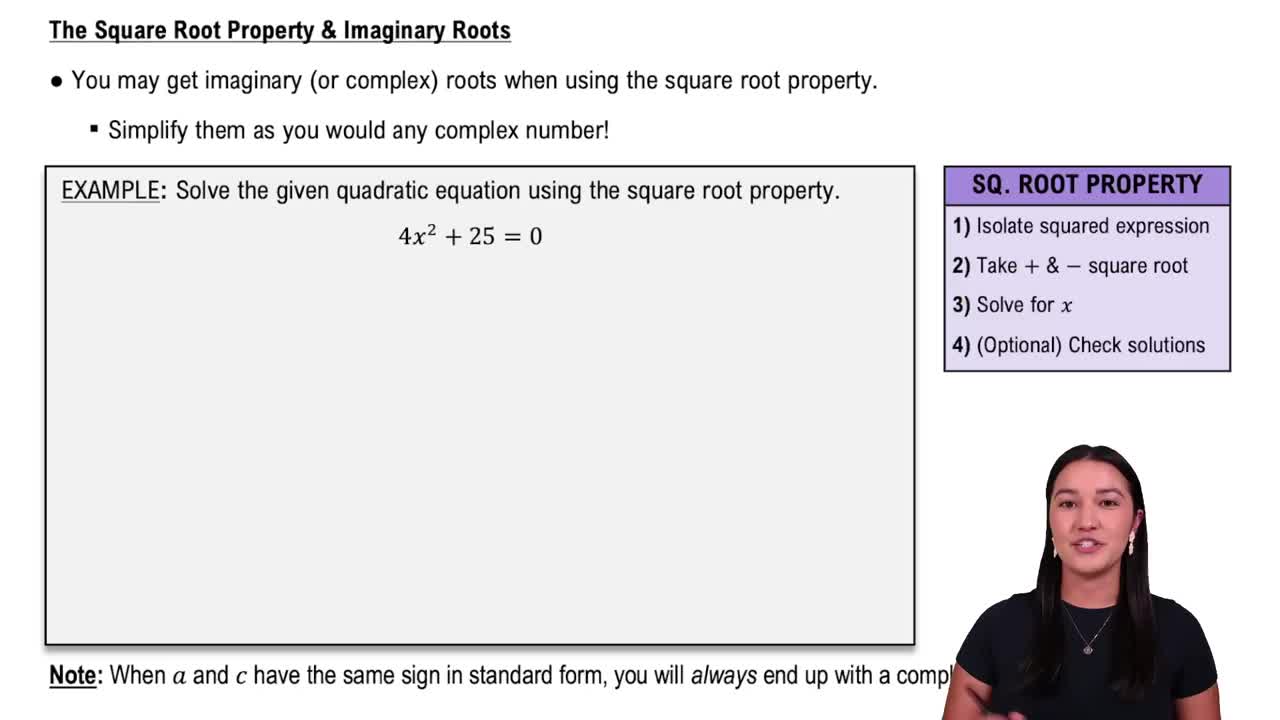
This involves translating a verbal description into a mathematical equation. Key phrases like '5 times a number' and 'decreased by 4' guide the construction of expressions, enabling the problem to be solved algebraically.
The principal square root of a number is the non-negative root. Understanding this helps interpret expressions like 'the principal square root of this difference,' ensuring correct handling of square root operations in equations.
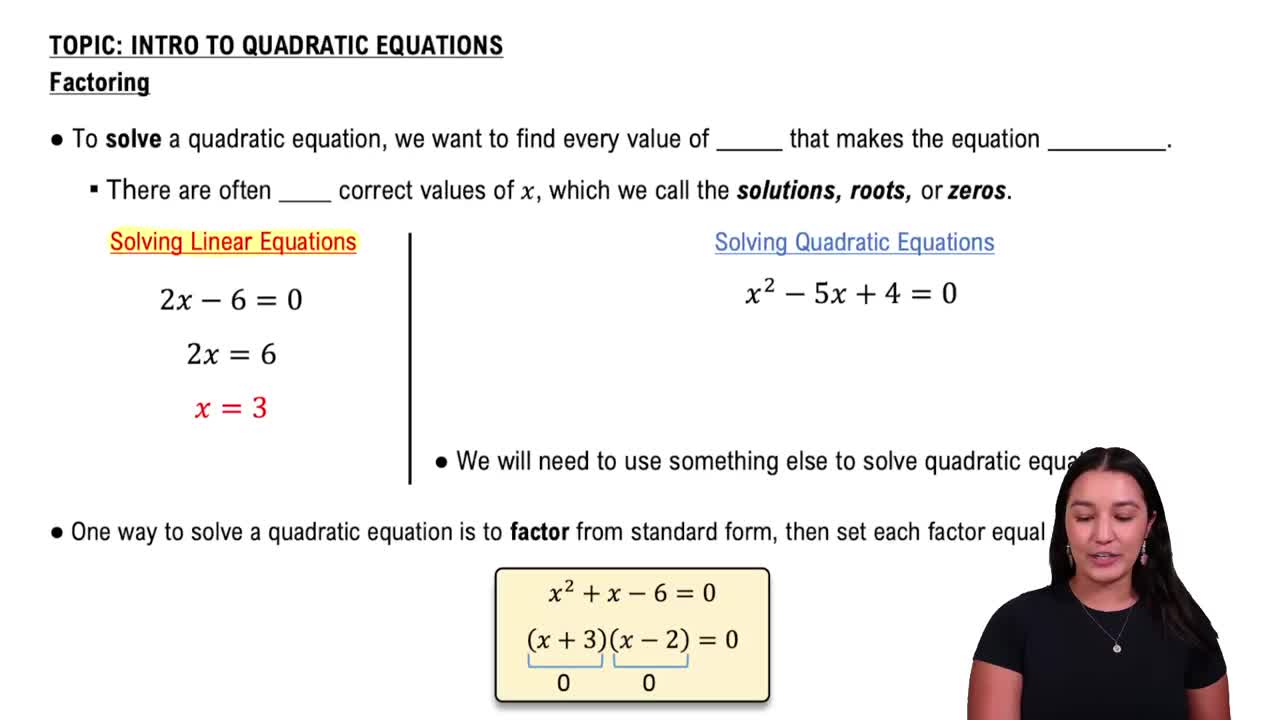
After forming the equation, solving it often leads to a quadratic equation. Techniques such as factoring, completing the square, or using the quadratic formula are essential to find the number(s) that satisfy the problem.

 6:33 minutes
 Verified step by step guidance
 07:07
07:07