In Exercises 27–38, evaluate each function at the given values of the independent variable and simplify.f(x)=4x+5 a. f(6)
Verified step by step guidance
1
Step 1: Understand the problem. The function f(x) = 4x + 5 is given, and you are asked to evaluate it at x = 6. This means substituting 6 for x in the function.
Step 2: Substitute x = 6 into the function. Replace every occurrence of x in f(x) = 4x + 5 with 6. The expression becomes f(6) = 4(6) + 5.
Step 3: Simplify the multiplication. Multiply 4 by 6 to get 24. The expression now becomes f(6) = 24 + 5.
Step 4: Simplify the addition. Add 24 and 5 to simplify the expression further.
Step 5: The result of f(6) is the simplified value obtained in the previous step. This is the value of the function at x = 6.
Verified video answer for a similar problem:
This video solution was recommended by our tutors as helpful for the problem above
Video duration:
1m
Play a video:
0 Comments
Key Concepts
Here are the essential concepts you must grasp in order to answer the question correctly.
Function Evaluation
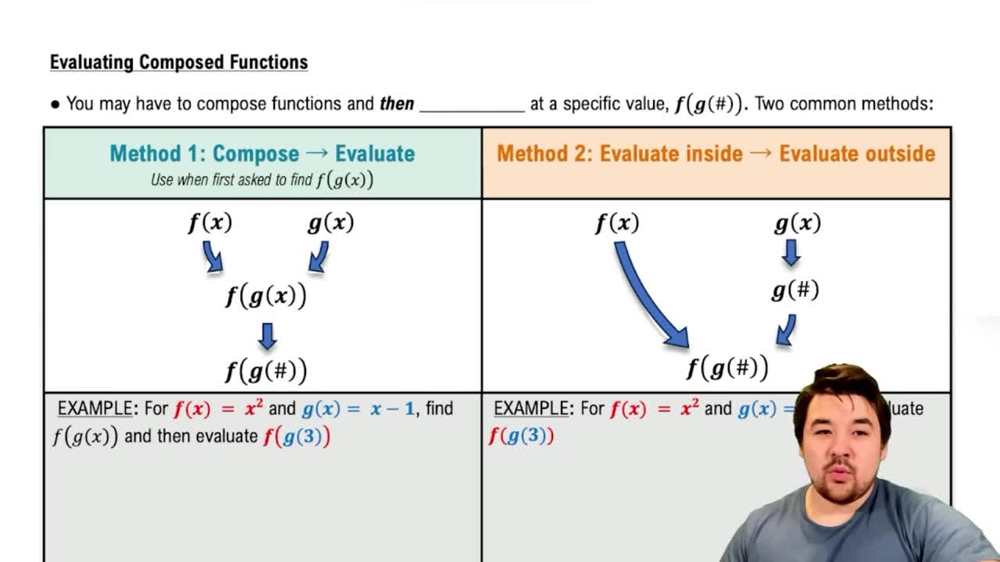
Function evaluation involves substituting a specific value for the independent variable in a function. In this case, to evaluate f(6) for the function f(x) = 4x + 5, you replace x with 6, resulting in f(6) = 4(6) + 5. This process is fundamental in understanding how functions operate and yield outputs based on given inputs.
A linear function is a polynomial function of degree one, which can be expressed in the form f(x) = mx + b, where m is the slope and b is the y-intercept. The function f(x) = 4x + 5 is linear, with a slope of 4 and a y-intercept of 5. Understanding the characteristics of linear functions helps in visualizing their graphs and predicting their behavior.
Simplification in mathematics refers to the process of reducing an expression to its simplest form. After evaluating the function, the next step is to simplify the result, if necessary. For example, in f(6) = 24 + 5, the simplification leads to f(6) = 29, which is the final output. Mastering simplification is crucial for clear and concise mathematical communication.

 1:16 minutes
 Verified step by step guidance
 4:26
4:26