In Exercises 49–64, factor any perfect square trinomials, or state that the polynomial is prime.x² − 10x + 25
Verified step by step guidance
1
Identify the structure of a perfect square trinomial, which is of the form \(a^2 - 2ab + b^2\).
Compare the given trinomial \(x^2 - 10x + 25\) with the perfect square trinomial form.
Notice that \(x^2\) is \((x)^2\) and \(25\) is \((5)^2\).
Check if the middle term \(-10x\) is equal to \(-2 \cdot x \cdot 5\).
Since \(-10x = -2 \cdot x \cdot 5\), the trinomial is a perfect square and can be factored as \((x - 5)^2\).
Verified video answer for a similar problem:
This video solution was recommended by our tutors as helpful for the problem above
Video duration:
2m
Play a video:
0 Comments
Key Concepts
Here are the essential concepts you must grasp in order to answer the question correctly.
Perfect Square Trinomials
A perfect square trinomial is a quadratic expression that can be expressed as the square of a binomial. It takes the form (a ± b)² = a² ± 2ab + b². Recognizing this pattern is essential for factoring, as it allows us to rewrite the trinomial in a simpler form, making it easier to solve or analyze.
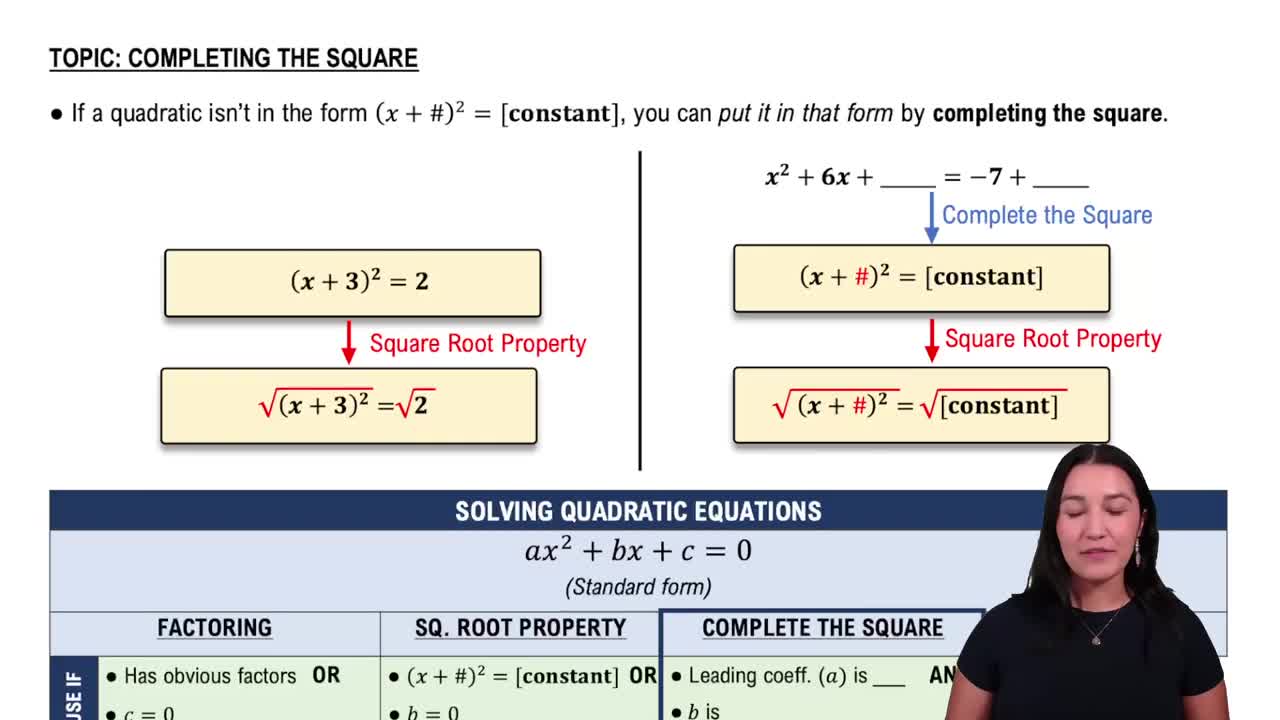
Solving Quadratic Equations by Completing the Square
Factoring Polynomials
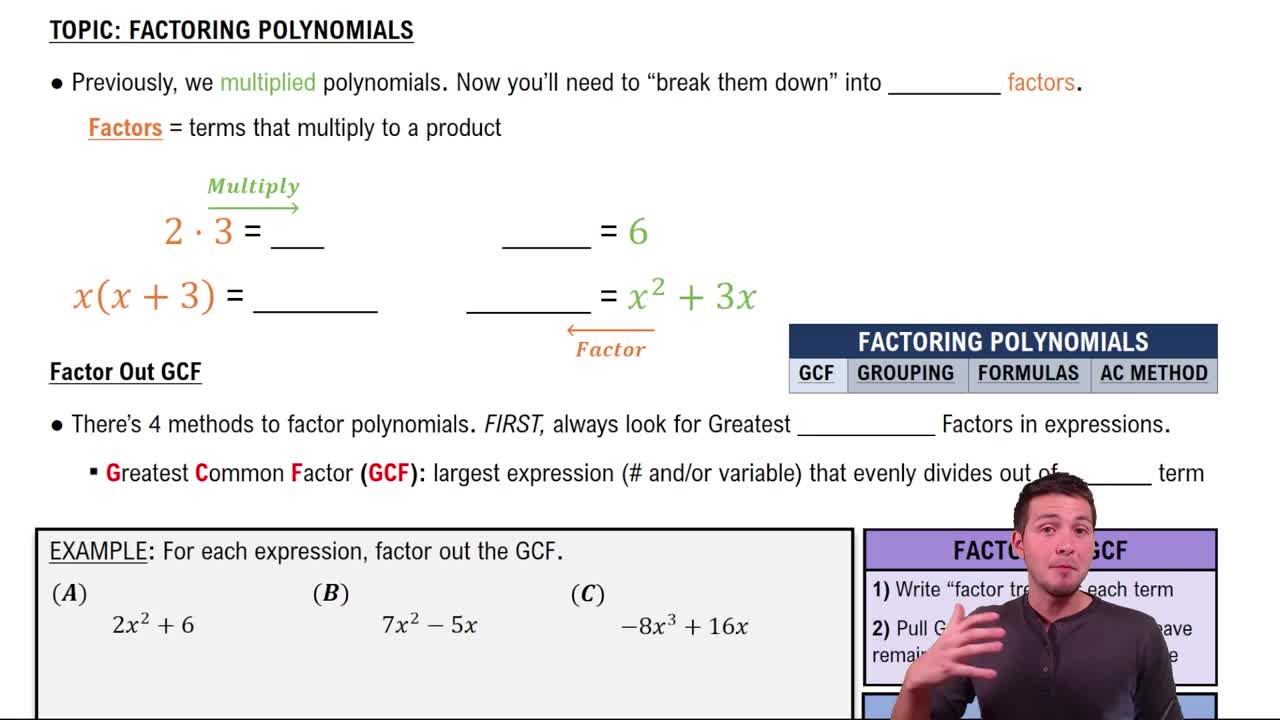
Factoring polynomials involves breaking down a polynomial into simpler components, or factors, that when multiplied together yield the original polynomial. This process is crucial in algebra as it simplifies expressions and helps in solving equations. Understanding how to identify and apply different factoring techniques is key to mastering polynomial manipulation.
A prime polynomial is one that cannot be factored into simpler polynomials with real coefficients. In the context of quadratic expressions, if a polynomial does not fit the criteria for factoring (like being a perfect square trinomial), it is considered prime. Recognizing when a polynomial is prime is important for determining the limits of factorization and solving equations.

 2:53 minutes
 Verified step by step guidance
 06:24
06:24