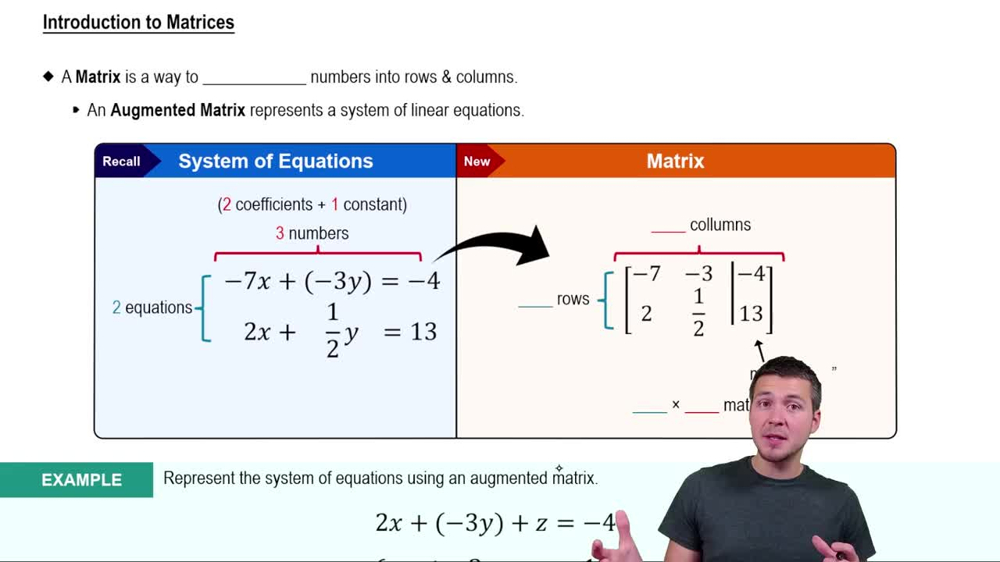
Identify the dimensions of the matrices involved. A <3x1> matrix has 3 rows and 1 column, while a <1x3> matrix has 1 row and 3 columns.
Recall that matrix addition or subtraction is only defined when both matrices have the same dimensions (i.e., the same number of rows and columns).
Since the given matrices have different dimensions (<3x1> vs. <1x3>), they cannot be added or subtracted directly.
Therefore, conclude that the sum or difference of these two matrices is not possible due to incompatible dimensions.
If you want to perform operations involving these matrices, consider other operations like matrix multiplication, but addition and subtraction require matching dimensions.
Verified video answer for a similar problem:
This video solution was recommended by our tutors as helpful for the problem above
Video duration:
1m
Play a video:
0 Comments
Key Concepts
Here are the essential concepts you must grasp in order to answer the question correctly.
Matrix Dimensions and Compatibility
Matrix addition and subtraction require the matrices to have the same dimensions, meaning the same number of rows and columns. If the matrices differ in size, their sum or difference is undefined. Understanding this is crucial to determine if the operation is possible.
When two matrices have the same dimensions, their sum or difference is found by adding or subtracting corresponding elements. This operation is performed element-wise, resulting in a new matrix of the same size.
Matrices are represented by rows and columns, often denoted as m x n, where m is the number of rows and n is the number of columns. Recognizing the notation helps in visualizing the structure and performing operations correctly.

 1:06 minutes
 Verified step by step guidance
 4:35
4:35