In Exercises 1–10, approximate each number using a calculator. Round your answer to three decimal places. 4-1.5
Verified step by step guidance
1
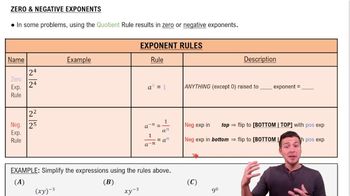
Recognize that the expression \$4^{-1.5}$ involves a negative exponent, which means you will take the reciprocal of the base raised to the positive exponent. So, rewrite the expression as \(\frac{1}{4^{1.5}}\).
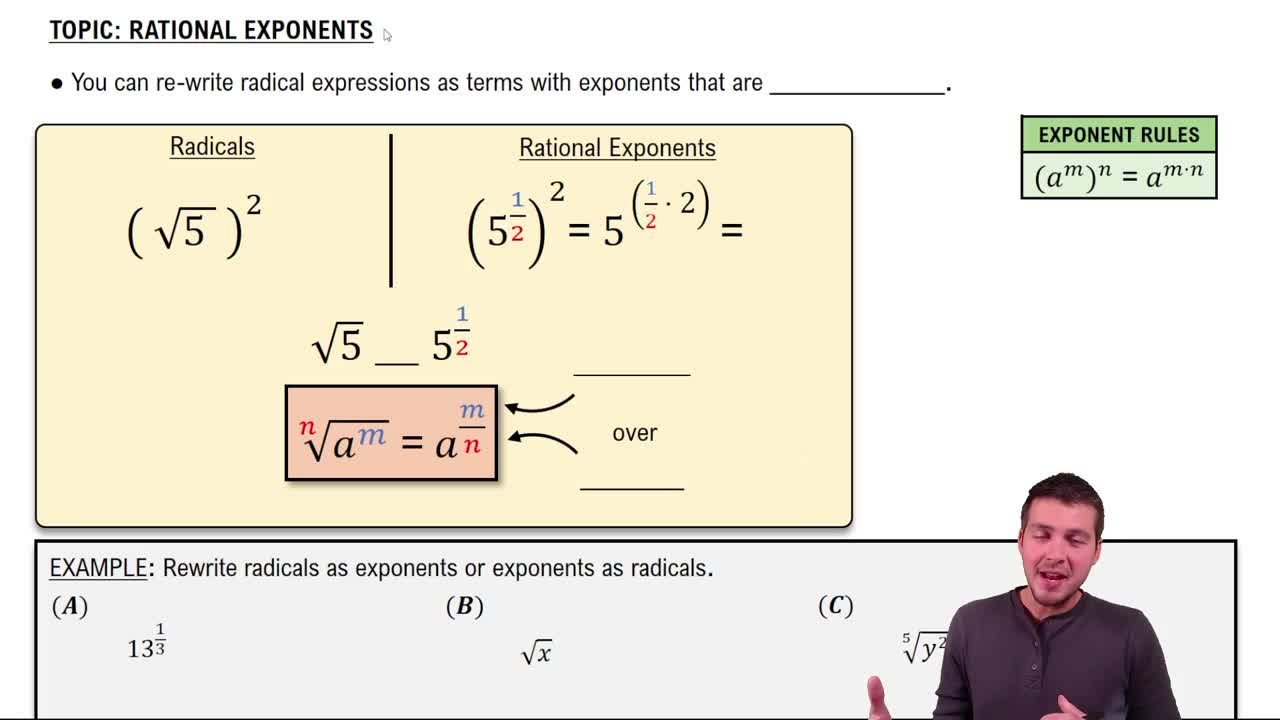
Understand that the exponent \$1.5\( can be expressed as a fraction: \(1.5 = \frac{3}{2}\). This means you are dealing with a power of \)4$ raised to \(\frac{3}{2}\).
Rewrite \(4^{\frac{3}{2}}\) using radicals: \(4^{\frac{3}{2}} = \left(4^{\frac{1}{2}}\right)^3 = (\sqrt{4})^3\).
Calculate the square root of 4, which is \(\sqrt{4} = 2\), and then raise this result to the third power: \$2^3$.
Finally, take the reciprocal of the result from the previous step to account for the negative exponent, giving you \(4^{-1.5} = \frac{1}{2^3}\). Use a calculator to approximate this value and round to three decimal places.
Verified video answer for a similar problem:
This video solution was recommended by our tutors as helpful for the problem above
Video duration:
54s
Play a video:
0 Comments
Key Concepts
Here are the essential concepts you must grasp in order to answer the question correctly.
Exponents and Powers
Exponents indicate how many times a base number is multiplied by itself. A power like 4^-1.5 means raising 4 to the negative 1.5 exponent, which involves both a negative sign and a fractional exponent.
A negative exponent means taking the reciprocal of the base raised to the corresponding positive exponent. For example, 4^-1.5 equals 1 divided by 4^1.5, which changes the operation from multiplication to division.
Fractional exponents represent roots and powers combined. An exponent of 1.5 equals 1 plus 0.5, so 4^1.5 is 4^1 times 4^0.5, or 4 times the square root of 4. Understanding this helps in calculating or approximating values.