In Exercises 9–14, perform the indicated operations. Write the resulting polynomial in standard form and indicate its degree. (−6x3+5x2−8x+9)+(17x3+2x2−4x−13)
Verified step by step guidance
1
Step 1: Identify the given polynomials. The first polynomial is \(-6x^3 + 5x^2 - 8x + 9\), and the second polynomial is \(17x^3 + 2x^2 - 4x - 13\).
Step 2: Group like terms from both polynomials. Like terms are terms with the same variable raised to the same power. For example, \(-6x^3\) and \(17x^3\) are like terms, \(5x^2\) and \(2x^2\) are like terms, and so on.
Step 3: Add the coefficients of the like terms. For the \(x^3\) terms, add \(-6 + 17\). For the \(x^2\) terms, add \(5 + 2\). For the \(x\) terms, add \(-8 - 4\). For the constant terms, add \(9 - 13\).
Step 4: Write the resulting polynomial by combining the results from Step 3. Arrange the terms in descending order of the powers of \(x\) (this is called standard form).
Step 5: Determine the degree of the resulting polynomial. The degree is the highest power of \(x\) in the polynomial.
Verified video answer for a similar problem:
This video solution was recommended by our tutors as helpful for the problem above
Video duration:
3m
Play a video:
0 Comments
Key Concepts
Here are the essential concepts you must grasp in order to answer the question correctly.
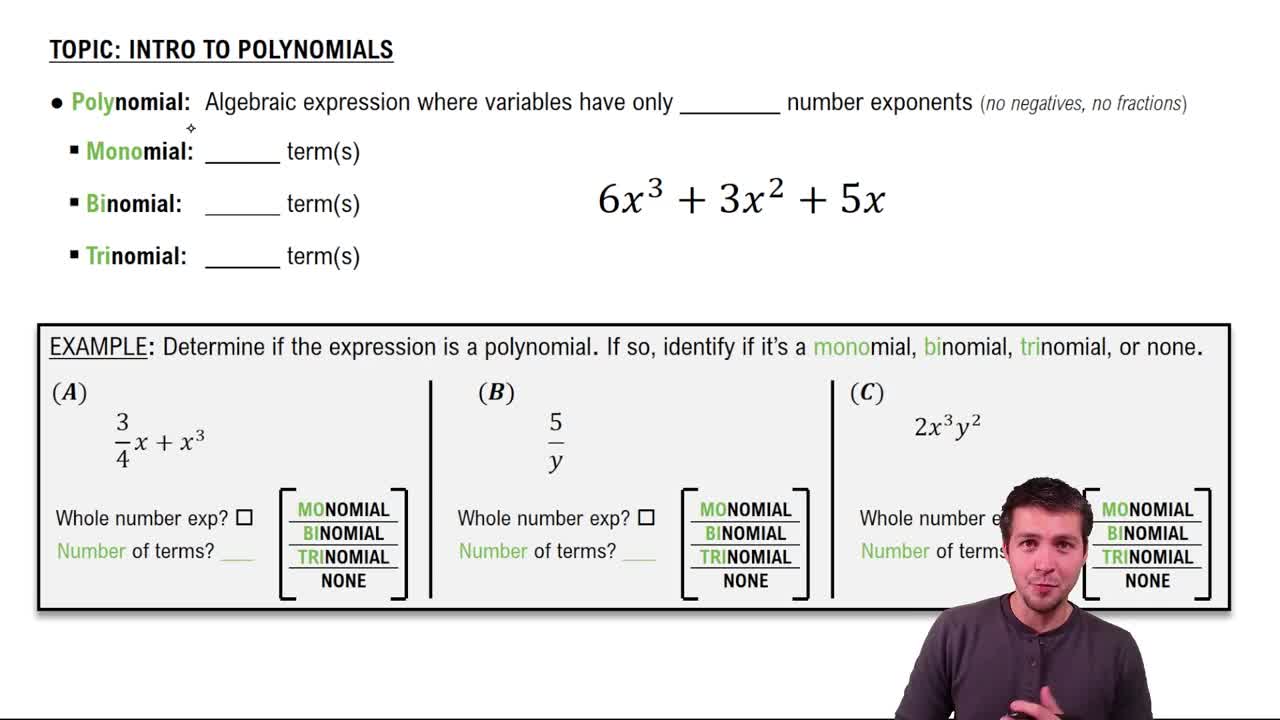
Polynomial Addition
Polynomial addition involves combining like terms from two or more polynomials. Like terms are those that have the same variable raised to the same power. To perform the addition, align the terms based on their degrees and sum the coefficients of like terms. The result is a new polynomial that retains the highest degree of the original polynomials.
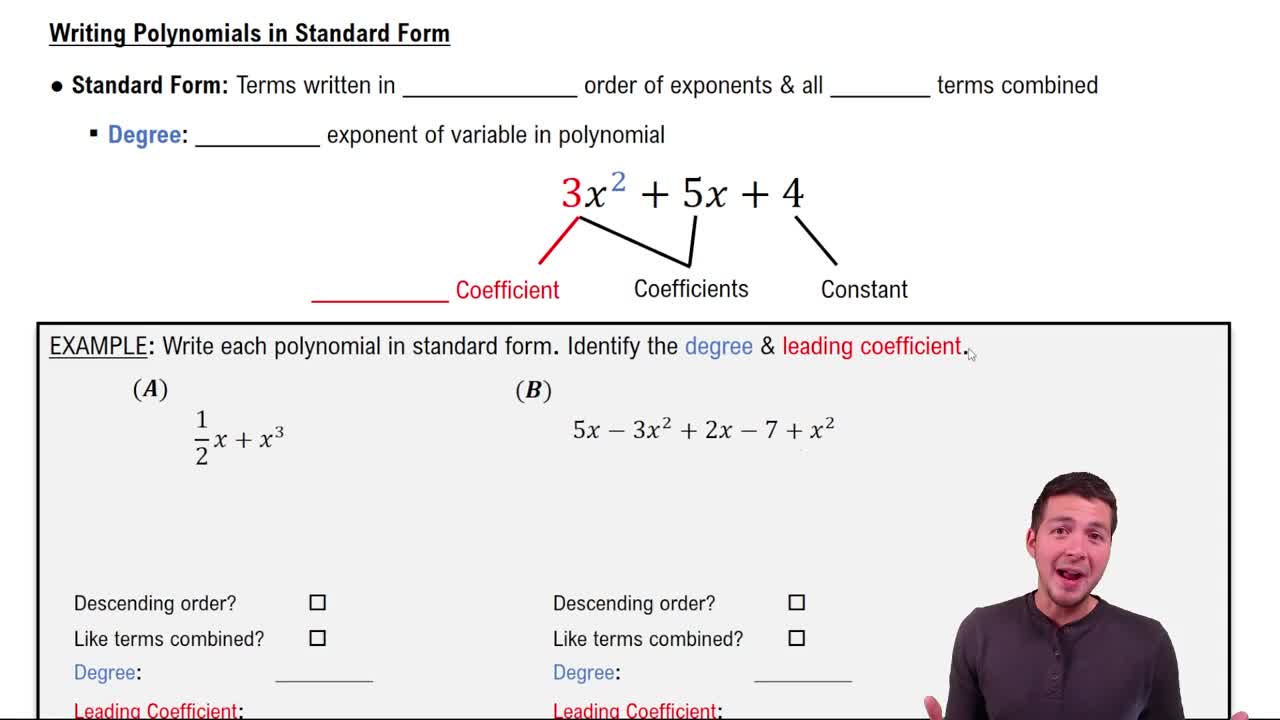
The standard form of a polynomial is expressed as a sum of terms in descending order of their degrees. This means the term with the highest exponent comes first, followed by terms with lower exponents. Writing a polynomial in standard form helps in easily identifying its degree and simplifies further operations or analysis.
The degree of a polynomial is the highest exponent of the variable in the polynomial expression. It provides insight into the polynomial's behavior, such as the number of roots and the end behavior of its graph. For example, in the polynomial 4x^3 + 2x^2 - x + 5, the degree is 3, indicating it is a cubic polynomial.