In Exercises 59-64, let f(x) = 2x - 5 g(x) = 4x - 1 h(x) = x² + x + 2. Evaluate the indicated function without finding an equation for the function. g (f[h (1)])
Verified step by step guidance
1
Step 1: Start by evaluating the innermost function, h(1). Substitute x = 1 into h(x) = x² + x + 2. This means you calculate h(1) = (1)² + (1) + 2.
Step 2: Use the result from h(1) as the input for the next function, f(x). Substitute the value of h(1) into f(x) = 2x - 5. This means you calculate f(h(1)) = 2(h(1)) - 5.
Step 3: Use the result from f(h(1)) as the input for the next function, g(x). Substitute the value of f(h(1)) into g(x) = 4x - 1. This means you calculate g(f(h(1))) = 4(f(h(1))) - 1.
Step 4: Combine all the results step by step, ensuring each function is evaluated correctly before moving to the next.
Step 5: The final result is g(f(h(1))). You now have the steps to evaluate the indicated function without finding an explicit equation for the composite function.
Verified video answer for a similar problem:
This video solution was recommended by our tutors as helpful for the problem above
Video duration:
3m
Play a video:
0 Comments
Key Concepts
Here are the essential concepts you must grasp in order to answer the question correctly.
Function Composition
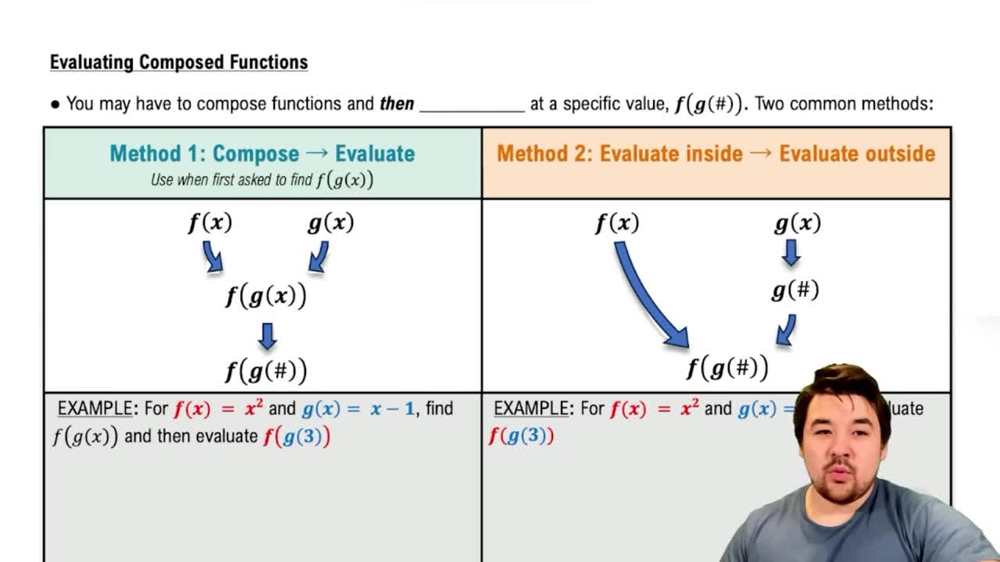
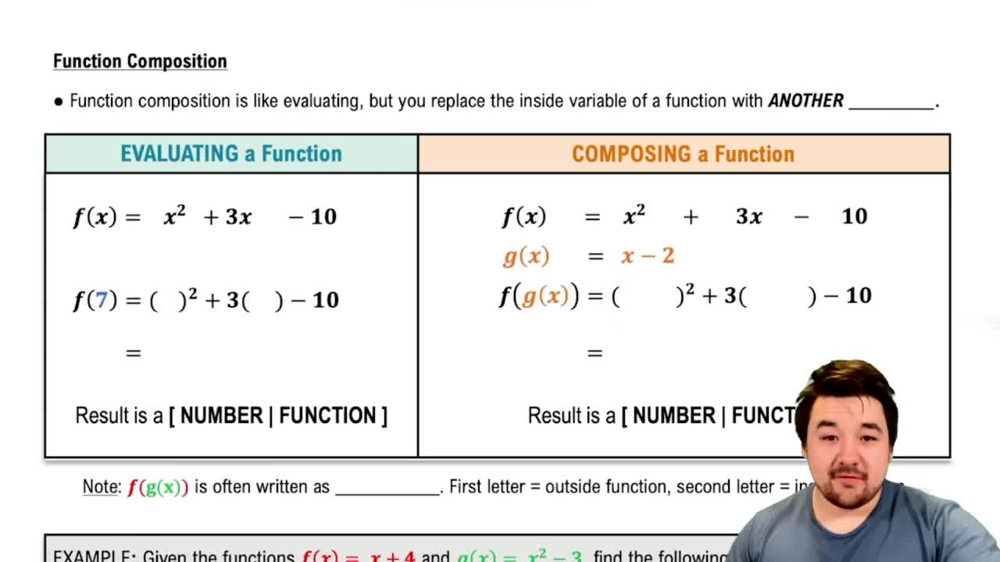
Function composition involves combining two functions where the output of one function becomes the input of another. In this case, we need to evaluate g(f[h(1)]), meaning we first find h(1), then use that result as the input for f, and finally use the output of f as the input for g. Understanding how to properly nest functions is crucial for solving such problems.
Evaluating a function means substituting a specific value into the function's equation to find the output. For example, to evaluate h(1) for the function h(x) = x² + x + 2, we replace x with 1, resulting in h(1) = 1² + 1 + 2 = 4. This step is essential for determining the values needed for further function evaluations.
Linear functions, like f(x) = 2x - 5 and g(x) = 4x - 1, have a constant rate of change and graph as straight lines, while quadratic functions, such as h(x) = x² + x + 2, have a variable rate of change and graph as parabolas. Recognizing the differences between these types of functions helps in understanding their behavior and how to manipulate them during evaluations.

 3:35 minutes
 Verified step by step guidance
 4:56
4:56