Solve each equation. In Exercises 11–34, give irrational solutions as decimals correct to the nearest thousandth. In Exercises 35-40, give solutions in exact form. e2x - 6ex + 8 = 0
Table of contents
- 0. Review of Algebra4h 18m
- 1. Equations & Inequalities3h 18m
- 2. Graphs of Equations1h 43m
- 3. Functions2h 17m
- 4. Polynomial Functions1h 44m
- 5. Rational Functions1h 23m
- 6. Exponential & Logarithmic Functions2h 28m
- 7. Systems of Equations & Matrices4h 5m
- 8. Conic Sections2h 23m
- 9. Sequences, Series, & Induction1h 22m
- 10. Combinatorics & Probability1h 45m
6. Exponential & Logarithmic Functions
Solving Exponential and Logarithmic Equations
Problem 39
Textbook Question
Solve each equation. In Exercises 11–34, give irrational solutions as decimals correct to the nearest thousandth. In Exercises 35-40, give solutions in exact form. 52x + 3(5x) = 28
Verified step by step guidance1
Recognize that the equation involves exponential expressions with the same base, 5. The equation is \$5^{2x} + 3(5^x) = 28$.
Rewrite \$5^{2x}\( as \)(5^x)^2\( to express the equation in terms of a single variable. Let \)y = 5^x\(, so the equation becomes \)y^2 + 3y = 28$.
Rewrite the equation as a quadratic equation by moving all terms to one side: \(y^2 + 3y - 28 = 0\).
Solve the quadratic equation \(y^2 + 3y - 28 = 0\) using the quadratic formula \(y = \frac{-b \pm \sqrt{b^2 - 4ac}}{2a}\), where \(a=1\), \(b=3\), and \(c=-28\).
After finding the values of \(y\), substitute back \(y = 5^x\) and solve for \(x\) by taking the logarithm base 5: \(x = \log_5(y)\). Calculate the decimal values of \(x\) to the nearest thousandth.
Verified video answer for a similar problem:This video solution was recommended by our tutors as helpful for the problem above
Video duration:
3mPlay a video:
Key Concepts
Here are the essential concepts you must grasp in order to answer the question correctly.
Exponential Equations
Exponential equations involve variables in the exponent position, such as 5^x. Solving these requires understanding how to manipulate and rewrite expressions to isolate the variable, often by expressing terms with the same base or using substitution.
Recommended video:
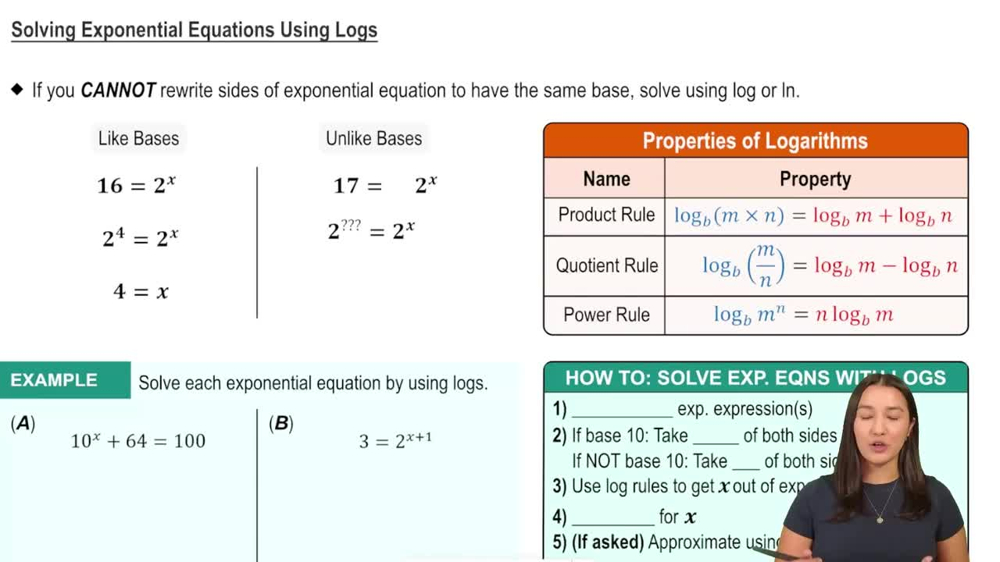
Solving Exponential Equations Using Logs
Substitution Method
When an equation contains terms like 5^(2x) and 5^x, substitution simplifies the problem. For example, letting y = 5^x transforms the equation into a quadratic form, making it easier to solve using algebraic methods.
Recommended video:
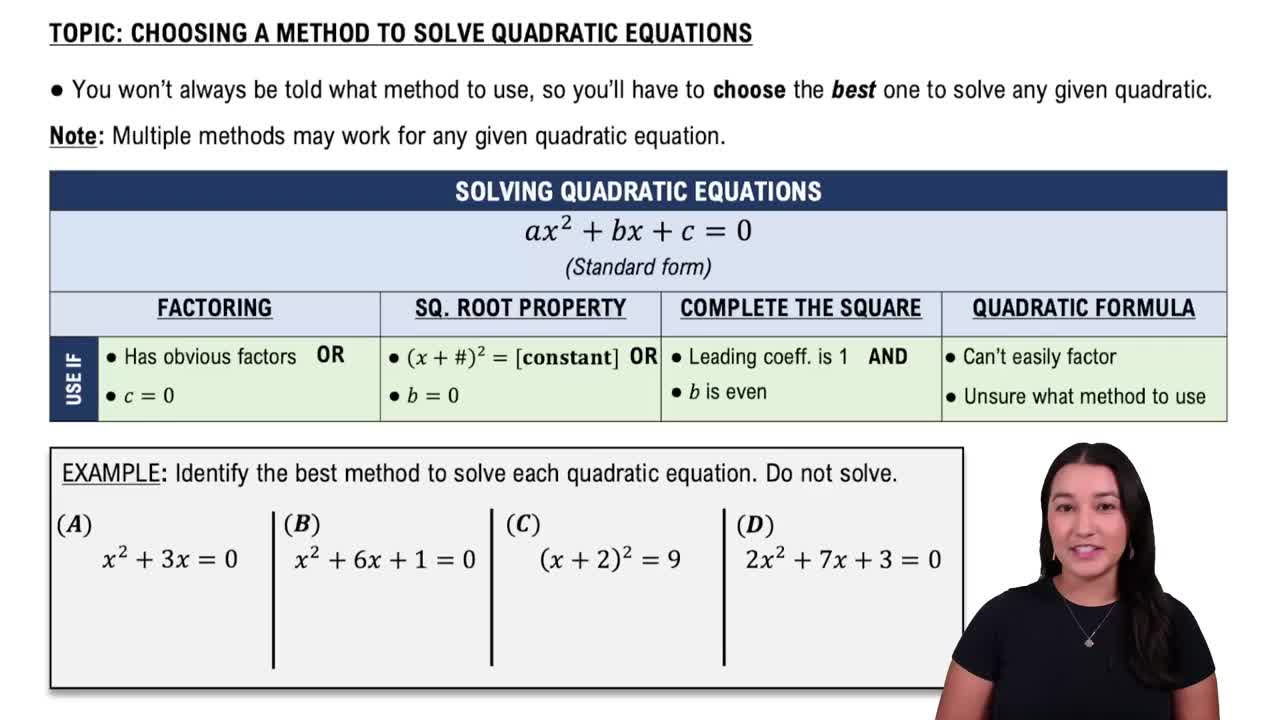
Choosing a Method to Solve Quadratics
Rounding Irrational Solutions
Some solutions to exponential equations are irrational numbers. These should be approximated as decimals rounded to a specified place value, such as the nearest thousandth, to provide a practical and understandable answer.
Recommended video:
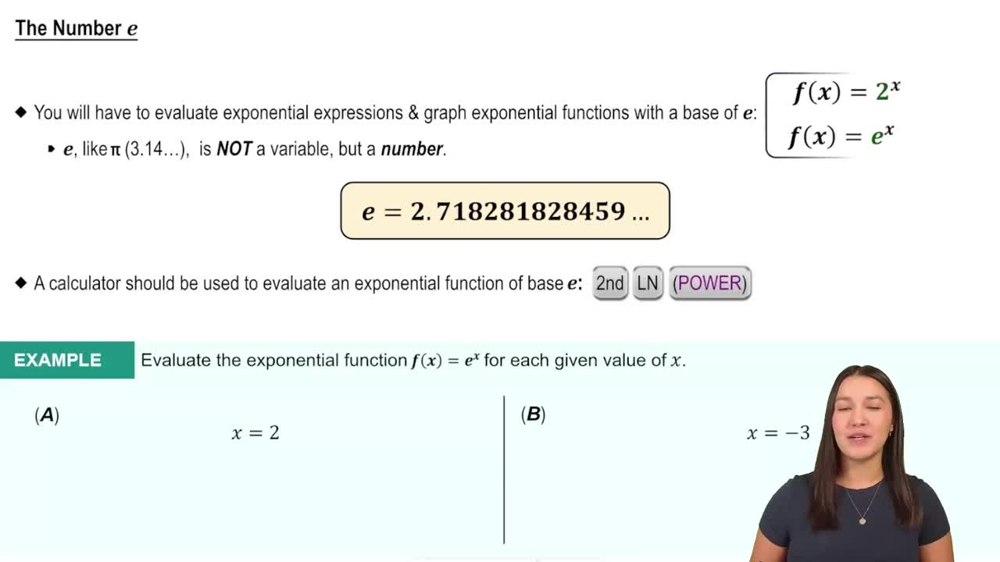
The Number e
Watch next
Master Solving Exponential Equations Using Like Bases with a bite sized video explanation from Patrick
Start learningRelated Videos
Related Practice
Textbook Question
594
views