In Exercises 17–38, factor each trinomial, or state that the trinomial is prime. x2−14x+45
Verified step by step guidance
1
Identify the trinomial: \(x^2 - 14x + 45\). This is a quadratic expression in the form \(ax^2 + bx + c\), where \(a = 1\), \(b = -14\), and \(c = 45\).
To factor the trinomial, look for two numbers that multiply to \(c = 45\) and add to \(b = -14\).
List the factor pairs of 45: \((1, 45), (3, 15), (5, 9)\). Consider their signs since \(b = -14\) is negative and \(c = 45\) is positive, meaning both numbers in the pair must be negative.
Check which pair of negative factors adds to \(-14\): \((-3, -15)\) works because \(-3 + (-15) = -14\) and \((-3) \cdot (-15) = 45\).
Rewrite the trinomial as \((x - 3)(x - 15)\). Verify by expanding: \((x - 3)(x - 15) = x^2 - 15x - 3x + 45 = x^2 - 14x + 45\). Thus, the factored form is \((x - 3)(x - 15)\).
Verified video answer for a similar problem:
This video solution was recommended by our tutors as helpful for the problem above
Video duration:
6m
Play a video:
0 Comments
Key Concepts
Here are the essential concepts you must grasp in order to answer the question correctly.
Factoring Trinomials
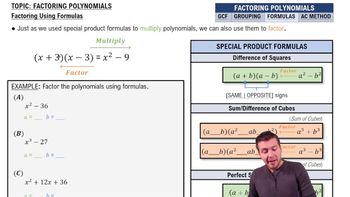
Factoring trinomials involves rewriting a quadratic expression in the form ax^2 + bx + c as a product of two binomials. This process requires identifying two numbers that multiply to 'c' (the constant term) and add to 'b' (the coefficient of the linear term). Understanding this concept is essential for simplifying quadratic expressions and solving equations.
A trinomial is considered prime if it cannot be factored into the product of two binomials with real coefficients. This occurs when the discriminant of the quadratic equation is negative or when no integer pairs exist that satisfy the conditions for factoring. Recognizing prime trinomials is crucial for determining the factorability of quadratic expressions.
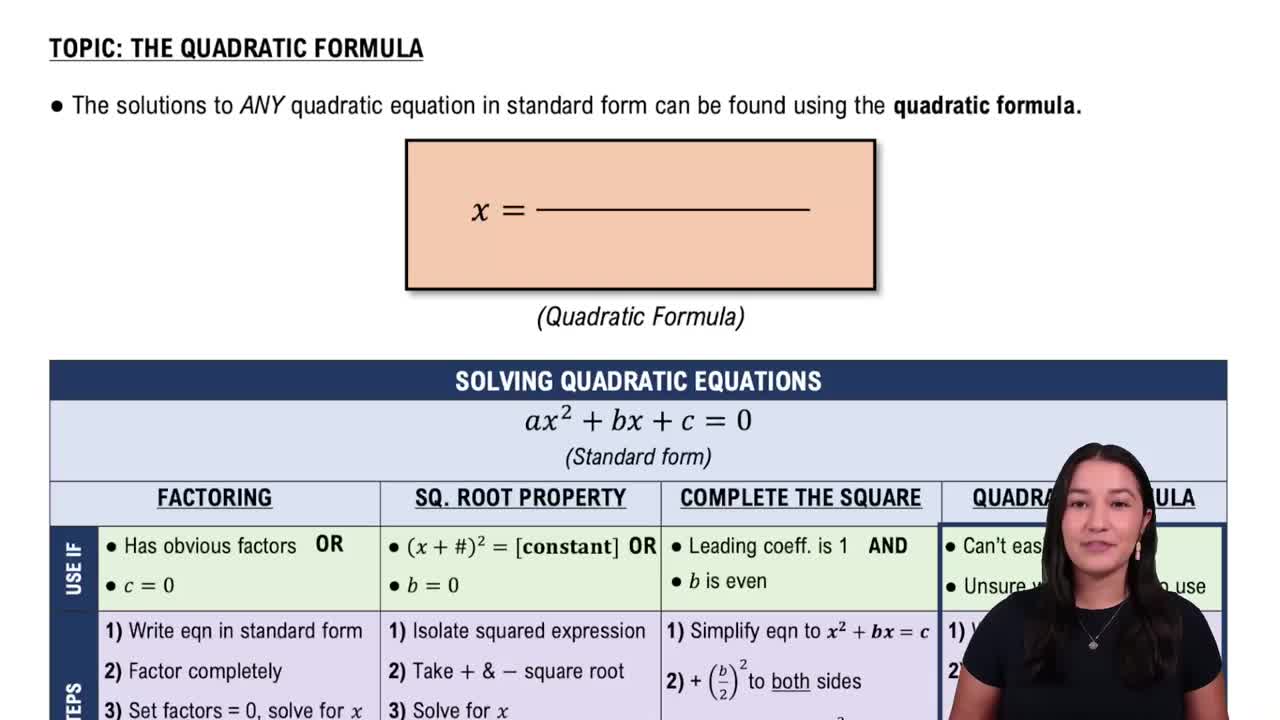
The quadratic formula, x = (-b ± √(b² - 4ac)) / (2a), provides a method for finding the roots of a quadratic equation ax^2 + bx + c = 0. While not directly related to factoring, it helps in determining whether a trinomial can be factored by revealing the nature of its roots. If the roots are rational, the trinomial can be factored; if not, it may be prime.