For each function, find (a)ƒ(x+h), (b)ƒ(x+h)-ƒ(x), and (c)[ƒ(x+h)-ƒ(x)]/h. ƒ(x)=1-x
Verified step by step guidance
1
Start by identifying the given function: \(f(x) = 1 - x\).
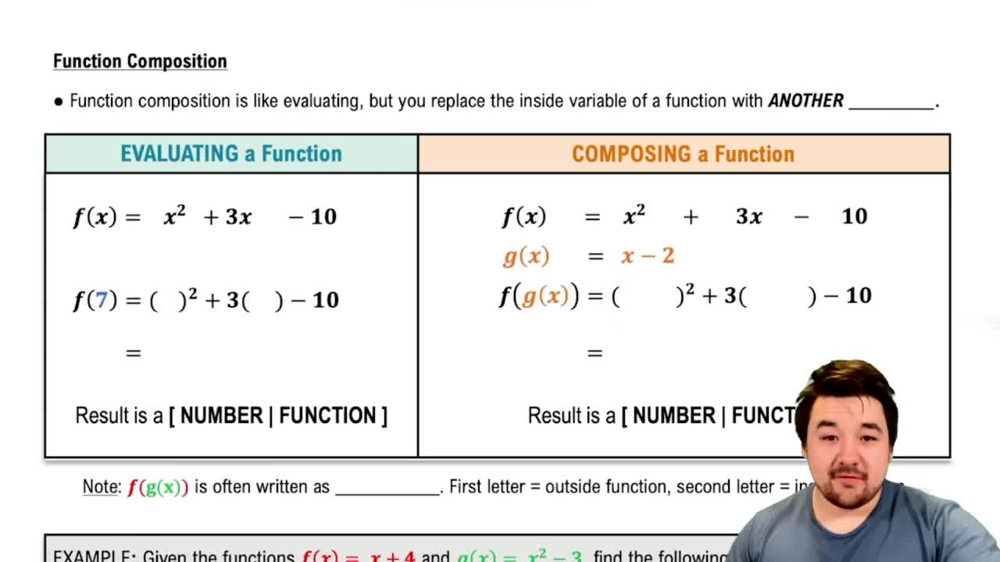
To find \(f(x+h)\), substitute \(x+h\) into the function in place of \(x\). This means replacing every \(x\) in \(f(x)\) with \(x+h\), so write \(f(x+h) = 1 - (x + h)\).
Next, calculate \(f(x+h) - f(x)\) by subtracting the original function \(f(x)\) from the expression you found for \(f(x+h)\). This gives \(f(x+h) - f(x) = [1 - (x + h)] - (1 - x)\).
Simplify the expression \(f(x+h) - f(x)\) by distributing the negative signs and combining like terms carefully.
Finally, find the difference quotient by dividing the simplified expression from the previous step by \(h\), which is \(\frac{f(x+h) - f(x)}{h}\). Simplify this expression as much as possible.
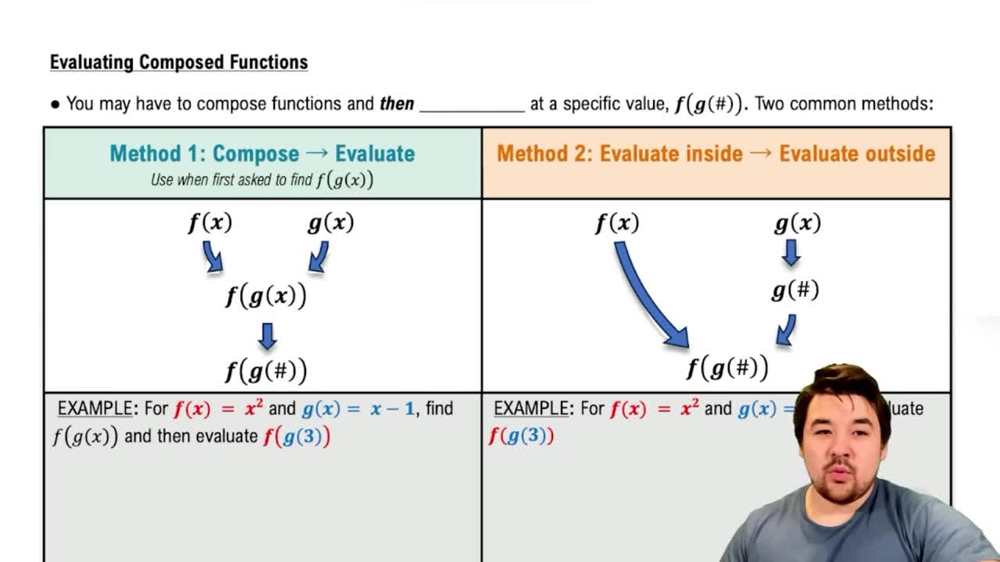
Verified video answer for a similar problem:
This video solution was recommended by our tutors as helpful for the problem above
Video duration:
3m
Play a video:
0 Comments
Key Concepts
Here are the essential concepts you must grasp in order to answer the question correctly.
Function Notation and Evaluation
Function notation, such as ƒ(x), represents a rule that assigns each input x to an output. Evaluating ƒ(x+h) means substituting x+h into the function in place of x, which helps analyze how the function behaves when its input changes by h.
The expression ƒ(x+h) - ƒ(x) calculates the change in the function's output as the input changes from x to x+h. This difference is fundamental in understanding how the function varies over an interval and is a stepping stone toward concepts like average rate of change.
The difference quotient, [ƒ(x+h) - ƒ(x)] / h, measures the average rate of change of the function over the interval from x to x+h. It is a key concept in calculus, representing the slope of the secant line, and is used to approximate derivatives.

 3:27 minutes
 Verified step by step guidance
 4:26
4:26