Solve each equation in Exercises 83–108 by the method of your choice.
Verified step by step guidance
1
Identify the given quadratic equation: \$3x^2 - 12x + 12 = 0$.
Divide the entire equation by 3 to simplify it: \(x^2 - 4x + 4 = 0\).
Recognize that the simplified quadratic is a perfect square trinomial, which can be factored as \((x - 2)^2 = 0\).
Set the factor equal to zero: \(x - 2 = 0\).
Solve for \(x\) by adding 2 to both sides: \(x = 2\).
Verified video answer for a similar problem:
This video solution was recommended by our tutors as helpful for the problem above
Video duration:
1m
Play a video:
0 Comments
Key Concepts
Here are the essential concepts you must grasp in order to answer the question correctly.
Quadratic Equations
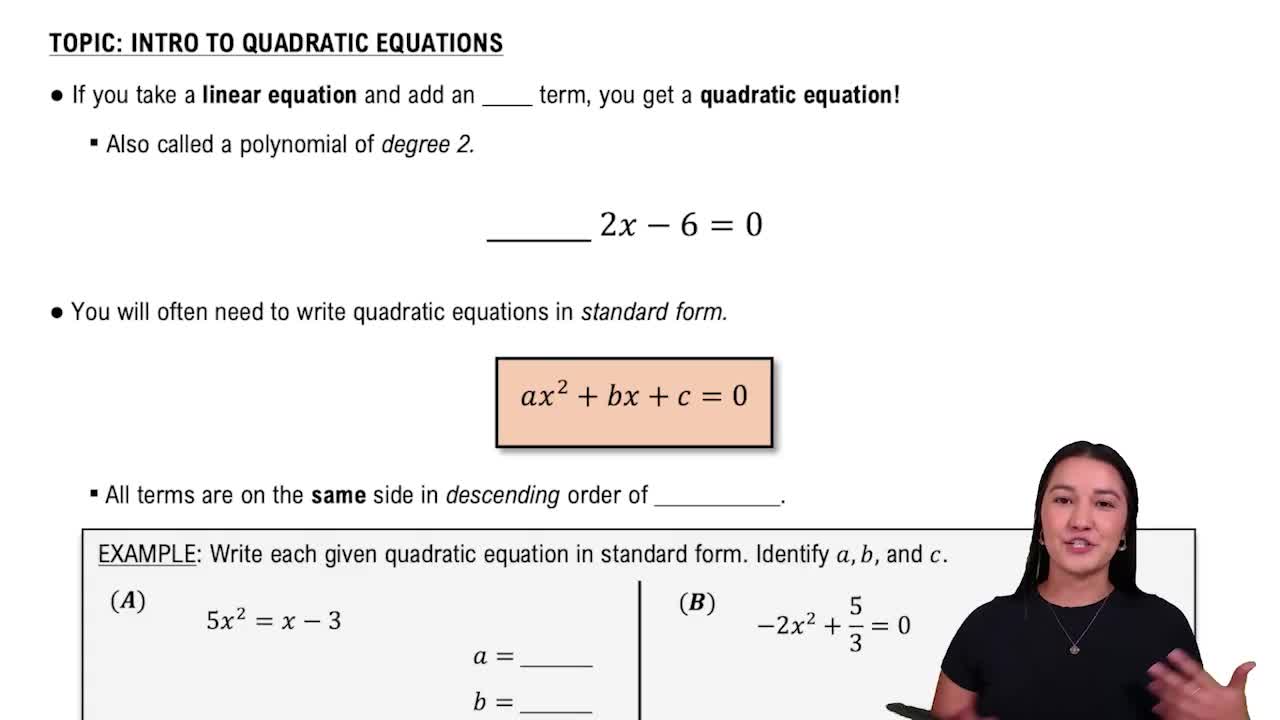
A quadratic equation is a second-degree polynomial equation in the form ax² + bx + c = 0, where a ≠ 0. It represents a parabola when graphed and can have zero, one, or two real solutions depending on the coefficients.
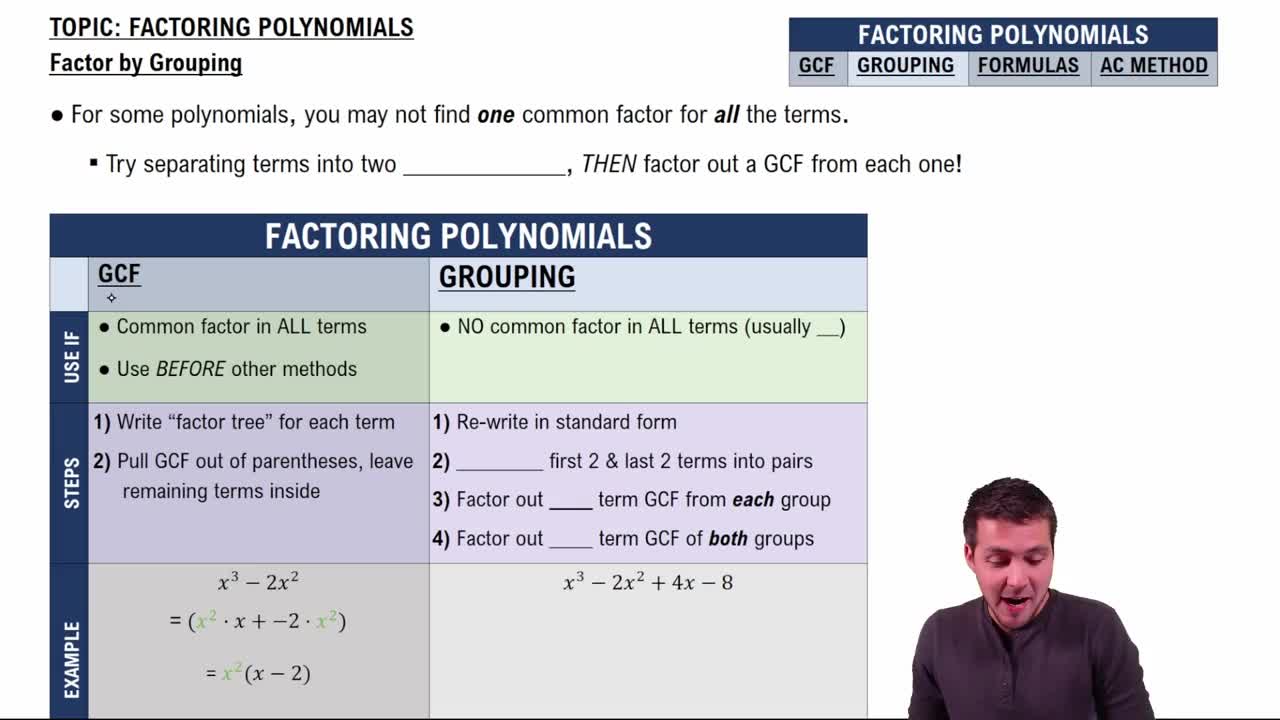
Factoring involves rewriting a quadratic equation as a product of simpler expressions to find its roots. Simplification may include dividing the entire equation by a common factor to make factoring or other methods easier.
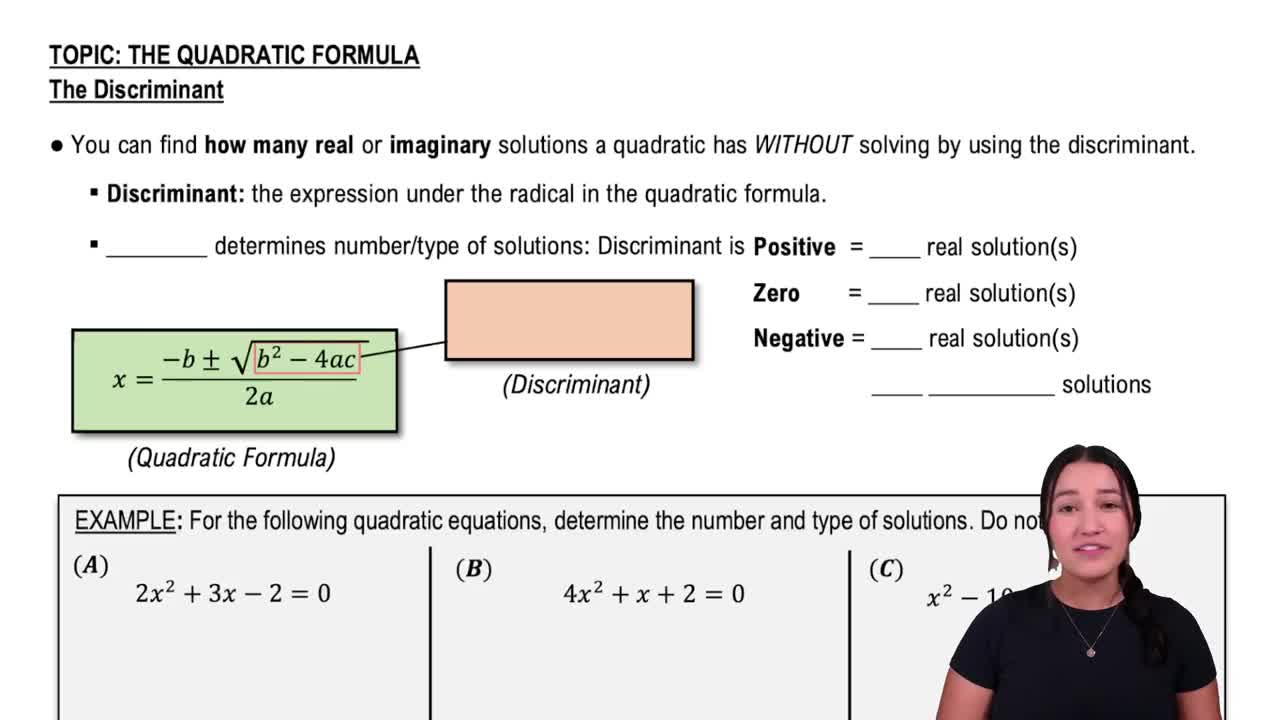
The quadratic formula x = (-b ± √(b² - 4ac)) / 2a provides solutions to any quadratic equation. The discriminant (b² - 4ac) determines the nature of the roots: positive for two real roots, zero for one real root, and negative for complex roots.

 1:55 minutes
 Verified step by step guidance
 05:35
05:35