Identify the property illustrated in each statement. Assume all variables represent real numbers. (7.5-y)+0=7.5-y
Verified step by step guidance
1
Look at the given expression: \( (7.5 - y) + 0 = 7.5 - y \).
Notice that adding zero to any number or expression does not change its value.
This illustrates the property where adding zero leaves the original number unchanged.
Recall that this property is called the \(\textbf{Additive Identity Property}\).
Therefore, the equation shows the Additive Identity Property because adding 0 to \((7.5 - y)\) results in \((7.5 - y)\) itself.
Verified video answer for a similar problem:
This video solution was recommended by our tutors as helpful for the problem above
Video duration:
1m
Play a video:
0 Comments
Key Concepts
Here are the essential concepts you must grasp in order to answer the question correctly.
Additive Identity Property
The additive identity property states that adding zero to any real number does not change its value. In other words, for any number a, a + 0 = a. This property is fundamental in simplifying expressions and solving equations.
Real numbers include all rational and irrational numbers, encompassing integers, fractions, and decimals. Understanding that variables represent real numbers ensures that properties like the additive identity apply universally in algebraic expressions.
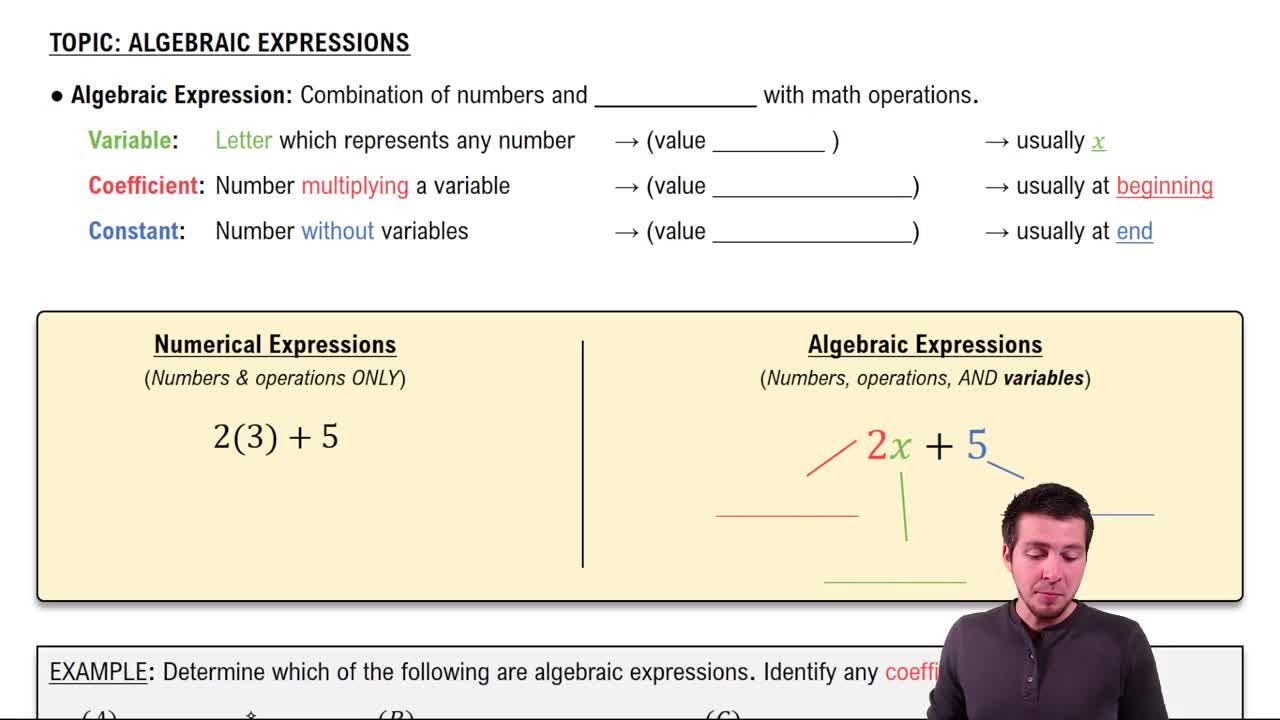
An algebraic expression combines numbers, variables, and operations. Recognizing how variables and constants interact in expressions, such as (7.5 - y), helps in applying properties correctly and simplifying or manipulating expressions.