Solve each equation using the quadratic formula. x2 = 2x - 5
Verified step by step guidance
1
Rewrite the equation in standard quadratic form, which is \(ax^2 + bx + c = 0\). Start by moving all terms to one side: \(x^2 - 2x + 5 = 0\).
Identify the coefficients \(a\), \(b\), and \(c\) from the quadratic equation. Here, \(a = 1\), \(b = -2\), and \(c = 5\).
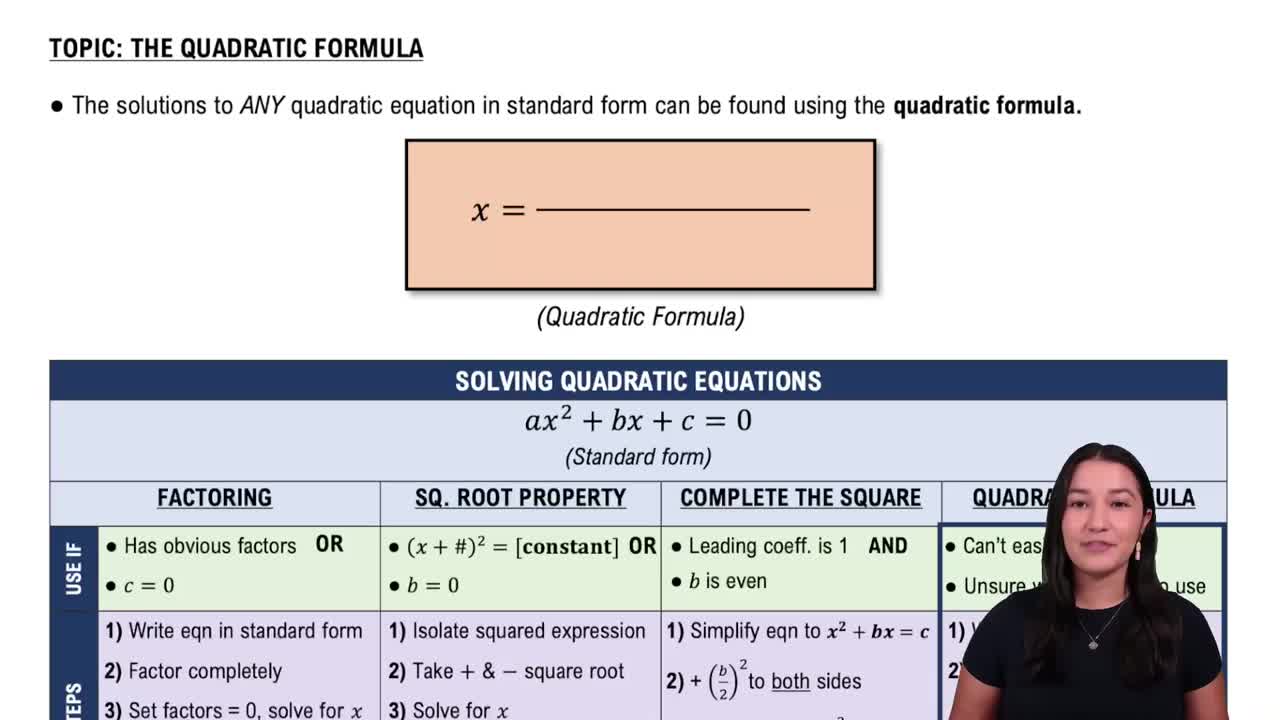
Recall the quadratic formula: \(x = \frac{-b \pm \sqrt{b^2 - 4ac}}{2a}\). This formula gives the solutions to any quadratic equation.
Substitute the values of \(a\), \(b\), and \(c\) into the quadratic formula: \(x = \frac{-(-2) \pm \sqrt{(-2)^2 - 4(1)(5)}}{2(1)}\).
Simplify inside the square root and the rest of the expression step-by-step to find the two possible values of \(x\).
Verified video answer for a similar problem:
This video solution was recommended by our tutors as helpful for the problem above
Video duration:
3m
Play a video:
0 Comments
Key Concepts
Here are the essential concepts you must grasp in order to answer the question correctly.
Quadratic Equation Standard Form
A quadratic equation is typically written in the standard form ax² + bx + c = 0. To solve using the quadratic formula, the equation must first be rearranged so that all terms are on one side, setting the equation equal to zero.
The quadratic formula x = (-b ± √(b² - 4ac)) / (2a) provides the solutions to any quadratic equation ax² + bx + c = 0. It uses the coefficients a, b, and c to find the roots, including real and complex solutions.
Solving Quadratic Equations Using The Quadratic Formula
Discriminant and Nature of Roots
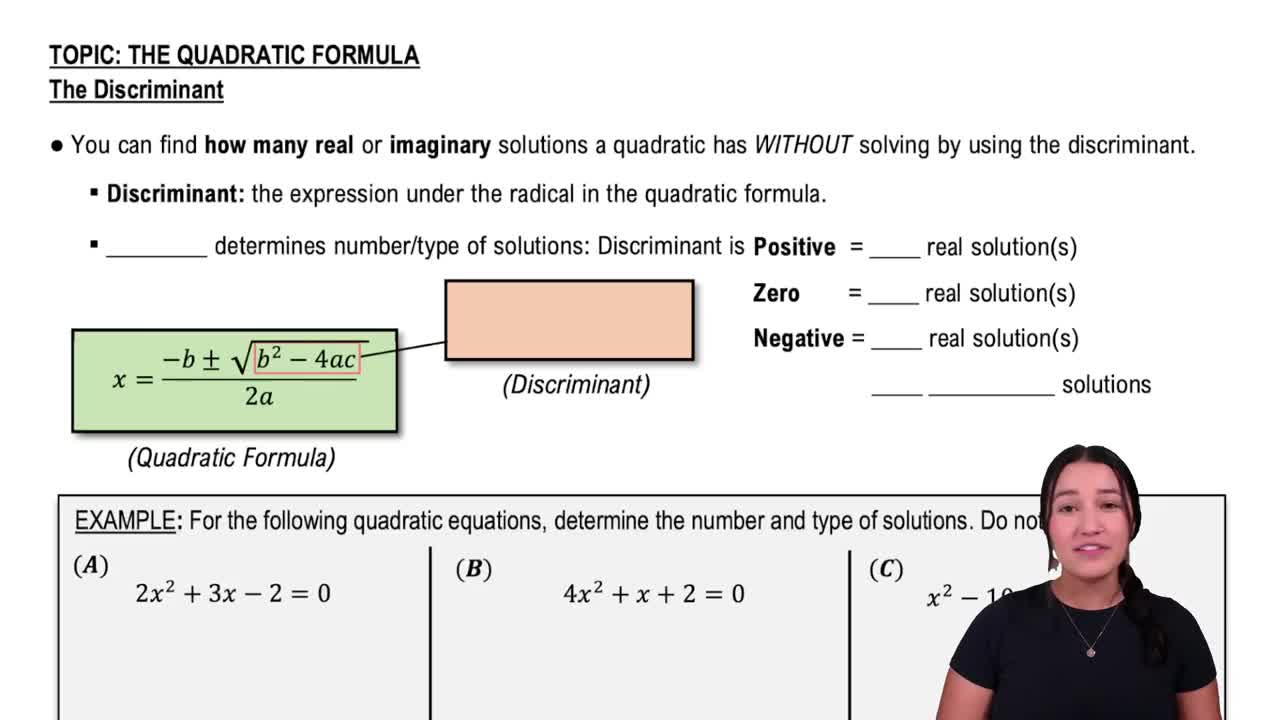
The discriminant, given by b² - 4ac, determines the nature of the roots of a quadratic equation. If positive, there are two distinct real roots; if zero, one real root; and if negative, two complex roots.

 3:35 minutes
 Verified step by step guidance
 04:34
04:34