Determine whether each statement is true or false. {5, 7, 9, 19} ∩ {7, 9, 11, 15} = {7, 9}
Verified step by step guidance
1
Recall that the intersection of two sets, denoted by \(A \cap B\), is the set of all elements that are common to both sets \(A\) and \(B\).
Identify the elements of the first set: \(\{5, 7, 9, 19\}\).
Identify the elements of the second set: \(\{7, 9, 11, 15\}\).
Find the common elements between the two sets by comparing each element: the elements that appear in both sets are \$7\( and \)9$.
Conclude that the intersection \(\{5, 7, 9, 19\} \cap \{7, 9, 11, 15\}\) is indeed \(\{7, 9\}\), so the statement is true.
Verified video answer for a similar problem:
This video solution was recommended by our tutors as helpful for the problem above
Video duration:
1m
Play a video:
0 Comments
Key Concepts
Here are the essential concepts you must grasp in order to answer the question correctly.
Set Intersection
The intersection of two sets includes all elements that are common to both sets. For example, the intersection of {1, 2, 3} and {2, 3, 4} is {2, 3}, as these elements appear in both sets.
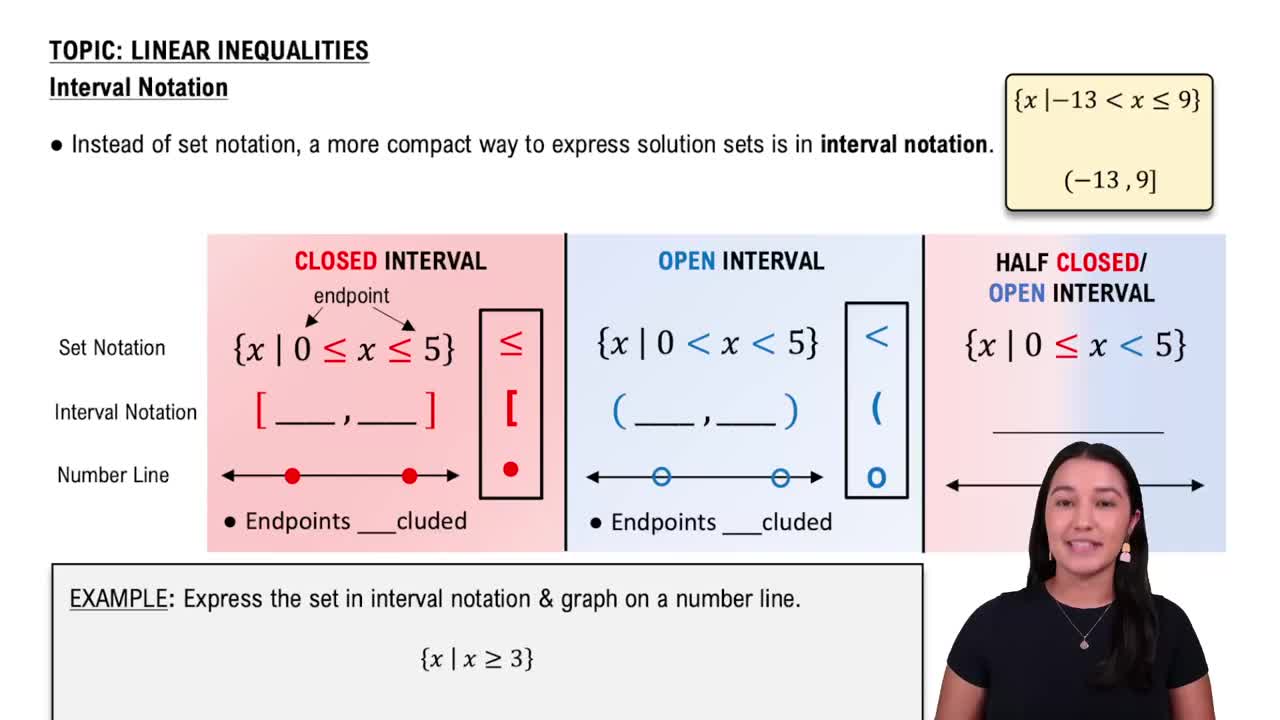
Set notation uses curly braces {} to list elements of a set, and symbols like ∩ to denote operations such as intersection. Understanding this notation is essential to interpret and manipulate sets correctly.
Determining the truth value of statements involving sets requires verifying if the given equality or relation holds based on set operations. This involves comparing the resulting sets from operations like intersection or union.

 1:20 minutes
 Verified step by step guidance
 07:52
07:52