Use synthetic division to determine whether the given number k is a zero of the polynomial function. If it is not, give the value of ƒ(k). ƒ(x) = x2 + 3x + 4; k = 2+i
Table of contents
- 0. Review of Algebra4h 18m
- 1. Equations & Inequalities3h 18m
- 2. Graphs of Equations1h 43m
- 3. Functions2h 17m
- 4. Polynomial Functions1h 44m
- 5. Rational Functions1h 23m
- 6. Exponential & Logarithmic Functions2h 28m
- 7. Systems of Equations & Matrices4h 5m
- 8. Conic Sections2h 23m
- 9. Sequences, Series, & Induction1h 22m
- 10. Combinatorics & Probability1h 45m
4. Polynomial Functions
Dividing Polynomials
Problem 99
Textbook Question
Perform each division. See Examples 9 and 10. (4x3-3x2+1)/(x-2)
Verified step by step guidance1
Identify the division problem as a polynomial division: divide the polynomial \$4x^3 - 3x^2 + 1\( by the binomial \)x - 2$.
Set up the long division by writing \$4x^3 - 3x^2 + 0x + 1\( (include the missing \)0x\( term for clarity) under the division bar and \)x - 2$ outside.
Divide the leading term of the dividend \$4x^3\( by the leading term of the divisor \)x$ to get the first term of the quotient: \(\frac{4x^3}{x} = 4x^2\).
Multiply the entire divisor \(x - 2\) by \$4x^2$ and subtract the result from the dividend to find the new polynomial to divide.
Repeat the process: divide the new leading term by \(x\), multiply the divisor by this term, subtract, and continue until the degree of the remainder is less than the degree of the divisor.
Verified video answer for a similar problem:This video solution was recommended by our tutors as helpful for the problem above
Video duration:
4mPlay a video:
0 Comments
Key Concepts
Here are the essential concepts you must grasp in order to answer the question correctly.
Polynomial Long Division
Polynomial long division is a method used to divide a polynomial by another polynomial of lower degree, similar to numerical long division. It involves dividing the leading term of the dividend by the leading term of the divisor, multiplying, subtracting, and repeating until the remainder has a lower degree than the divisor.
Recommended video:
Guided course
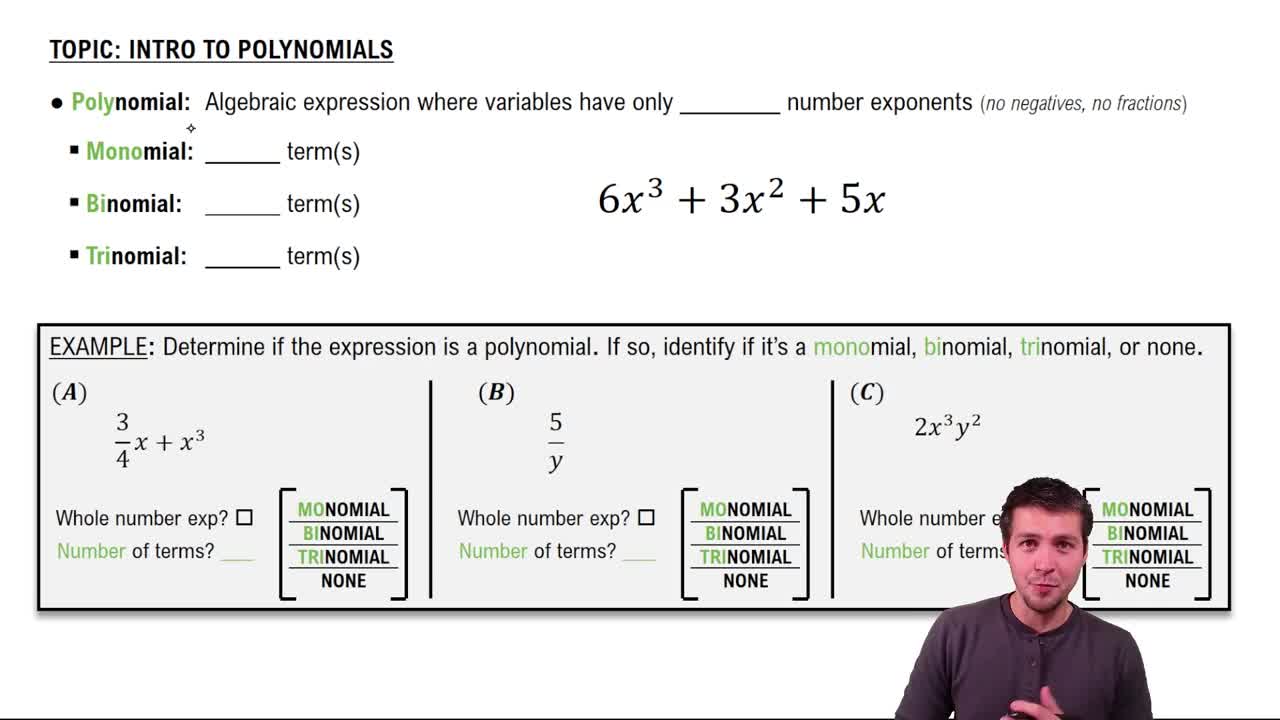
Introduction to Polynomials
Degree of a Polynomial
The degree of a polynomial is the highest power of the variable in the expression. Understanding the degree helps determine the steps in division and when to stop, as the division process continues until the remainder's degree is less than the divisor's degree.
Recommended video:
Guided course
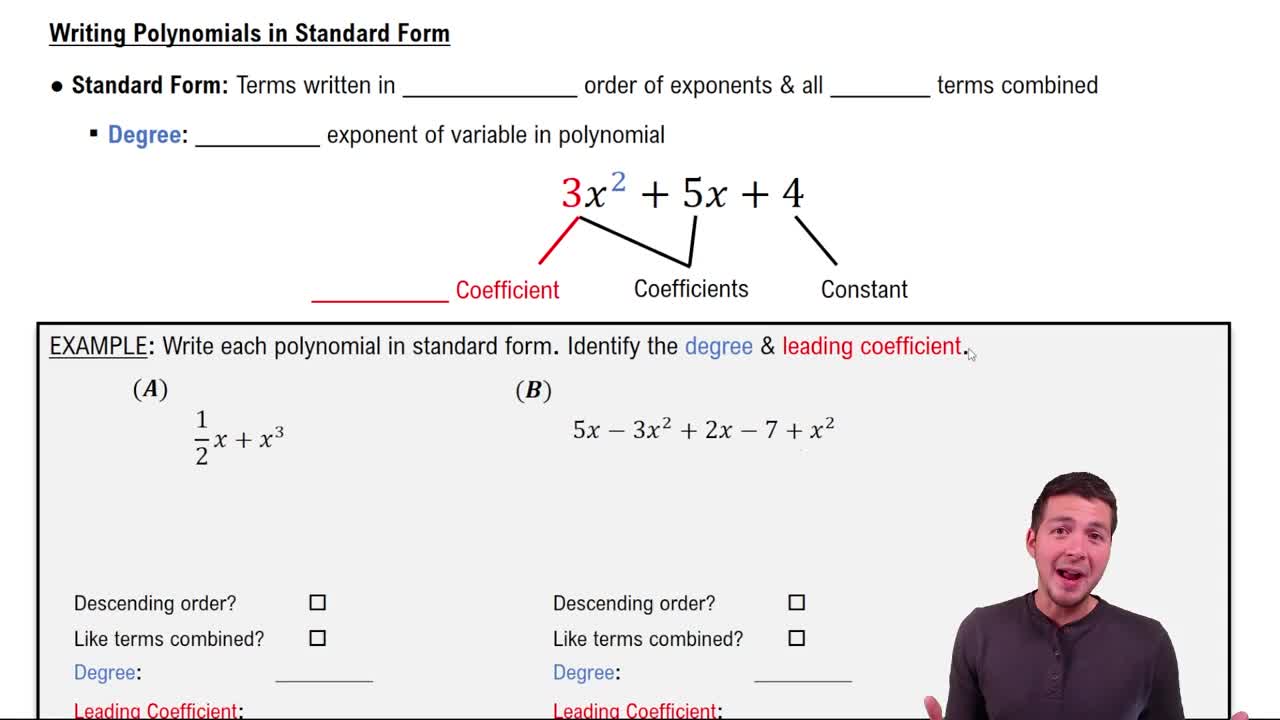
Standard Form of Polynomials
Remainder and Quotient in Polynomial Division
In polynomial division, the quotient is the result of the division, and the remainder is what is left over when the division cannot continue. The remainder must have a degree less than the divisor, and the original polynomial can be expressed as divisor × quotient + remainder.
Recommended video:
Guided course
Introduction to Polynomials
Related Videos
Related Practice
Textbook Question
435
views