In Exercises 1–68, factor completely, or state that the polynomial is prime. (x + 5)(x − 3) + (x + 5)(x − 7)
Verified step by step guidance
1
Factor out the common term \((x + 5)\) from both parts of the expression.
Rewrite the expression as \((x + 5)((x - 3) + (x - 7))\).
Simplify the expression inside the parentheses: \((x - 3) + (x - 7)\).
Combine like terms inside the parentheses: \(2x - 10\).
The factored form of the expression is \((x + 5)(2x - 10)\).
Verified video answer for a similar problem:
This video solution was recommended by our tutors as helpful for the problem above
Video duration:
4m
Play a video:
0 Comments
Key Concepts
Here are the essential concepts you must grasp in order to answer the question correctly.
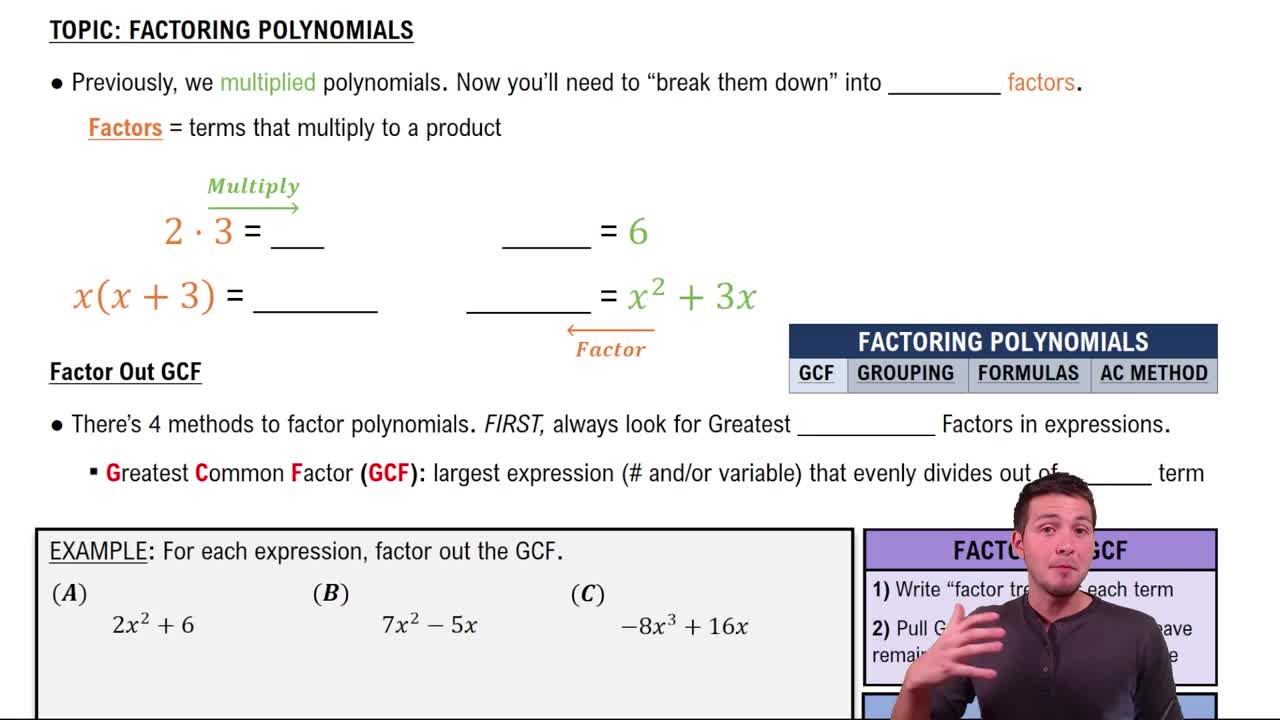
Factoring Polynomials
Factoring polynomials involves expressing a polynomial as a product of its simpler components, or factors. This process is essential for simplifying expressions and solving equations. In the given question, recognizing common factors in the polynomial will help in breaking it down into simpler forms.
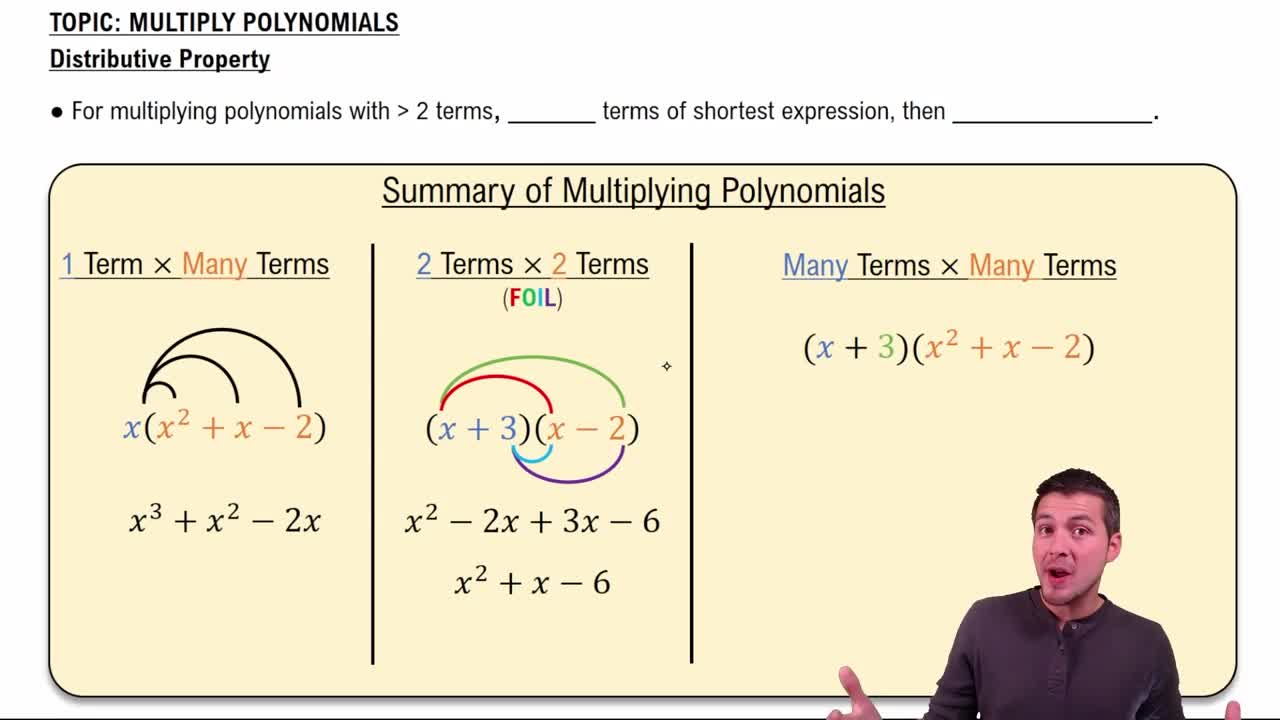
The distributive property states that a(b + c) = ab + ac, allowing us to multiply a single term by two or more terms inside parentheses. This property is crucial for expanding expressions and simplifying polynomials, as seen in the initial step of the problem where we need to combine like terms after applying this property.
Multiply Polynomials Using the Distributive Property
Combining Like Terms
Combining like terms is the process of simplifying an expression by adding or subtracting terms that have the same variable raised to the same power. This step is vital in polynomial manipulation, as it helps in reducing the expression to a more manageable form before factoring or determining if the polynomial is prime.

 4:41 minutes
 Verified step by step guidance
 07:30
07:30