Given and C=[−504316], find each product, if possible. See Examples 5–7. BA
Verified step by step guidance
1
Identify the dimensions of matrices B and A. Since B is a 2x3 matrix, it has 2 rows and 3 columns. The matrix A's dimensions must be known or assumed to proceed. For the product BA to be defined, the number of columns in B must equal the number of rows in A.
Check the compatibility for multiplication BA. Specifically, if B is 2x3, then A must be a 3xN matrix (where N is any number) for the product BA to be possible. If A is not 3xN, then the product BA is not defined.
If the product BA is defined, determine the dimensions of the resulting matrix. The resulting matrix will have the number of rows of B and the number of columns of A, so it will be a 2xN matrix.
To compute the product BA, multiply each row of B by each column of A. This involves taking the dot product of the row vector from B with the column vector from A for each element in the resulting matrix.
Write the general formula for the element in the ith row and jth column of the product BA as: \[(BA)_{ij} = \sum_{k=1}^{3} B_{ik} \times A_{kj}\] where \(i\) ranges from 1 to 2 and \(j\) ranges from 1 to N.
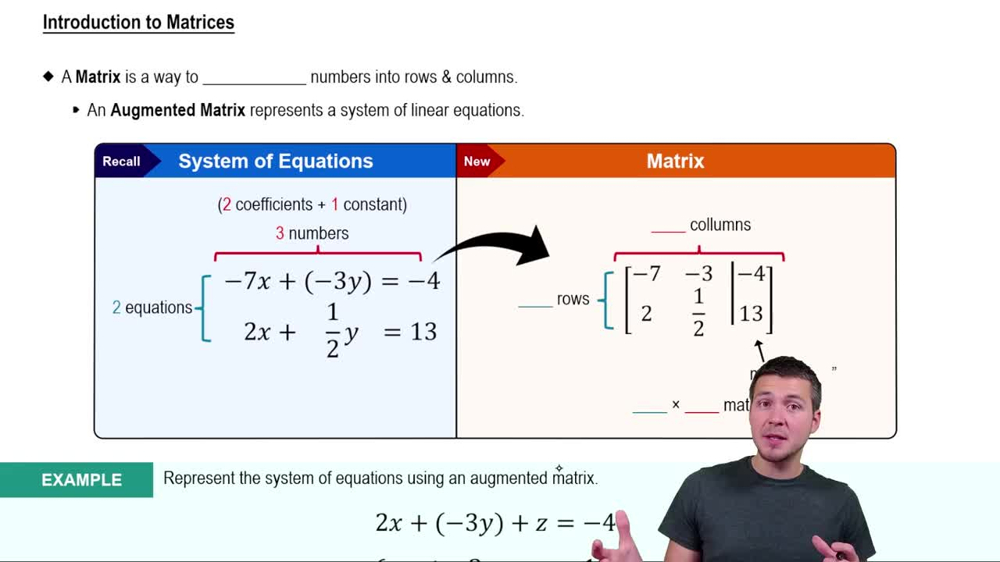
Verified video answer for a similar problem:
This video solution was recommended by our tutors as helpful for the problem above
Video duration:
6m
Play a video:
0 Comments
Key Concepts
Here are the essential concepts you must grasp in order to answer the question correctly.
Matrix Dimensions and Compatibility
Matrix multiplication is only defined when the number of columns in the first matrix equals the number of rows in the second. For example, if A is an m×n matrix and B is a p×q matrix, multiplication AB is possible only if n = p. Understanding this is essential to determine if the product BA exists.
Matrix multiplication involves taking the dot product of rows from the first matrix with columns of the second. Each element in the product matrix is computed by summing the products of corresponding entries. This process results in a new matrix whose dimensions depend on the outer dimensions of the multiplied matrices.
Unlike scalar multiplication, matrix multiplication is generally not commutative, meaning AB does not necessarily equal BA. Even if both products are defined, their results can differ. This concept is important when evaluating products like BA after AB.

 6:27 minutes
 Verified step by step guidance
 4:35
4:35