Use the product rule to simplify the expressions in Exercises 13–22. In Exercises 17–22, assume that variables represent nonnegative real numbers.
Verified step by step guidance
1
Identify the function as a product of two parts: \(\sqrt{125}\) and \(x^2\).
Rewrite the square root and constants in simpler radical or exponential form: \(\sqrt{125} = \sqrt{25 \times 5} = 5\sqrt{5}\).
Express the entire function as \(5\sqrt{5} \cdot x^2\) to clearly see the product of two functions: \(f(x) = 5\sqrt{5}\) and \(g(x) = x^2\).
Apply the product rule for derivatives, which states: \(\frac{d}{dx}[f(x)g(x)] = f'(x)g(x) + f(x)g'(x)\).
Since \(f(x) = 5\sqrt{5}\) is a constant, its derivative \(f'(x) = 0\). Then find \(g'(x)\) by differentiating \(x^2\) to get \$2x$. Substitute these into the product rule formula to write the derivative expression.
Verified video answer for a similar problem:
This video solution was recommended by our tutors as helpful for the problem above
Video duration:
1m
Play a video:
0 Comments
Key Concepts
Here are the essential concepts you must grasp in order to answer the question correctly.
Product Rule for Radicals
The product rule for radicals states that the square root of a product equals the product of the square roots: √(ab) = √a × √b. This rule allows simplification of expressions by separating factors under the radical into simpler parts.
Simplifying square roots involves factoring the radicand into perfect squares and other factors, then taking the square root of perfect squares outside the radical. For example, √125 can be simplified to 5√5 since 125 = 25 × 5.
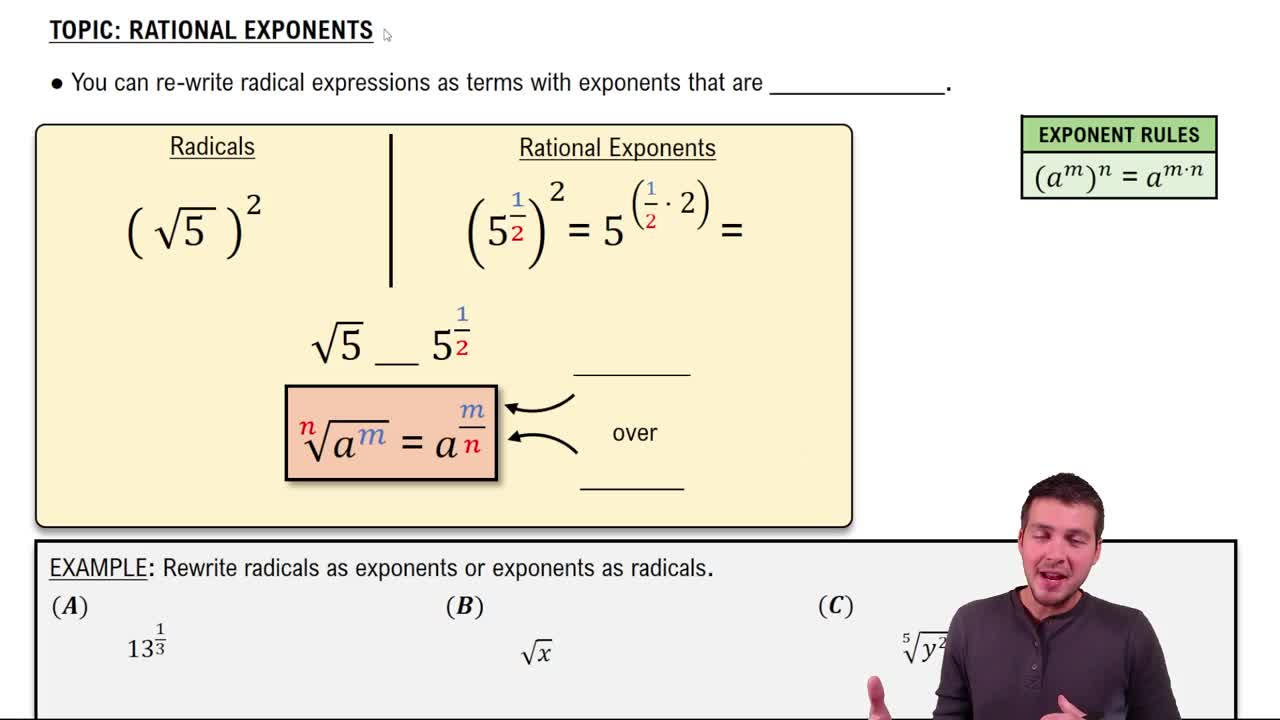
Variables under radicals can be expressed using fractional exponents, such as √(x^2) = x^(2/2) = x. When variables represent nonnegative real numbers, the square root of x squared simplifies directly to x, ensuring the expression remains valid.

 1:35 minutes
 Verified step by step guidance

 05:20
05:20