Multiply or divide, as indicated. (2k + 8)/6 ÷ (3k + 12)/2
Verified step by step guidance
1
Rewrite the division of fractions as multiplication by the reciprocal. So, the expression \(\frac{2k + 8}{6} \div \frac{3k + 12}{2}\) becomes \(\frac{2k + 8}{6} \times \frac{2}{3k + 12}\).
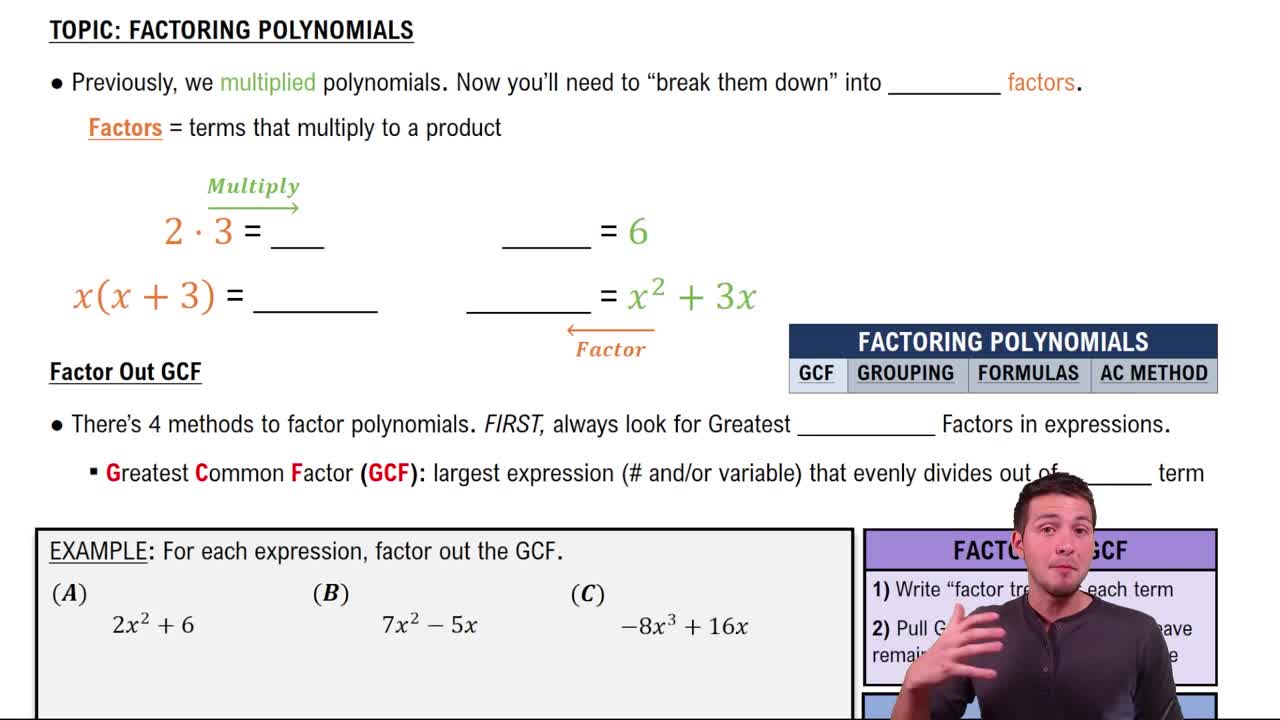
Factor any common factors in the numerators and denominators to simplify. For example, factor out the greatest common factor (GCF) from \$2k + 8\( and \)3k + 12$.
After factoring, rewrite the expression with the factored forms. For instance, \$2k + 8\( can be factored as \)2(k + 4)\( and \)3k + 12\( as \)3(k + 4)$.
Substitute the factored forms back into the expression: \(\frac{2(k + 4)}{6} \times \frac{2}{3(k + 4)}\).
Cancel out any common factors that appear in both numerator and denominator, such as \((k + 4)\), and simplify the remaining numerical coefficients.
Verified video answer for a similar problem:
This video solution was recommended by our tutors as helpful for the problem above
Video duration:
3m
Play a video:
0 Comments
Key Concepts
Here are the essential concepts you must grasp in order to answer the question correctly.
Dividing Rational Expressions
Dividing rational expressions involves multiplying the first expression by the reciprocal of the second. Instead of directly dividing, you flip the numerator and denominator of the divisor and then multiply, simplifying the process.
Factoring polynomials means rewriting expressions as products of simpler polynomials. For example, factoring out the greatest common factor (GCF) from terms like 2k + 8 or 3k + 12 helps simplify expressions before performing operations.
Simplifying rational expressions involves canceling common factors in the numerator and denominator after factoring. This reduces the expression to its simplest form, making it easier to interpret or use in further calculations.

 3:04 minutes
 Verified step by step guidance
 02:58
02:58