In Exercises 21–28, divide and express the result in standard form. 2/(3 - i)
Verified step by step guidance
1
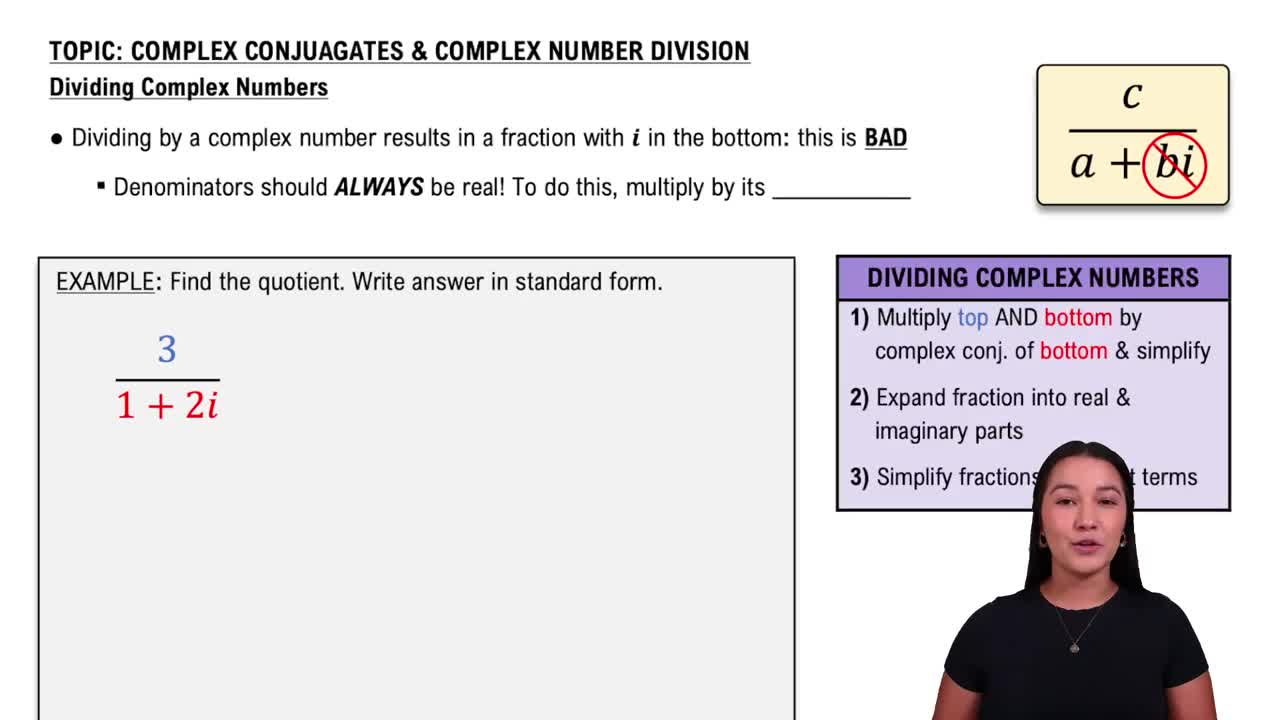
Step 1: Recognize that the denominator contains a complex number (3 - i). To simplify the expression, we need to eliminate the imaginary part from the denominator by multiplying both the numerator and denominator by the conjugate of the denominator.
Step 2: The conjugate of (3 - i) is (3 + i). Multiply both the numerator and denominator of the fraction by (3 + i): \( \frac{2}{3 - i} \cdot \frac{3 + i}{3 + i} \).
Step 3: Expand the numerator by distributing 2 across (3 + i): \( 2(3 + i) = 6 + 2i \). The numerator becomes \( 6 + 2i \).
Step 4: Expand the denominator using the difference of squares formula: \( (3 - i)(3 + i) = 3^2 - i^2 \). Simplify further: \( 9 - (-1) = 9 + 1 = 10 \). The denominator becomes 10.
Step 5: Combine the results to form the simplified fraction: \( \frac{6 + 2i}{10} \). Finally, separate the real and imaginary parts by dividing each term in the numerator by 10: \( \frac{6}{10} + \frac{2i}{10} \). Simplify the fractions to express the result in standard form.
Verified video answer for a similar problem:
This video solution was recommended by our tutors as helpful for the problem above
Video duration:
4m
Play a video:
0 Comments
Key Concepts
Here are the essential concepts you must grasp in order to answer the question correctly.
Complex Numbers
Complex numbers are numbers that have a real part and an imaginary part, expressed in the form a + bi, where 'a' is the real part and 'b' is the coefficient of the imaginary unit 'i', which is defined as the square root of -1. Understanding complex numbers is essential for performing operations such as addition, subtraction, multiplication, and division.
Dividing complex numbers involves multiplying the numerator and the denominator by the conjugate of the denominator. The conjugate of a complex number a + bi is a - bi. This process eliminates the imaginary part in the denominator, allowing the result to be expressed in standard form, which is a + bi.
The standard form of a complex number is expressed as a + bi, where 'a' and 'b' are real numbers. In this form, 'a' represents the real part and 'b' represents the imaginary part. Converting a complex number into standard form is crucial for clarity and further mathematical operations, making it easier to interpret and use in calculations.