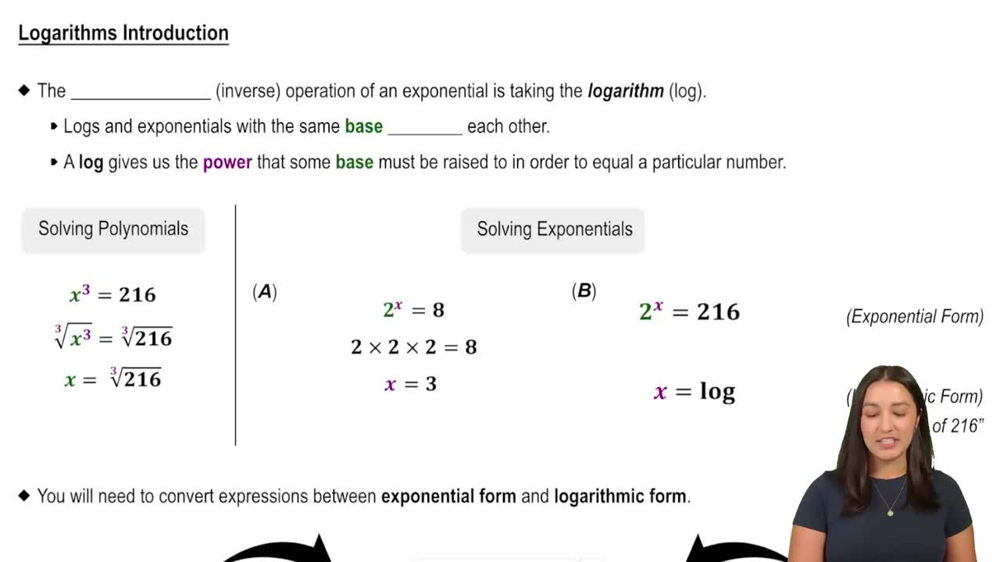
Write each equation in its equivalent exponential form. log6 216 = y
Verified step by step guidance
1
Recall the definition of logarithm: \( \log_b a = c \) means \( b^c = a \).
Identify the base \( b \), the argument \( a \), and the logarithm result \( c \) from the given equation \( \log_6 216 = y \). Here, \( b = 6 \), \( a = 216 \), and \( c = y \).
Rewrite the logarithmic equation \( \log_6 216 = y \) in its equivalent exponential form using the definition: \( 6^y = 216 \).
This expresses the original logarithmic equation as an exponential equation, which is the required form.
No further simplification is needed unless asked to solve for \( y \).
Verified video answer for a similar problem:
This video solution was recommended by our tutors as helpful for the problem above
Video duration:
1m
Play a video:
0 Comments
Key Concepts
Here are the essential concepts you must grasp in order to answer the question correctly.
Definition of Logarithms
A logarithm answers the question: to what exponent must the base be raised to produce a given number? For example, log_b(a) = c means b^c = a. Understanding this definition is essential to convert between logarithmic and exponential forms.
Converting a logarithmic equation log_b(a) = c into exponential form involves rewriting it as b^c = a. This equivalence allows solving for unknowns and understanding the relationship between logarithms and exponents.
Recognizing the base and the argument in logarithmic expressions helps in rewriting equations correctly. Knowing how to manipulate exponents and identify powers of numbers (e.g., 216 as 6^3) aids in simplifying and verifying the exponential form.

 1:52 minutes
 Verified step by step guidance
 7:30
7:30