Use the fact that if , then to find the inverse of each matrix, if possible. Check that and .
Verified step by step guidance
1
Identify the elements of matrix \(A\) as \(a = 2\), \(b = 3\), \(c = -1\), and \(d = 2\) from the given matrix \(A = \begin{bmatrix} 2 & 3 \\ -1 & 2 \end{bmatrix}\).
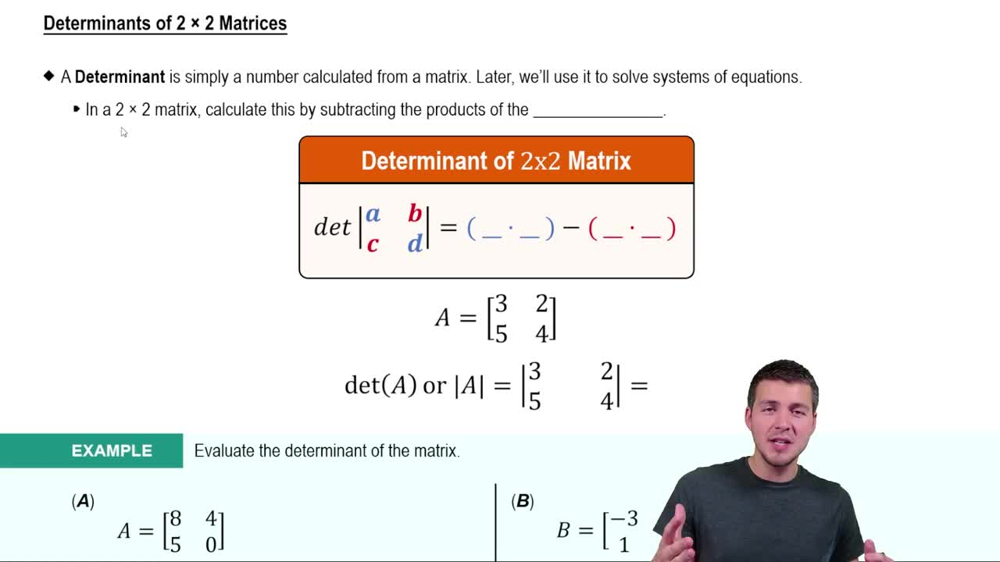
Calculate the determinant of matrix \(A\) using the formula \(ad - bc\). Substitute the values to get \(\det(A) = (2)(2) - (3)(-1)\).
Check if the determinant is non-zero. If \(\det(A) \neq 0\), the inverse matrix \(A^{-1}\) exists. If it equals zero, the inverse does not exist.
Use the formula for the inverse of a 2x2 matrix: \(A^{-1} = \frac{1}{ad - bc} \begin{bmatrix} d & -b \\ -c & a \end{bmatrix}\). Substitute the values of \(a\), \(b\), \(c\), and \(d\) into this formula.
Verify your result by multiplying \(A\) and \(A^{-1}\) in both orders: \(AA^{-1}\) and \(A^{-1}A\). Both products should equal the identity matrix \(I_2 = \begin{bmatrix} 1 & 0 \\ 0 & 1 \end{bmatrix}\).
Verified video answer for a similar problem:
This video solution was recommended by our tutors as helpful for the problem above
Video duration:
10m
Play a video:
0 Comments
Key Concepts
Here are the essential concepts you must grasp in order to answer the question correctly.
Matrix Inverse
The inverse of a square matrix A, denoted A⁻¹, is a matrix that when multiplied by A yields the identity matrix I. For a 2x2 matrix, the inverse exists only if the determinant is non-zero, and it is calculated using a specific formula involving the elements of A.
The determinant of a 2x2 matrix A = [[a, b], [c, d]] is given by ad - bc. This scalar value determines whether the matrix is invertible; if the determinant is zero, the matrix has no inverse.
The identity matrix I₂ is a 2x2 matrix with ones on the diagonal and zeros elsewhere. To verify a matrix inverse, multiply A by A⁻¹ and A⁻¹ by A; both products should equal I₂, confirming the correctness of the inverse.