Start with the given equation: \(2|\ln x| - 6 = 0\).
Isolate the absolute value expression by adding 6 to both sides: \(2|\ln x| = 6\).
Divide both sides by 2 to solve for the absolute value: \(|\ln x| = 3\).
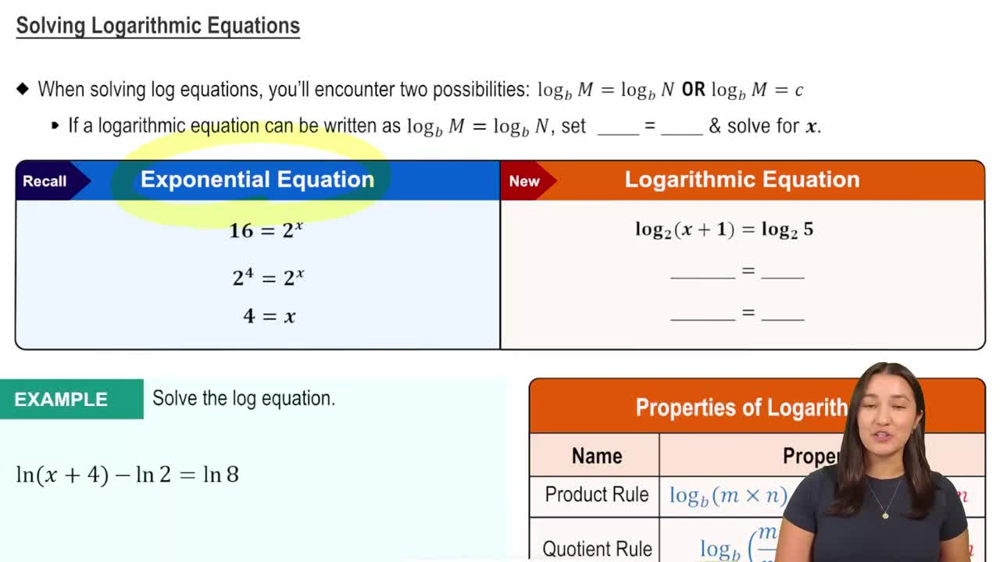
Recall that \(|A| = B\) means \(A = B\) or \(A = -B\). So, set up two equations: \(\ln x = 3\) and \(\ln x = -3\).
Solve each equation for \(x\) by exponentiating both sides with base \(e\): \(x = e^{3}\) and \(x = e^{-3}\). Remember to check that \(x > 0\) since the natural logarithm is only defined for positive \(x\).
Verified video answer for a similar problem:
This video solution was recommended by our tutors as helpful for the problem above
Video duration:
3m
Play a video:
0 Comments
Key Concepts
Here are the essential concepts you must grasp in order to answer the question correctly.
Properties of Logarithmic Functions
The natural logarithm function, denoted ln(x), is defined only for positive values of x. Understanding its domain and behavior is essential when solving equations involving ln(x), as it restricts the possible solutions to x > 0.
An absolute value equation like |A| = B splits into two cases: A = B and A = -B. This concept is crucial for solving equations involving absolute values, as it allows us to consider both positive and negative scenarios of the expression inside the absolute value.
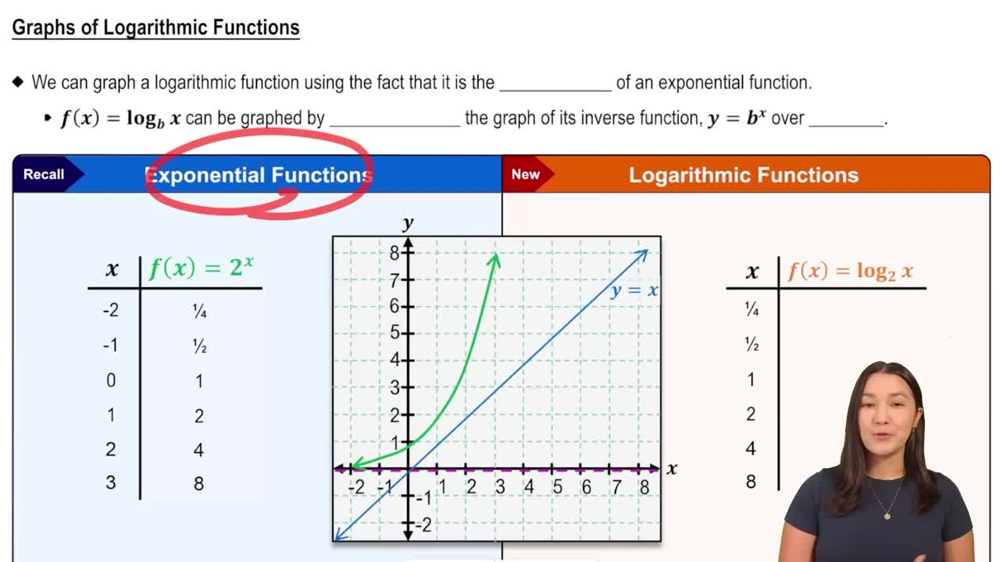
To solve equations involving logarithms, we often isolate the logarithmic expression and then exponentiate both sides to eliminate the log. This process helps convert the equation into a more manageable algebraic form for finding the variable.