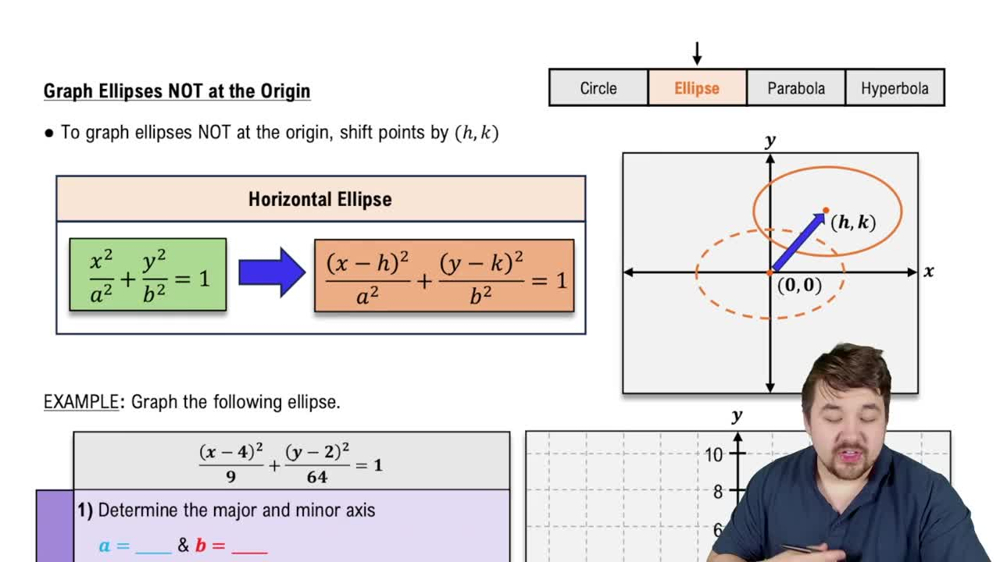
Graph each ellipse and locate the foci. x2/25 +y2/64 = 1
Verified step by step guidance
1
Identify the standard form of the ellipse equation given: \(\frac{x^{2}}{25} + \frac{y^{2}}{64} = 1\). Here, \(a^{2}\) and \(b^{2}\) are the denominators under \(x^{2}\) and \(y^{2}\) respectively.
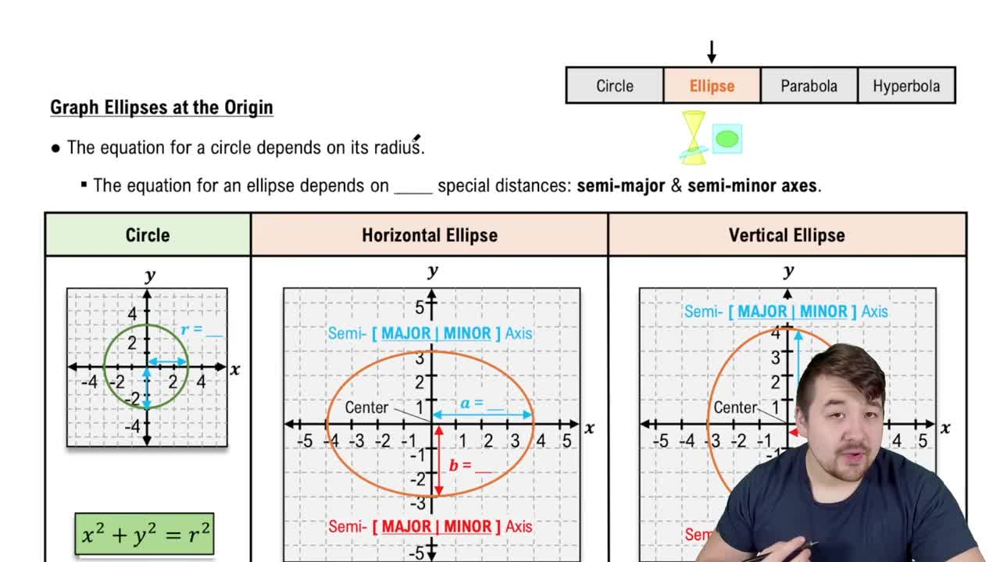
Determine which denominator is larger to find the major axis. Since \$64 > 25\(, the major axis is vertical, so \)a^{2} = 64\( and \)b^{2} = 25$.
Calculate the lengths of the semi-major axis \(a\) and semi-minor axis \(b\) by taking the square roots: \(a = \sqrt{64}\) and \(b = \sqrt{25}\).
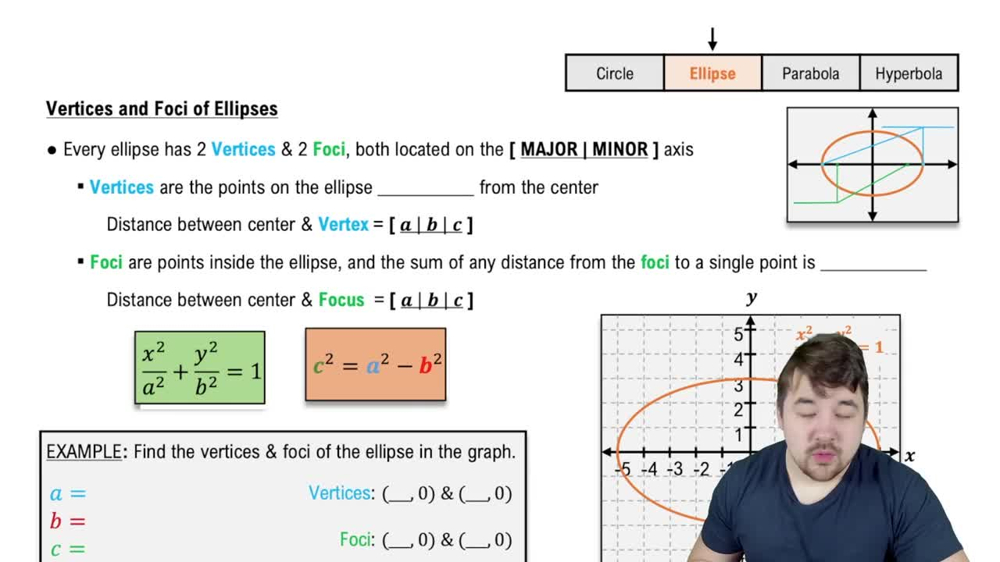
Find the distance \(c\) from the center to each focus using the relationship \(c^{2} = a^{2} - b^{2}\). Substitute the values of \(a^{2}\) and \(b^{2}\) to find \(c\).
Plot the ellipse centered at the origin with vertices at \((0, \pm a)\) and co-vertices at \((\pm b, 0)\). Then, mark the foci at \((0, \pm c)\) along the major axis.
Verified video answer for a similar problem:
This video solution was recommended by our tutors as helpful for the problem above
Video duration:
8m
Play a video:
0 Comments
Key Concepts
Here are the essential concepts you must grasp in order to answer the question correctly.
Standard Form of an Ellipse
The equation x²/a² + y²/b² = 1 represents an ellipse centered at the origin. Here, a² and b² are the denominators under x² and y², indicating the lengths of the semi-major and semi-minor axes. Identifying which denominator is larger helps determine the ellipse's orientation.
To graph an ellipse, plot the center at the origin, then mark points a units along the major axis and b units along the minor axis. Connect these points smoothly to form the ellipse. This visual representation helps in understanding the shape and size of the ellipse.
The foci are two fixed points inside the ellipse along the major axis. Their distance from the center is c, found using c² = |a² - b²|. Knowing c allows you to place the foci accurately, which is essential for understanding ellipse properties like reflection and eccentricity.

 8:41 minutes
 Verified step by step guidance
 5:12
5:12