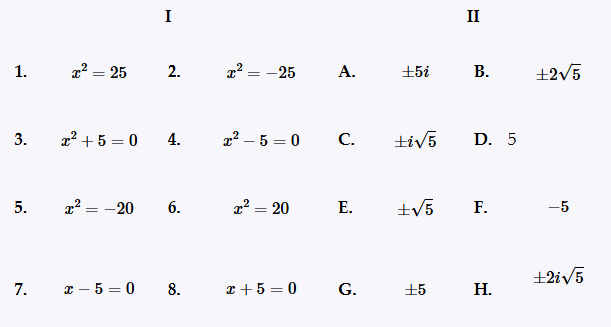
Match the equation in Column I with its solution(s) in Column II. x2 - 5 = 0
Verified step by step guidance
1
Start with the given equation: \(x^2 - 5 = 0\).
Isolate the squared term by adding 5 to both sides: \(x^2 = 5\).
To solve for \(x\), take the square root of both sides: \(x = \pm \sqrt{5}\).
Remember that taking the square root introduces both positive and negative solutions, so the solutions are \(x = \sqrt{5}\) and \(x = -\sqrt{5}\).
Match these solutions with the corresponding option in Column II that lists \(x = \pm \sqrt{5}\).
Verified video answer for a similar problem:
This video solution was recommended by our tutors as helpful for the problem above
Video duration:
1m
Play a video:
0 Comments
Key Concepts
Here are the essential concepts you must grasp in order to answer the question correctly.
Solving Quadratic Equations
A quadratic equation is a polynomial equation of degree two, typically in the form ax² + bx + c = 0. Solving it involves finding values of x that satisfy the equation, often by factoring, completing the square, or using the quadratic formula.
Isolating the variable means manipulating the equation to get the variable alone on one side. For example, in x² - 5 = 0, adding 5 to both sides isolates x², making it easier to solve for x by taking square roots.
The square root property states that if x² = k, then x = ±√k. This means when solving equations like x² = 5, the solutions are both the positive and negative square roots of 5, reflecting two possible values for x.