Identify the given 3x3 matrix \( A \) for which you need to find the inverse.
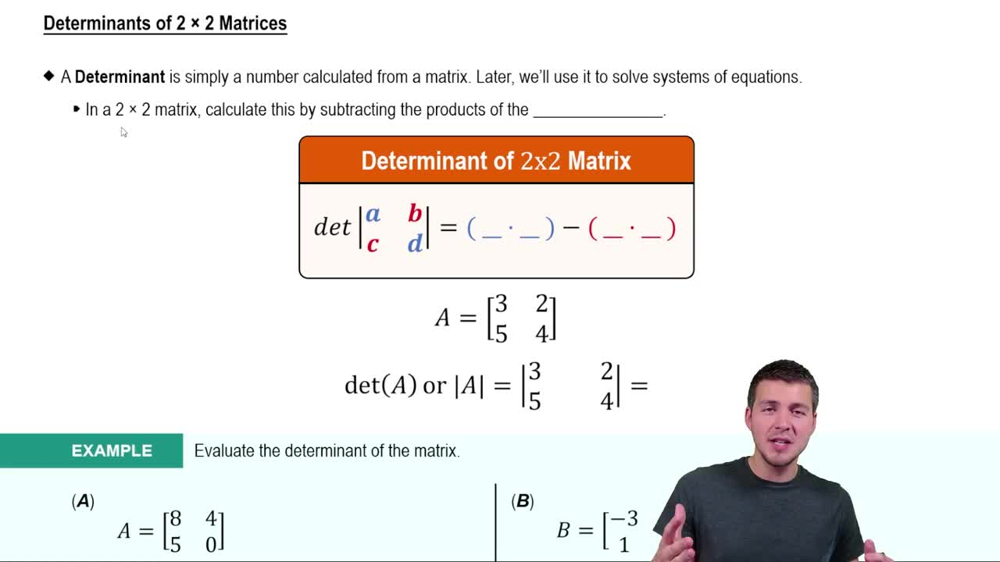
Calculate the determinant of matrix \( A \) using the formula for a 3x3 matrix determinant:
\[ \det(A) = a(ei - fh) - b(di - fg) + c(dh - eg) \]
where the matrix elements are:
\[ \begin{bmatrix} a & b & c \\ d & e & f \\ g & h & i \end{bmatrix} \]
Check if the determinant \( \det(A) \) is nonzero. If \( \det(A) = 0 \), the inverse does not exist. If it is nonzero, proceed to the next step.
Find the matrix of minors by calculating the determinant of each 2x2 submatrix formed by removing the row and column of each element.
Form the matrix of cofactors by applying a checkerboard pattern of signs (+, -, +, -, +, -, +, -, +) to the matrix of minors, then transpose this cofactor matrix to get the adjugate matrix. Finally, multiply the adjugate matrix by \( \frac{1}{\det(A)} \) to find the inverse matrix \( A^{-1} \).
Verified video answer for a similar problem:
This video solution was recommended by our tutors as helpful for the problem above
Video duration:
9m
Play a video:
0 Comments
Key Concepts
Here are the essential concepts you must grasp in order to answer the question correctly.
Matrix Inverse
The inverse of a matrix A is another matrix, denoted A⁻¹, such that when multiplied together, they produce the identity matrix. Only square matrices with non-zero determinants have inverses. Finding the inverse is essential for solving matrix equations and understanding linear transformations.
The determinant is a scalar value computed from a square matrix that indicates whether the matrix is invertible. If the determinant is zero, the matrix does not have an inverse. Calculating the determinant is a crucial step before attempting to find the inverse.
Common methods to find a matrix inverse include using the adjoint formula, row reduction to the identity matrix, or applying elementary row operations. For a 3x3 matrix, the row reduction method or the formula involving cofactors and the determinant are typically used.