Use the Gauss-Jordan method to solve each system of equations. For systems in two variables with infinitely many solutions, write the solution with y arbitrary. For systems in three variables with infinitely many solutions, write the solution set with z arbitrary. 6x - 3y - 4 = 0 3x + 6y - 7= 0
Verified step by step guidance
1
Rewrite each equation in the system to isolate the constant term on the right side. For the first equation, move the constant term to the right: \$6x - 3y = 4\(. For the second equation, do the same: \)3x + 6y = 7$.
Set up the augmented matrix for the system of equations. The matrix will have the coefficients of \(x\) and \(y\) in the first two columns and the constants on the right side as the last column:
\[\left[\begin{array}{cc|c} 6 & -3 & 4 \\ 3 & 6 & 7 \end{array}\right]\]
Use row operations to transform the augmented matrix into reduced row echelon form (RREF). Start by making the leading coefficient of the first row a 1 by dividing the entire first row by 6.
Next, eliminate the \(x\)-term in the second row by subtracting an appropriate multiple of the first row from the second row. Then, make the leading coefficient of the second row a 1 by dividing the second row by its leading coefficient.
Finally, eliminate the \(y\)-term in the first row by subtracting an appropriate multiple of the second row from the first row. Once the matrix is in RREF, write the corresponding system of equations and solve for \(x\) and \(y\). If the system has infinitely many solutions, express one variable in terms of the other (e.g., \(y\) arbitrary).
Verified video answer for a similar problem:
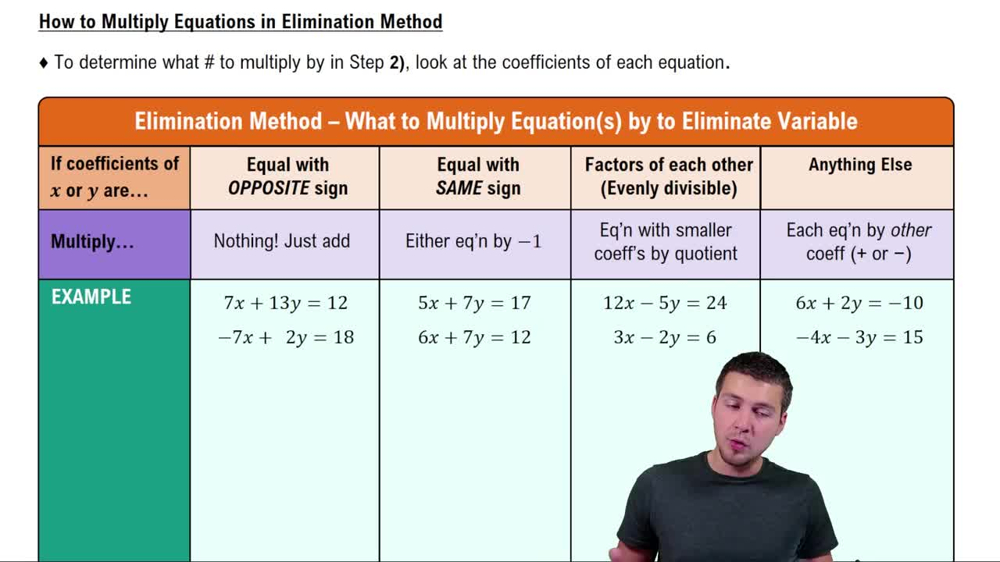
This video solution was recommended by our tutors as helpful for the problem above
Video duration:
7m
Play a video:
0 Comments
Key Concepts
Here are the essential concepts you must grasp in order to answer the question correctly.
Gauss-Jordan Elimination Method
Gauss-Jordan elimination is a systematic procedure to solve systems of linear equations by transforming the augmented matrix into reduced row-echelon form. This method uses row operations to simplify the matrix, making it easier to identify solutions or determine if there are infinitely many or no solutions.
A system of two linear equations with two variables can have a unique solution, infinitely many solutions, or no solution. Understanding how to interpret the results of the matrix reduction helps determine the nature of the solution, such as expressing one variable in terms of an arbitrary parameter when infinitely many solutions exist.
When a system has infinitely many solutions, the solution set is expressed parametrically by assigning one variable as arbitrary (a parameter). For two-variable systems, typically y is chosen as arbitrary, allowing the other variable to be written in terms of y, which describes all possible solutions.