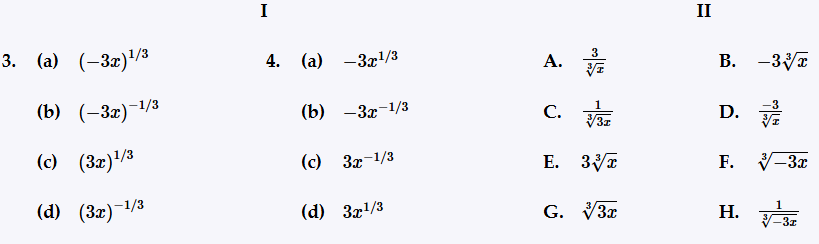
Match the rational exponent expression in Column I with the equivalent radical expression in Column II. Assume that x is not 0. ( 3x )1/3
Verified step by step guidance
1
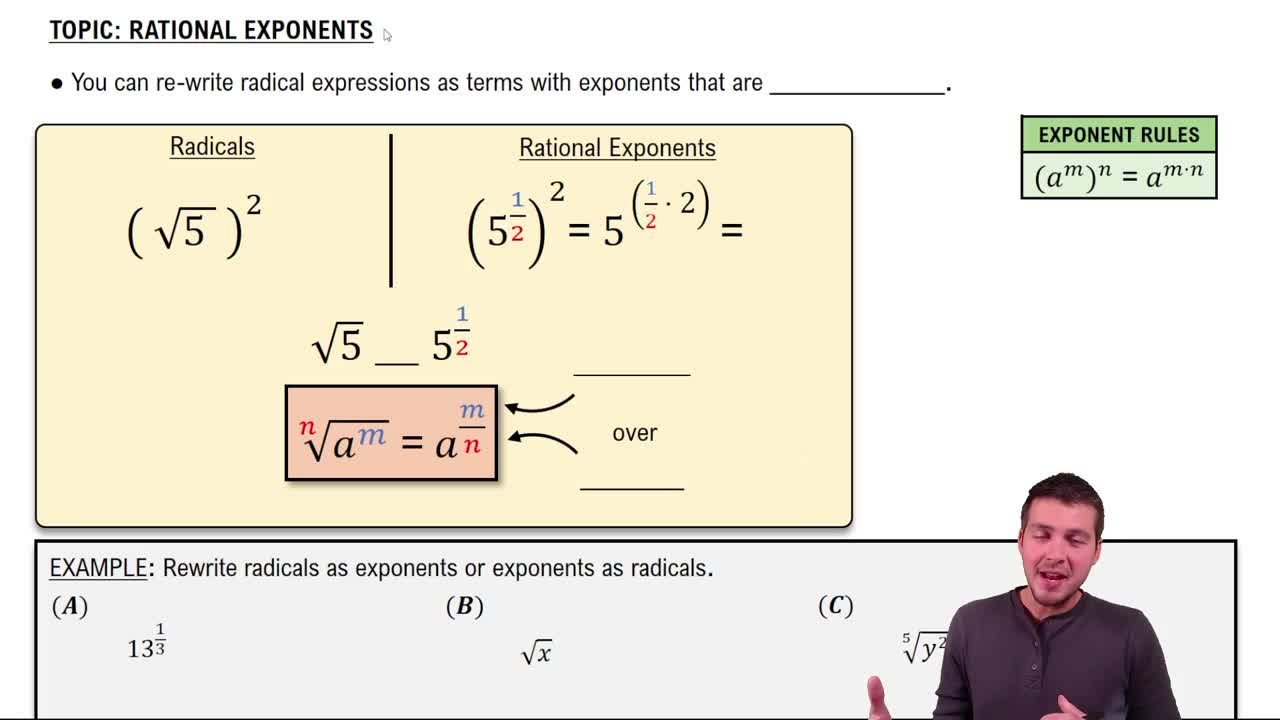
Recall that a rational exponent of the form \(a^{\frac{m}{n}}\) can be rewritten as a radical expression: \(a^{\frac{m}{n}} = \sqrt[n]{a^m}\).
Identify the base and the exponent in the expression \((3x)^{\frac{1}{3}}\). Here, the base is \((3x)\) and the exponent is \(\frac{1}{3}\).
Apply the rule for rational exponents: \((3x)^{\frac{1}{3}} = \sqrt[3]{(3x)^1}\), which simplifies to the cube root of \$3x$.
Write the equivalent radical expression as \(\sqrt[3]{3x}\), which means the cube root of the product \$3x$.
Confirm that this radical expression matches the one given in Column II to complete the matching process.
Verified video answer for a similar problem:
This video solution was recommended by our tutors as helpful for the problem above
Video duration:
2m
Play a video:
Key Concepts
Here are the essential concepts you must grasp in order to answer the question correctly.
Rational Exponents
Rational exponents represent roots and powers combined. An expression like x^(m/n) means the nth root of x raised to the mth power, or equivalently, (x^(1/n))^m. Understanding this allows conversion between exponent and radical forms.
Radical expressions use root symbols to denote roots, such as square roots or cube roots. The nth root of a number x is written as √[n]{x}, which corresponds to x raised to the 1/n power. Recognizing this helps match radicals to rational exponents.
Properties of exponents include rules like (ab)^m = a^m * b^m and (x^m)^n = x^(mn). These rules allow simplification and rewriting of expressions involving powers and roots, essential for matching expressions like (3x)^(1/3) to their radical equivalents.