In Exercises 69–82, factor completely.10y⁵ – 17y⁴ + 3y³
Verified step by step guidance
1
Step 1: Identify the greatest common factor (GCF) of the terms in the expression. Here, the GCF is \( y^3 \).
Step 2: Factor out the GCF \( y^3 \) from each term in the expression: \( 10y^5 - 17y^4 + 3y^3 = y^3(10y^2 - 17y + 3) \).
Step 3: Focus on the quadratic expression inside the parentheses: \( 10y^2 - 17y + 3 \).
Step 4: Look for two numbers that multiply to \( 10 \times 3 = 30 \) and add to \(-17\). These numbers are \(-15\) and \(-2\).
Step 5: Rewrite the middle term \(-17y\) using \(-15y\) and \(-2y\), then factor by grouping: \( 10y^2 - 15y - 2y + 3 \).
Verified video answer for a similar problem:
This video solution was recommended by our tutors as helpful for the problem above
Video duration:
5m
Play a video:
0 Comments
Key Concepts
Here are the essential concepts you must grasp in order to answer the question correctly.
Factoring Polynomials
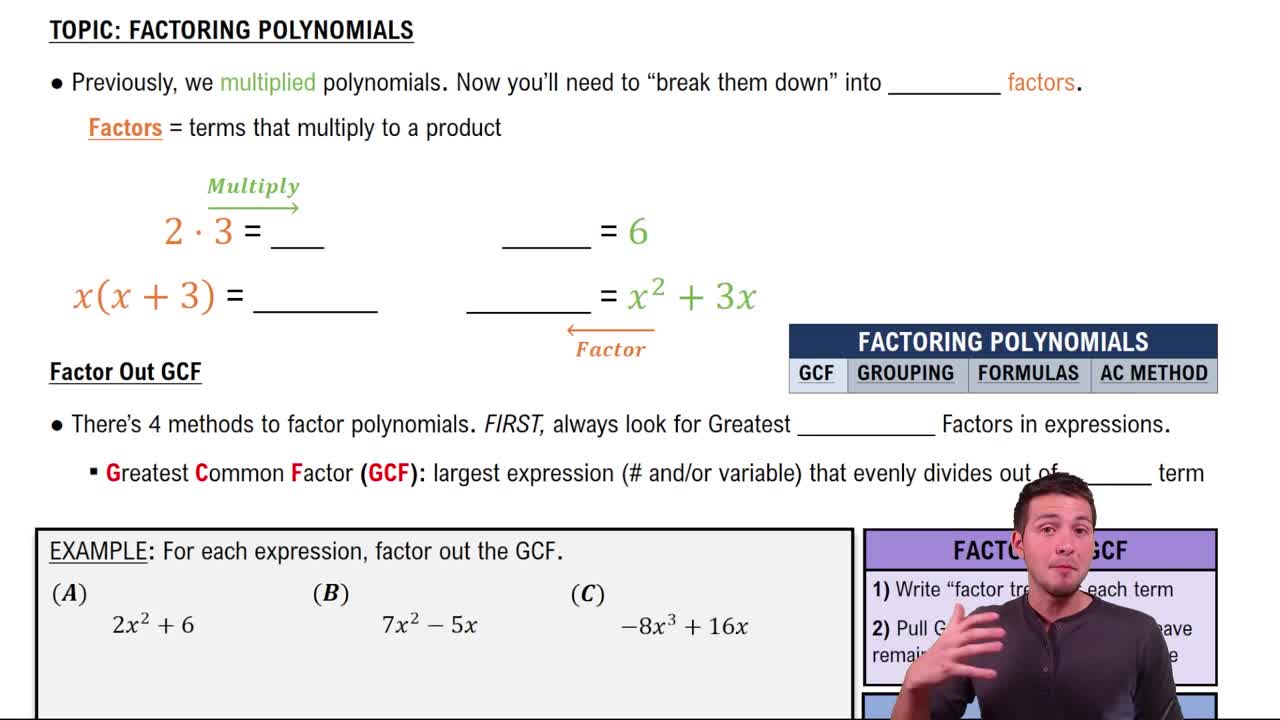
Factoring polynomials involves rewriting a polynomial expression as a product of simpler polynomials. This process is essential for simplifying expressions and solving equations. Common methods include factoring out the greatest common factor (GCF), using special products like the difference of squares, and applying techniques such as grouping.
The greatest common factor (GCF) is the largest polynomial that divides all terms of a polynomial without leaving a remainder. Identifying the GCF is the first step in factoring, as it simplifies the polynomial and makes it easier to factor the remaining terms. For the polynomial 10y⁵ – 17y⁴ + 3y³, the GCF is y³.
The degree of a polynomial is the highest power of the variable in the expression. Understanding the degree helps in determining the number of roots and the behavior of the polynomial. Each term in a polynomial contributes to its overall degree, and recognizing how to combine like terms is crucial for effective factoring.

 5:17 minutes
 Verified step by step guidance
 07:30
07:30