Find ƒ+g, f−g, fg, and f/g. Determine the domain for each function. f(x)= = 9x/(x - 4), g(x) = 7/(x+8)
Verified step by step guidance
1
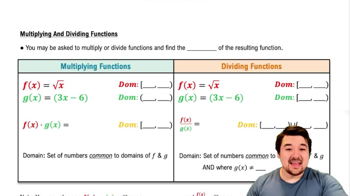
Step 1: Understand the problem. You are tasked with finding the sum (ƒ+g), difference (ƒ−g), product (ƒg), and quotient (ƒ/g) of the given functions f(x) = 9x/(x - 4) and g(x) = 7/(x + 8). Additionally, you need to determine the domain for each resulting function.
Step 2: To find ƒ+g, add the two functions: ƒ+g = (9x/(x - 4)) + (7/(x + 8)). Combine the fractions by finding a common denominator, which is (x - 4)(x + 8). Rewrite each fraction with the common denominator and simplify.
Step 3: To find ƒ−g, subtract the two functions: ƒ−g = (9x/(x - 4)) − (7/(x + 8)). Similar to addition, find a common denominator (x - 4)(x + 8), rewrite the fractions, and simplify.
Step 4: To find ƒg, multiply the two functions: ƒg = (9x/(x - 4)) * (7/(x + 8)). Multiply the numerators and denominators directly: (9x * 7)/((x - 4)(x + 8)). Simplify the expression.
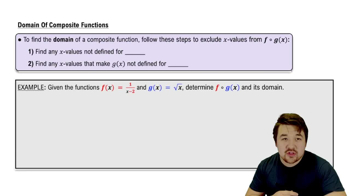
Step 5: To find ƒ/g, divide the two functions: ƒ/g = (9x/(x - 4)) ÷ (7/(x + 8)). Division of fractions involves multiplying the first fraction by the reciprocal of the second: (9x/(x - 4)) * ((x + 8)/7). Simplify the resulting expression. For the domain of each function, exclude values of x that make any denominator zero (x = 4, x = -8).
Verified video answer for a similar problem:
This video solution was recommended by our tutors as helpful for the problem above
Video duration:
7m
Play a video:
0 Comments
Key Concepts
Here are the essential concepts you must grasp in order to answer the question correctly.
Function Operations
Function operations involve combining two functions through addition, subtraction, multiplication, and division. For example, if f(x) and g(x) are two functions, then f+g means adding their outputs, while f-g means subtracting the output of g from f. Understanding these operations is essential for manipulating and analyzing functions in algebra.
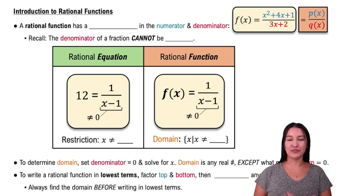
The domain of a function is the set of all possible input values (x-values) for which the function is defined. For rational functions, the domain is restricted by values that make the denominator zero, as these would lead to undefined outputs. Identifying the domain is crucial for ensuring that the operations performed on functions yield valid results.
Rational functions are ratios of two polynomial functions. They can exhibit unique behaviors, such as vertical asymptotes where the denominator is zero, and horizontal asymptotes that describe end behavior. Understanding the characteristics of rational functions is important for analyzing their graphs and determining their domains.