Use the graph of g to solve Exercises 71–76. Find g(-4)
Verified step by step guidance
1
Identify the function g on the graph, which is represented by the blue line.
Locate the x-value of -4 on the horizontal axis (x-axis).
From x = -4, move vertically until you reach the point on the graph of g.
Determine the y-coordinate of this point, which represents g(-4).
Write the value of g(-4) as the y-coordinate found in the previous step.
Verified video answer for a similar problem:
This video solution was recommended by our tutors as helpful for the problem above
Video duration:
2m
Play a video:
0 Comments
Key Concepts
Here are the essential concepts you must grasp in order to answer the question correctly.
Function and Function Notation
A function relates each input (x) to exactly one output (y). Function notation, such as g(-4), means finding the output value of g when the input is -4. Understanding this helps interpret what the question asks: the y-value corresponding to x = -4 on the graph.
To find g(-4) using the graph, locate the point where x = -4 on the horizontal axis, then find the corresponding y-value on the curve. This y-value is the output of the function at that input. Accurate reading of coordinates from the graph is essential.
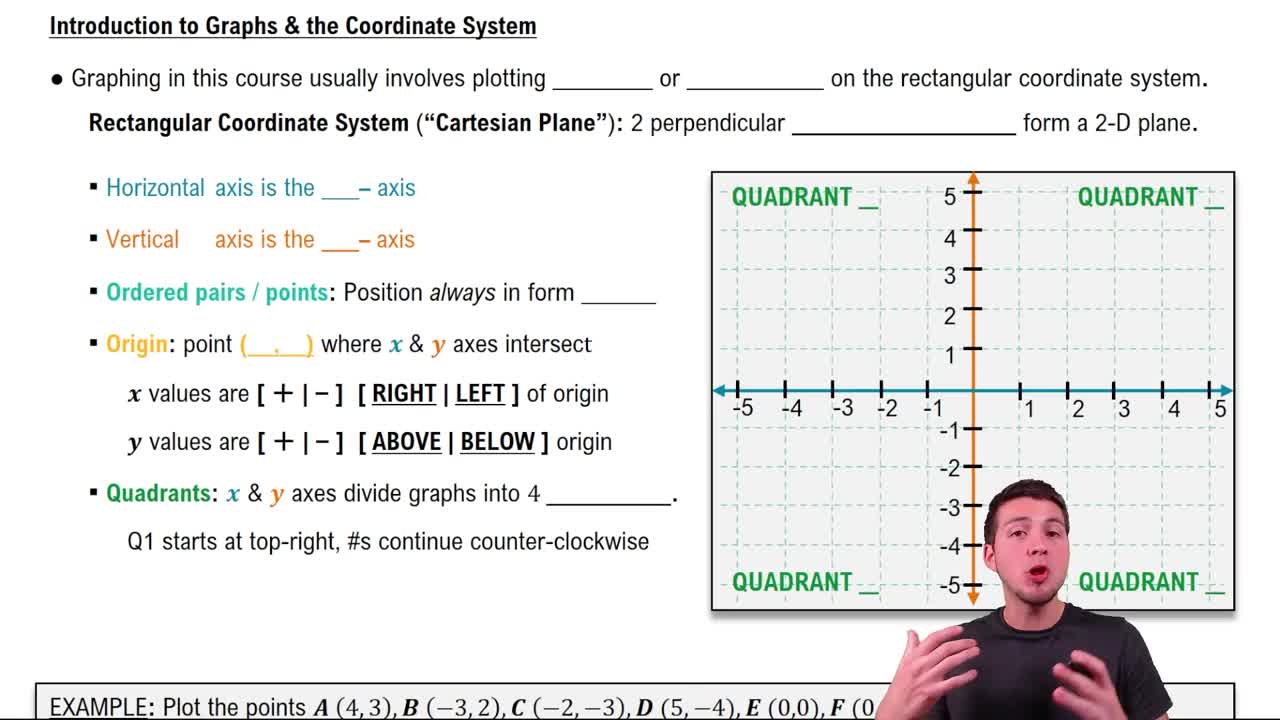
The coordinate plane consists of the x-axis (horizontal) and y-axis (vertical), which intersect at the origin (0,0). Points on the graph are given as (x, y). Understanding the axes and how to plot or read points is fundamental to interpreting the graph and solving for function values.

 2:07 minutes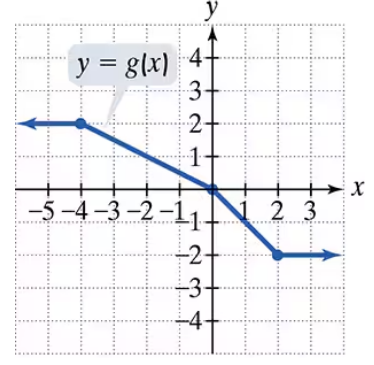
 Verified step by step guidance
 4:56
4:56