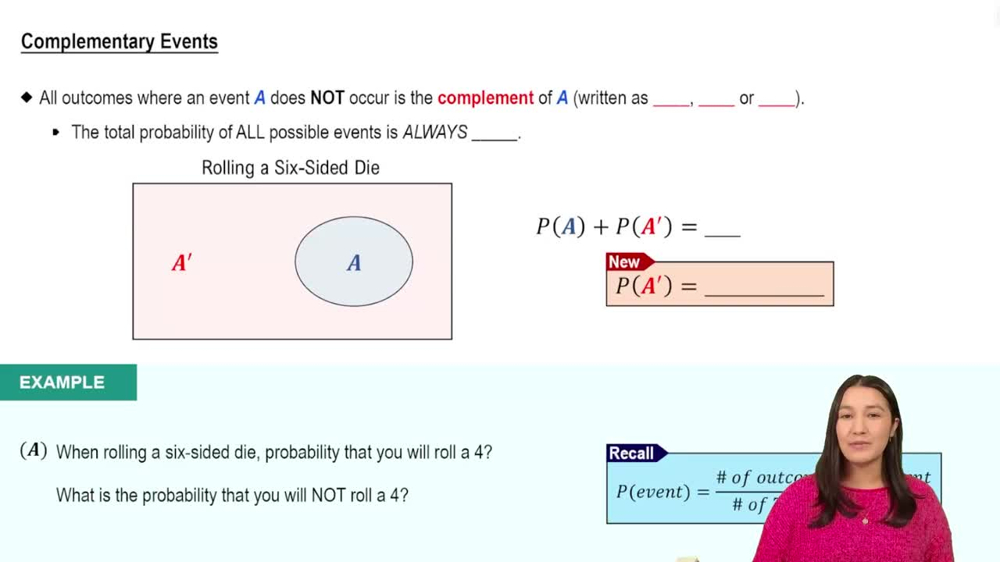
A die is rolled. Find the probability of getting a number less than 3 or greater than 4.
Verified step by step guidance
1
Step 1: Understand the problem. A standard die has six faces numbered 1 through 6. We need to find the probability of rolling a number less than 3 or greater than 4.
Step 2: Identify the numbers that satisfy the condition 'less than 3'. These are the numbers 1 and 2.
Step 3: Identify the numbers that satisfy the condition 'greater than 4'. These are the numbers 5 and 6.
Step 4: Combine the two sets of numbers (less than 3 and greater than 4). The numbers satisfying either condition are 1, 2, 5, and 6.
Step 5: Calculate the probability. Since there are 4 favorable outcomes (1, 2, 5, 6) out of 6 possible outcomes (1 through 6), the probability is the ratio of favorable outcomes to total outcomes: \( \frac{4}{6} \). Simplify the fraction if needed.
Verified video answer for a similar problem:
This video solution was recommended by our tutors as helpful for the problem above
Video duration:
2m
Play a video:
0 Comments
Key Concepts
Here are the essential concepts you must grasp in order to answer the question correctly.
Probability
Probability is a measure of the likelihood that an event will occur, expressed as a number between 0 and 1. In this context, it quantifies the chance of rolling a specific outcome on a die. The probability of an event can be calculated by dividing the number of favorable outcomes by the total number of possible outcomes.
The sample space is the set of all possible outcomes of a random experiment. For a single roll of a standard six-sided die, the sample space consists of the numbers {1, 2, 3, 4, 5, 6}. Understanding the sample space is crucial for calculating probabilities, as it provides the context for determining favorable outcomes.
Compound events involve the combination of two or more simple events. In this question, we are interested in the event of rolling a number less than 3 (which includes 1 and 2) or greater than 4 (which includes 5 and 6). To find the probability of compound events, we can use the addition rule, ensuring that we account for any overlapping outcomes.