Ch. 7 - Further Topics in Algebra

Lial13th EditionCollege AlgebraISBN: 9780136881063
Not the one you use?Change textbookSelect a different textbook
Table of contents

Chapter 8, Problem 59
The factorial of a positive integer n can be computed as a product. n! = 1 * 2 * 3 *. . . * n
Calculators and computers can evaluate factorials very quickly. Before the days of modern technology, mathematicians developed Stirling’s formula for approximating large factorials. The formula involves the irrational numbers p and e.
n! = √2πn * n^n * e^−n
As an example, the exact value of 5! is 120, and Stirling’s formula gives the approximation as 118.019168 with a graphing calculator. This is “off” by less than 2, an error of only 1.65%. Work Exercises 59–62 in order. Use a calculator to find the exact value of 10! and its approximation, using Stirling’s
formula.
 Verified step by step guidance
1
Identify the exact value of 10! by calculating the product of all positive integers up to 10: 10! = 1 \(\times\) 2 \(\times\) 3 \(\times\) \(\ldots\) \(\times\) 10.
Use Stirling's approximation formula for factorials: n! \(\approx\) \(\sqrt{2\pi n}\) \(\times\) n^n \(\times\) e^{-n}.
Substitute n = 10 into Stirling's formula: 10! \(\approx\) \(\sqrt{2\pi \times 10}\) \(\times\) 10^{10} \(\times\) e^{-10}.
Calculate each component of the formula: \(\sqrt{2\pi \times 10}\), 10^{10}, and e^{-10}.
Multiply the results from the previous step to find the approximate value of 10! using Stirling's formula.
Verified video answer for a similar problem:
This video solution was recommended by our tutors as helpful for the problem above.

Video duration:
3mWas this helpful?
Key Concepts
Here are the essential concepts you must grasp in order to answer the question correctly.
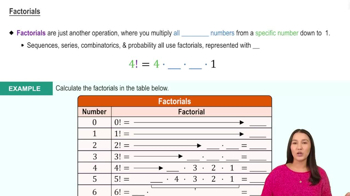
Factorial
The factorial of a positive integer n, denoted as n!, is the product of all positive integers from 1 to n. It is defined as n! = 1 × 2 × 3 × ... × n. Factorials are fundamental in combinatorics, probability, and various mathematical calculations, particularly in determining permutations and combinations.
Recommended video:
 5:22
5:22
Factorials
Stirling's Formula
Stirling's formula provides an approximation for large factorials, expressed as n! ≈ √(2πn) * (n/e)^n. This formula is particularly useful when calculating the factorial of large numbers, as it simplifies the computation while maintaining a high degree of accuracy. It highlights the relationship between factorials and exponential functions.
Recommended video:
 06:36
06:36Solving Quadratic Equations Using The Quadratic Formula
Error Analysis
Error analysis in the context of approximations involves assessing the difference between the exact value and the estimated value provided by a formula like Stirling's. In the example given, the error is calculated as the absolute difference between 5! (120) and its approximation (118.019168), which is about 1.65%. Understanding error is crucial for evaluating the reliability of approximations in mathematical computations.
Recommended video:
 3:43
3:43Finding the Domain of an Equation
0