Insert ⊆ or ⊈ in each blank to make the resulting statement true. {0, 1, 2} ____ {1, 2, 3, 4, 5}
Verified step by step guidance
1
Understand the symbols: The symbol \( \subseteq \) means 'is a subset of,' which means every element of the first set is also in the second set. The symbol \( s \) here likely refers to the symbol \( \in \), which means 'is an element of.'
Identify the sets given: The first set is \( \{0, 1, 2\} \) and the second set is \( \{1, 2, 3, 4, 5\} \).
Check if the first set is a subset of the second set by verifying if every element of \( \{0, 1, 2\} \) is in \( \{1, 2, 3, 4, 5\} \).
Since the element \(0\) is in the first set but not in the second set, the first set is not a subset of the second set, so \( \subseteq \) is not correct here.
Therefore, the correct symbol to use is \( s \) (or \( \in \)) only if referring to individual elements, but since the problem compares two sets, neither \( \subseteq \) nor \( s \) fits perfectly; however, based on the instructions, the blank should be filled with \( s \) if the problem intends to say 'is an element of' for an element, or \( \subseteq \) if the first set is a subset. Here, since the first set is not a subset, the correct choice is \( s \) indicating the relation is not subset.
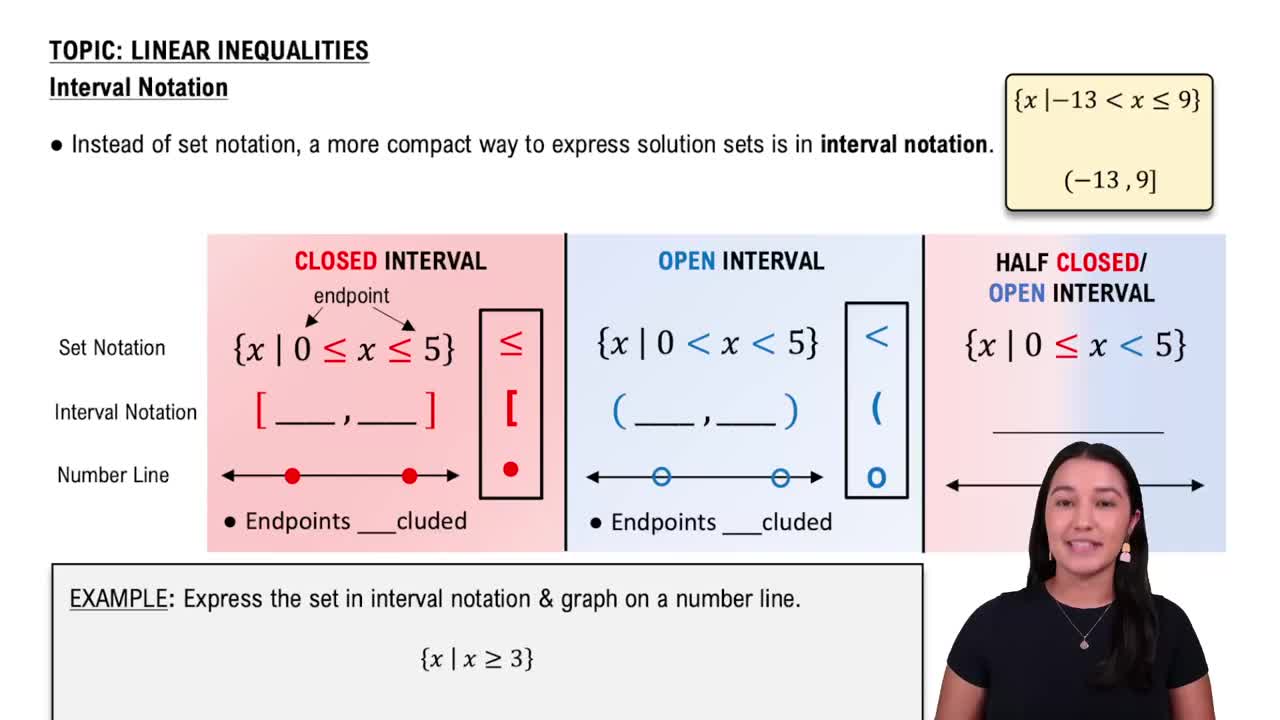
Verified video answer for a similar problem:
This video solution was recommended by our tutors as helpful for the problem above
Video duration:
1m
Play a video:
0 Comments
Key Concepts
Here are the essential concepts you must grasp in order to answer the question correctly.
Subset and Proper Subset
A subset is a set where every element of the first set is also in the second set, denoted by '⊆'. A proper subset means the first set is contained within the second set but is not equal to it, denoted by '⊂' or sometimes 's'. Understanding the difference helps determine which symbol correctly expresses the relationship.
Set Elements and Membership
Set elements are the individual objects contained within a set. To determine subset relationships, you must check if all elements of one set appear in another. For example, {0, 1, 2} and {1, 2, 3, 4, 5} share some elements, but not all, which affects the subset status.
Set theory uses specific symbols to express relationships: '⊆' means subset (possibly equal), and '⊂' or 's' often denotes proper subset (strictly contained). Correctly interpreting and applying these symbols is essential for writing true statements about sets.

 1:21 minutes
 Verified step by step guidance
 05:25
05:25