Solve each equation. See Examples 8 and 9. 2x-2/5-x-1/5-1=0
Verified step by step guidance
1
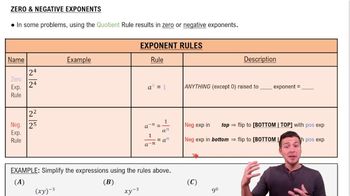
Rewrite the equation \(2x^{-\frac{2}{5}} - x^{-\frac{1}{5}} - 1 = 0\) by recognizing the negative exponents as reciprocals. For example, \(x^{-\frac{2}{5}} = \frac{1}{x^{\frac{2}{5}}}\) and \(x^{-\frac{1}{5}} = \frac{1}{x^{\frac{1}{5}}}\).
To simplify the equation, introduce a substitution: let \(y = x^{-\frac{1}{5}}\). Then, \(x^{-\frac{2}{5}} = (x^{-\frac{1}{5}})^2 = y^2\). Rewrite the equation in terms of \(y\).
Substitute into the equation to get a quadratic form: \$2y^2 - y - 1 = 0\(. This is a standard quadratic equation in \)y$.
Solve the quadratic equation \$2y^2 - y - 1 = 0\( using the quadratic formula \(y = \frac{-b \pm \sqrt{b^2 - 4ac}}{2a}\), where \)a=2\(, \)b=-1\(, and \)c=-1$.
After finding the values of \(y\), substitute back \(y = x^{-\frac{1}{5}}\) and solve for \(x\) by raising both sides to the power of \(-5\) to isolate \(x\).
Verified video answer for a similar problem:
This video solution was recommended by our tutors as helpful for the problem above
Video duration:
5m
Play a video:
0 Comments
Key Concepts
Here are the essential concepts you must grasp in order to answer the question correctly.
Negative Exponents
Negative exponents indicate the reciprocal of the base raised to the positive exponent. For example, x^(-n) equals 1 divided by x^n. Understanding this helps rewrite terms like x^(-2/5) as 1 over x^(2/5), simplifying the equation.
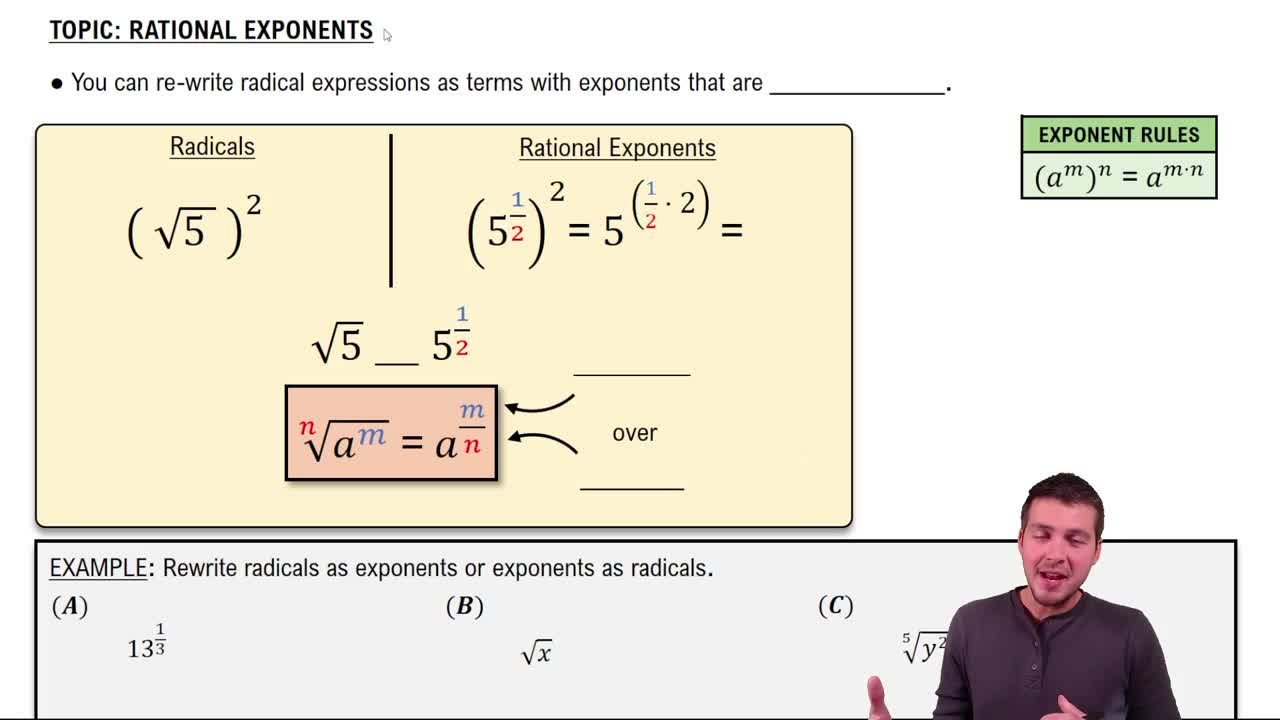
Fractional exponents represent roots and powers simultaneously; x^(m/n) means the n-th root of x raised to the m-th power. For instance, x^(1/5) is the fifth root of x. Recognizing this allows manipulation of terms with fractional powers effectively.
Solving equations involving variables with negative and fractional exponents often requires rewriting terms to a common base or exponent, then isolating the variable. Techniques include substitution or multiplying through by an expression to clear denominators, enabling solution of the equation.