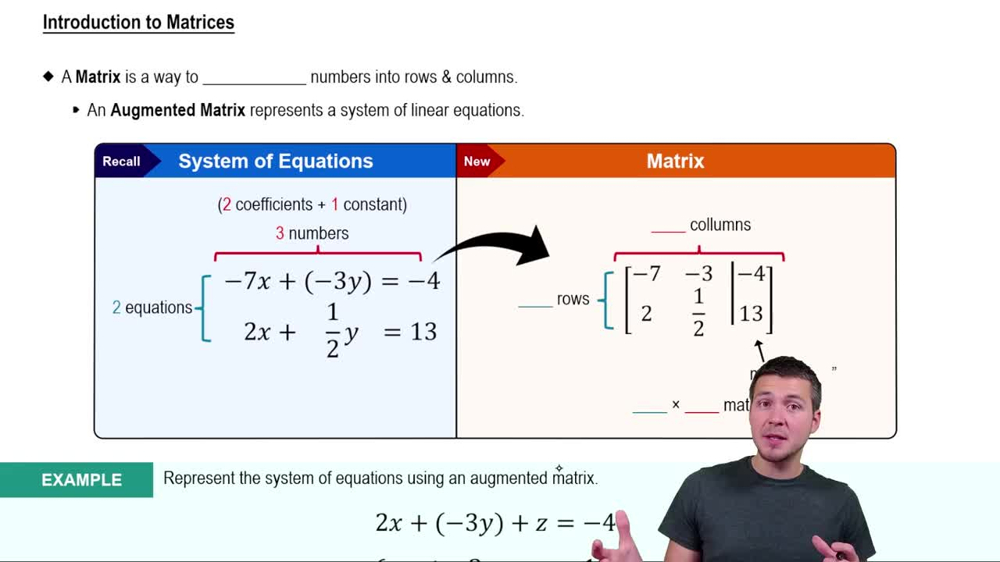
Identify the dimensions of each matrix involved in the operation. Here, all matrices are 1x3, meaning they each have 1 row and 3 columns.
Recall that matrix addition and subtraction are only defined for matrices of the same dimensions. Since all matrices are 1x3, these operations are possible.
Perform the subtraction first: subtract corresponding elements of the first and second 1x3 matrices. If the first matrix is \(A = [a_1, a_2, a_3]\) and the second is \(B = [b_1, b_2, b_3]\), then \(A - B = [a_1 - b_1, a_2 - b_2, a_3 - b_3]\).
Next, add the resulting matrix from the subtraction to the third 1x3 matrix. If the third matrix is \(C = [c_1, c_2, c_3]\), then \((A - B) + C = [(a_1 - b_1) + c_1, (a_2 - b_2) + c_2, (a_3 - b_3) + c_3]\).
Write the final matrix as the result of the operation, which will also be a 1x3 matrix with each element calculated as above.
Verified video answer for a similar problem:
This video solution was recommended by our tutors as helpful for the problem above
Video duration:
2m
Play a video:
0 Comments
Key Concepts
Here are the essential concepts you must grasp in order to answer the question correctly.
Matrix Dimensions and Compatibility
Matrix operations like addition and subtraction require the matrices to have the same dimensions. Here, all matrices are 1x3, meaning they each have one row and three columns, so they are compatible for addition and subtraction.
Matrix addition and subtraction are performed element-wise. For two matrices of the same size, you add or subtract corresponding elements to get the resulting matrix.
When performing multiple operations, follow the order of operations (left to right for addition and subtraction). First subtract the second matrix from the first, then add the third matrix to the result.

 2:31 minutes
 Verified step by step guidance
 4:35
4:35