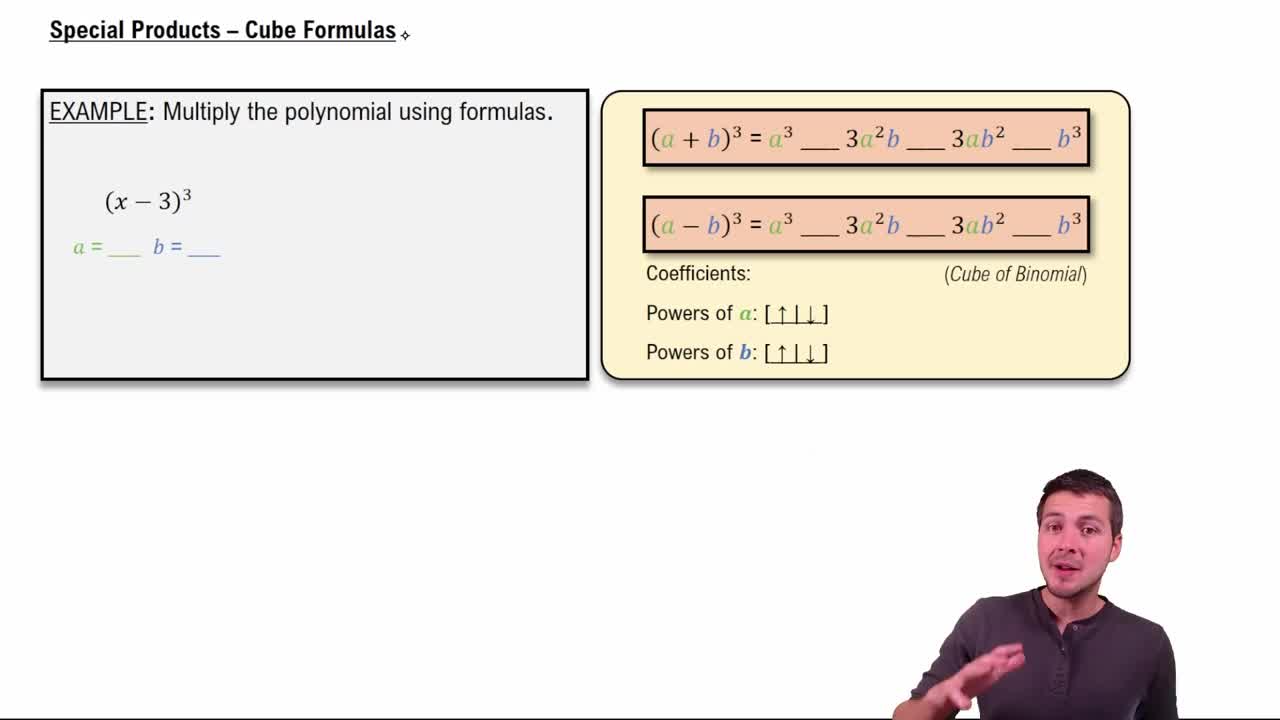
Recognize that the expression \((x+2)^3\) represents the cube of a binomial. To expand this, we use the Binomial Theorem, which states \((a+b)^n = \sum_{k=0}^n \binom{n}{k} a^{n-k} b^k\).
Identify the components of the binomial: \(a = x\), \(b = 2\), and \(n = 3\).
Apply the Binomial Theorem to expand \((x+2)^3\): \((x+2)^3 = \binom{3}{0}x^3(2^0) + \binom{3}{1}x^2(2^1) + \binom{3}{2}x^1(2^2) + \binom{3}{3}x^0(2^3)\).
Simplify each term using the binomial coefficients \(\binom{n}{k}\), which are calculated as \(\binom{n}{k} = \frac{n!}{k!(n-k)!}\). For example, \(\binom{3}{0} = 1\), \(\binom{3}{1} = 3\), \(\binom{3}{2} = 3\), and \(\binom{3}{3} = 1\).
Combine the simplified terms to write the expanded form of \((x+2)^3\). The result will be a polynomial with four terms.
Verified video answer for a similar problem:
This video solution was recommended by our tutors as helpful for the problem above
Video duration:
3m
Play a video:
0 Comments
Key Concepts
Here are the essential concepts you must grasp in order to answer the question correctly.
Binomial Expansion
Binomial expansion refers to the process of expanding expressions that are raised to a power, particularly those in the form of (a + b)^n. The expansion can be systematically achieved using the Binomial Theorem, which states that (a + b)^n = Σ (n choose k) * a^(n-k) * b^k, where k ranges from 0 to n. This theorem provides a formula for calculating the coefficients of the expanded terms.
A cubic function is a polynomial function of degree three, typically expressed in the form f(x) = ax^3 + bx^2 + cx + d. In the context of the question, (x + 2)^3 represents a cubic function where the variable x is transformed by adding 2 before cubing. Understanding cubic functions is essential for recognizing their properties, such as their shape and the behavior of their graphs.
Polynomial multiplication involves multiplying two or more polynomials to produce a new polynomial. This process requires distributing each term in the first polynomial to every term in the second polynomial, combining like terms afterward. In the case of (x + 2)^3, this means multiplying (x + 2) by itself three times, which illustrates the principles of both distribution and combining like terms.

 3:35 minutes
 Verified step by step guidance
 03:41
03:41