Factor each polynomial over the set of rational number coefficients. (25/9)x4-(9y2)
Verified step by step guidance
1
Identify the given polynomial: \(\frac{25}{9}x^{4} - 9y^{2}\).
Recognize that this expression is a difference of two squares because it can be written as \(\left(\frac{5}{3}x^{2}\right)^{2} - (3y)^{2}\).
Recall the difference of squares factoring formula: \(a^{2} - b^{2} = (a - b)(a + b)\).
Apply the formula by setting \(a = \frac{5}{3}x^{2}\) and \(b = 3y\), so the factorization becomes \(\left(\frac{5}{3}x^{2} - 3y\right)\left(\frac{5}{3}x^{2} + 3y\right)\).
Check if either factor can be further factored over the rationals; since both are binomials with no common factors or special patterns, the factorization is complete.
Verified video answer for a similar problem:
This video solution was recommended by our tutors as helpful for the problem above
Video duration:
1m
Play a video:
0 Comments
Key Concepts
Here are the essential concepts you must grasp in order to answer the question correctly.
Factoring Polynomials
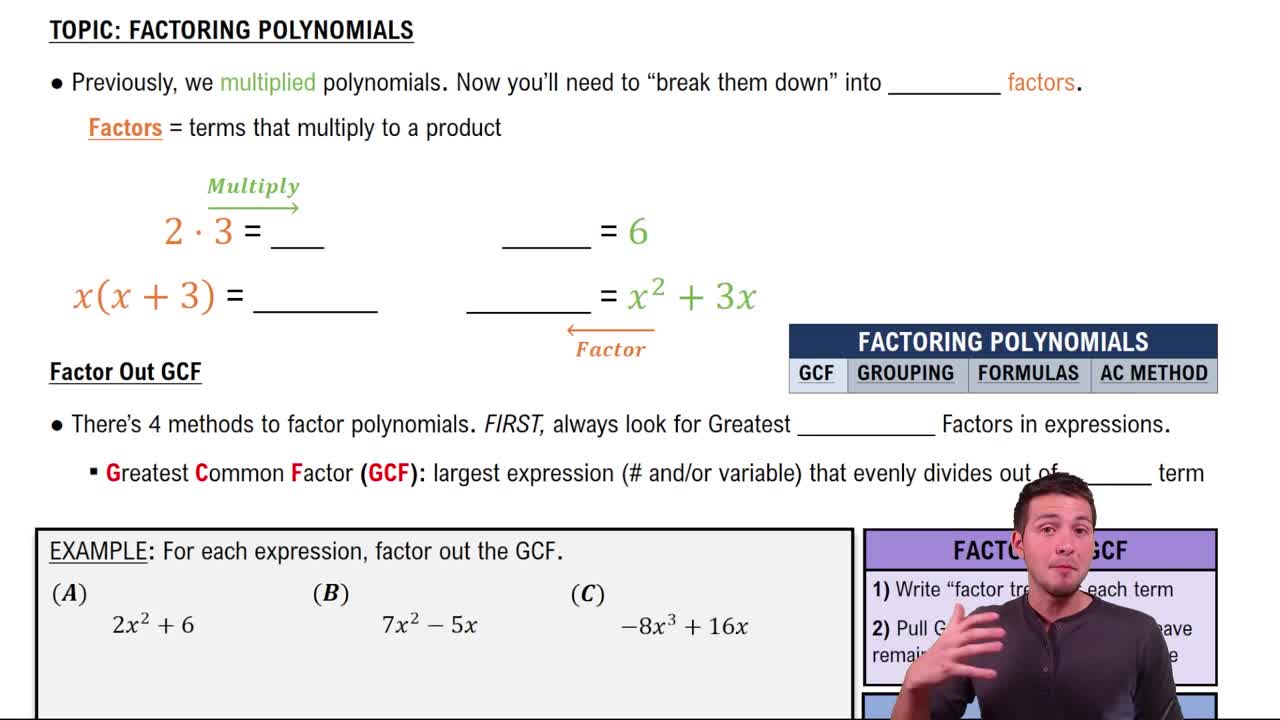
Factoring polynomials involves rewriting a polynomial as a product of simpler polynomials. This process helps simplify expressions and solve equations. Common methods include factoring out the greatest common factor, grouping, and special products like difference of squares.
The difference of squares is a special factoring pattern where an expression of the form a² - b² can be factored into (a - b)(a + b). Recognizing this pattern is essential for factoring polynomials that involve squared terms subtracted from each other.
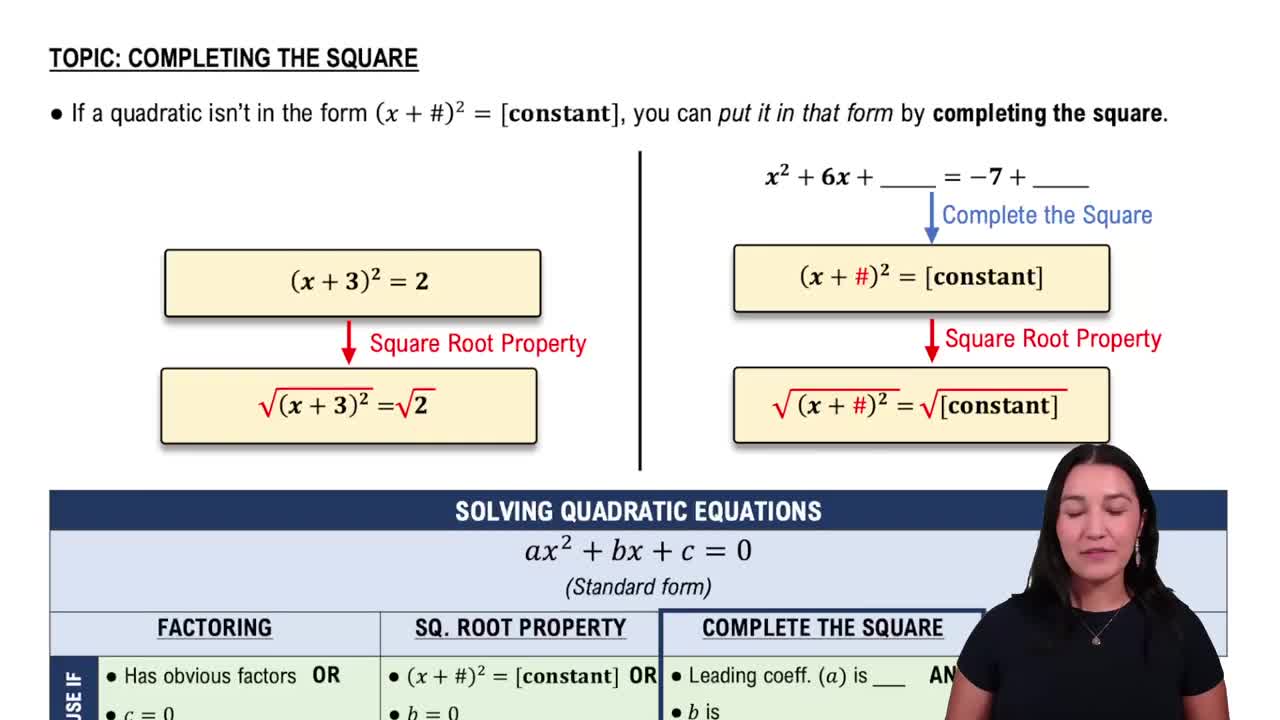
Solving Quadratic Equations by Completing the Square
Rational Coefficients
Factoring over rational coefficients means expressing the polynomial factors using only rational numbers (fractions or integers). This restricts the factorization to avoid irrational or complex numbers, ensuring the factors remain within the set of rational numbers.