Find ƒ-1(x), and give the domain and range. ƒ(x) = ex + 10
Verified step by step guidance
1
Start by writing the function as an equation: \(y = e^{x} + 10\).
To find the inverse function, swap the roles of \(x\) and \(y\): \(x = e^{y} + 10\).
Solve this new equation for \(y\): first, isolate the exponential term by subtracting 10 from both sides to get \(x - 10 = e^{y}\).
Next, apply the natural logarithm to both sides to undo the exponential, giving \(y = \ln(x - 10)\).
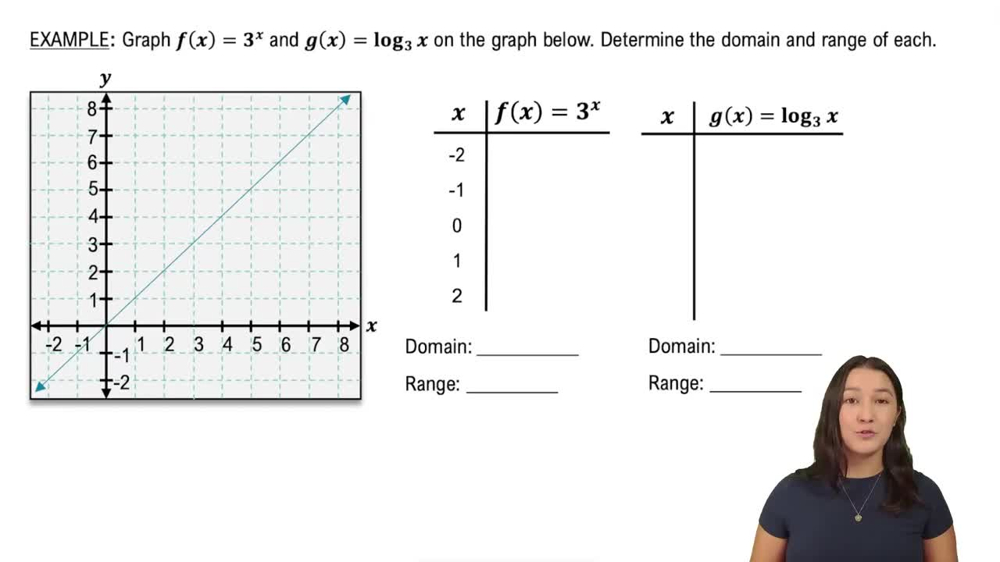
Therefore, the inverse function is \(f^{-1}(x) = \ln(x - 10)\). The domain of \(f^{-1}\) is all \(x\) such that \(x - 10 > 0\), so \(x > 10\). The range of \(f^{-1}\) is all real numbers, since the original function's domain was all real numbers.
Verified video answer for a similar problem:
This video solution was recommended by our tutors as helpful for the problem above
Video duration:
4m
Play a video:
0 Comments
Key Concepts
Here are the essential concepts you must grasp in order to answer the question correctly.
Inverse Functions
An inverse function reverses the effect of the original function, swapping inputs and outputs. To find ƒ⁻¹(x), solve the equation y = ƒ(x) for x in terms of y. The inverse exists only if the original function is one-to-one, ensuring each output corresponds to exactly one input.
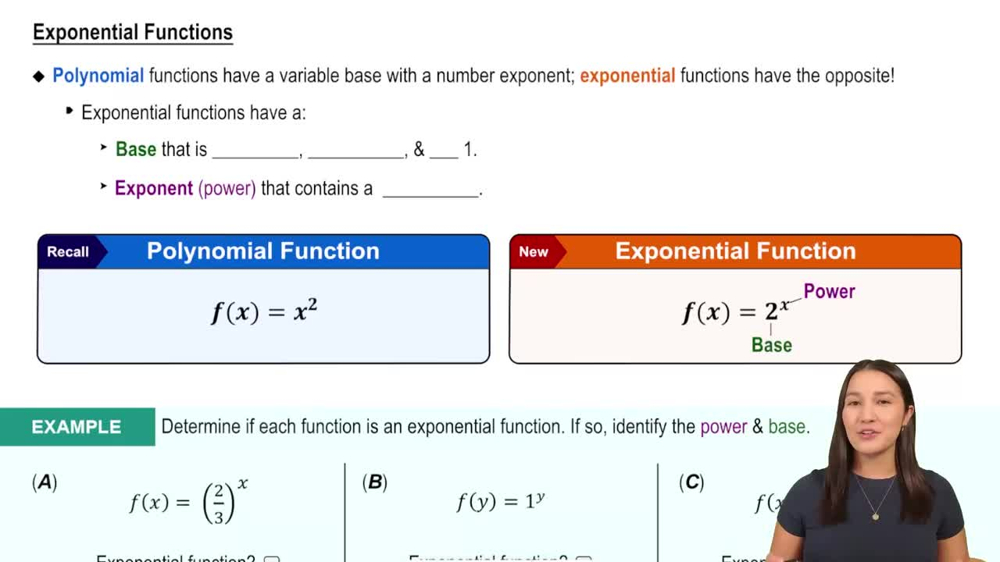
Exponential functions have the form f(x) = a^x, where a > 0 and a ≠ 1. They are continuous, one-to-one, and always positive. Understanding their behavior, such as growth and horizontal shifts (like adding 10), is essential for manipulating and inverting these functions.
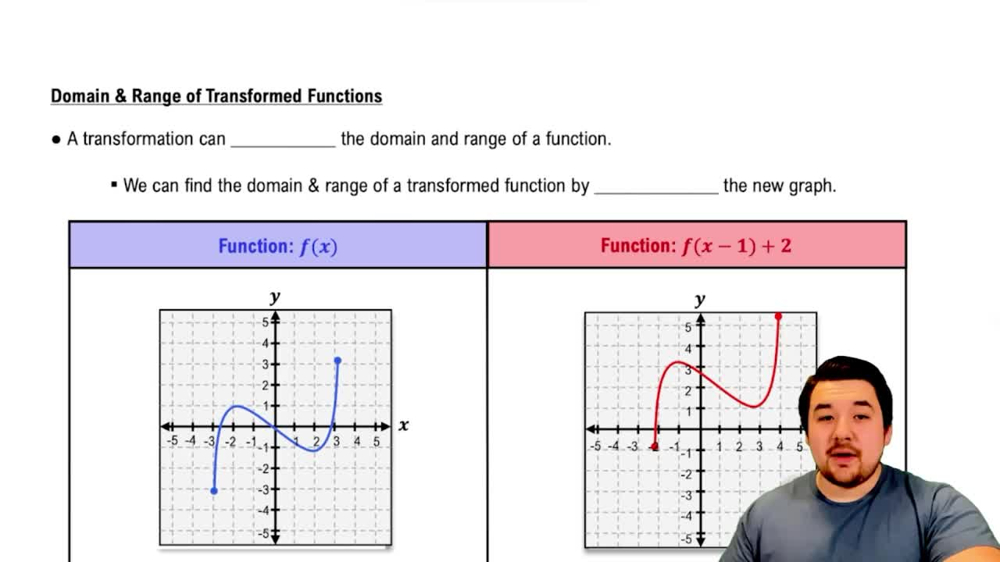
The domain is the set of all possible inputs, and the range is the set of all possible outputs of a function. For inverse functions, the domain and range swap roles compared to the original function. Identifying these sets helps in correctly defining the inverse function.

 4:49 minutes
 Verified step by step guidance
 4:30
4:30