Step 1: Recognize that the problem involves finding the value of \( x \) such that the determinant of the given 3x3 matrix equals \( -8 \). The matrix is \( \begin{bmatrix} 1 & x & -2 \\ 3 & 1 & 1 \\ 0 & -2 & 2 \end{bmatrix} \).
Step 2: Recall the formula for the determinant of a 3x3 matrix \( A = \begin{bmatrix} a & b & c \\ d & e & f \\ g & h & i \end{bmatrix} \) is \( \det(A) = a(ei - fh) - b(di - fg) + c(dh - eg) \).
Step 3: Apply the determinant formula to the given matrix, substituting \( a=1 \), \( b=x \), \( c=-2 \), \( d=3 \), \( e=1 \), \( f=1 \), \( g=0 \), \( h=-2 \), and \( i=2 \).
Step 4: Calculate each minor determinant: \( ei - fh = (1)(2) - (1)(-2) \), \( di - fg = (3)(2) - (1)(0) \), and \( dh - eg = (3)(-2) - (1)(0) \).
Step 5: Substitute these values back into the determinant expression, simplify the resulting equation, and set it equal to \( -8 \). Then solve the resulting linear equation for \( x \).
Verified video answer for a similar problem:
This video solution was recommended by our tutors as helpful for the problem above
Video duration:
3m
Play a video:
0 Comments
Key Concepts
Here are the essential concepts you must grasp in order to answer the question correctly.
Determinant of a 3x3 Matrix
The determinant is a scalar value that can be computed from a square matrix and provides important properties such as invertibility. For a 3x3 matrix, the determinant is calculated using expansion by minors or the rule of Sarrus, involving sums and products of matrix elements. Understanding how to compute this determinant is essential to solving the given equation.
When a variable appears inside a matrix, such as 'x' in this problem, the determinant becomes an expression in terms of that variable. Solving the equation involves setting the determinant equal to the given value and solving the resulting algebraic equation for x. This requires combining matrix operations with algebraic manipulation.
Determinants have properties like linearity and the effect of row operations, which can simplify calculations. Recognizing these properties helps in efficiently computing the determinant and solving for variables. Additionally, the determinant's value can indicate matrix invertibility, which is often relevant in algebra problems.

 3:39 minutes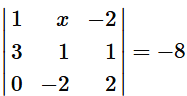
 Verified step by step guidance
 4:36
4:36