Compute the discriminant. Then determine the number and type of solutions for the given equation. x2 - 3x - 7 = 0
Verified step by step guidance
1
Identify the coefficients of the quadratic equation in the standard form ax^2 + bx + c = 0. For the equation x^2 - 3x - 7 = 0, the coefficients are: a = 1, b = -3, and c = -7.
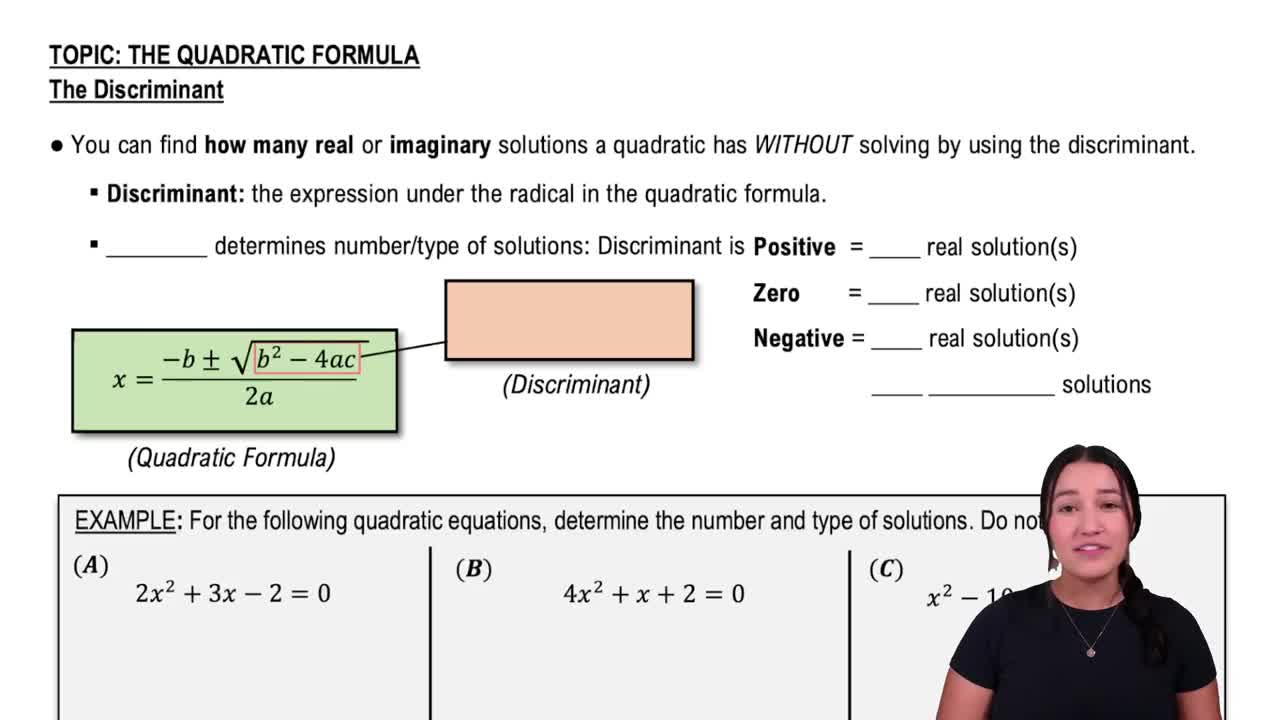
Recall the formula for the discriminant, which is Δ = b^2 - 4ac. The discriminant helps determine the number and type of solutions for a quadratic equation.
Substitute the values of a, b, and c into the discriminant formula: Δ = (-3)^2 - 4(1)(-7).
Simplify the expression for the discriminant step by step: First, calculate (-3)^2, then compute 4(1)(-7), and finally subtract the results.
Interpret the discriminant value: If Δ > 0, the equation has two distinct real solutions. If Δ = 0, the equation has one real solution (a repeated root). If Δ < 0, the equation has two complex solutions.
Verified video answer for a similar problem:
This video solution was recommended by our tutors as helpful for the problem above
Video duration:
2m
Play a video:
0 Comments
Key Concepts
Here are the essential concepts you must grasp in order to answer the question correctly.
Discriminant
The discriminant is a key component of the quadratic formula, given by the expression b² - 4ac for a quadratic equation in the form ax² + bx + c = 0. It helps determine the nature of the roots of the equation. If the discriminant is positive, there are two distinct real solutions; if it is zero, there is exactly one real solution; and if it is negative, there are two complex solutions.
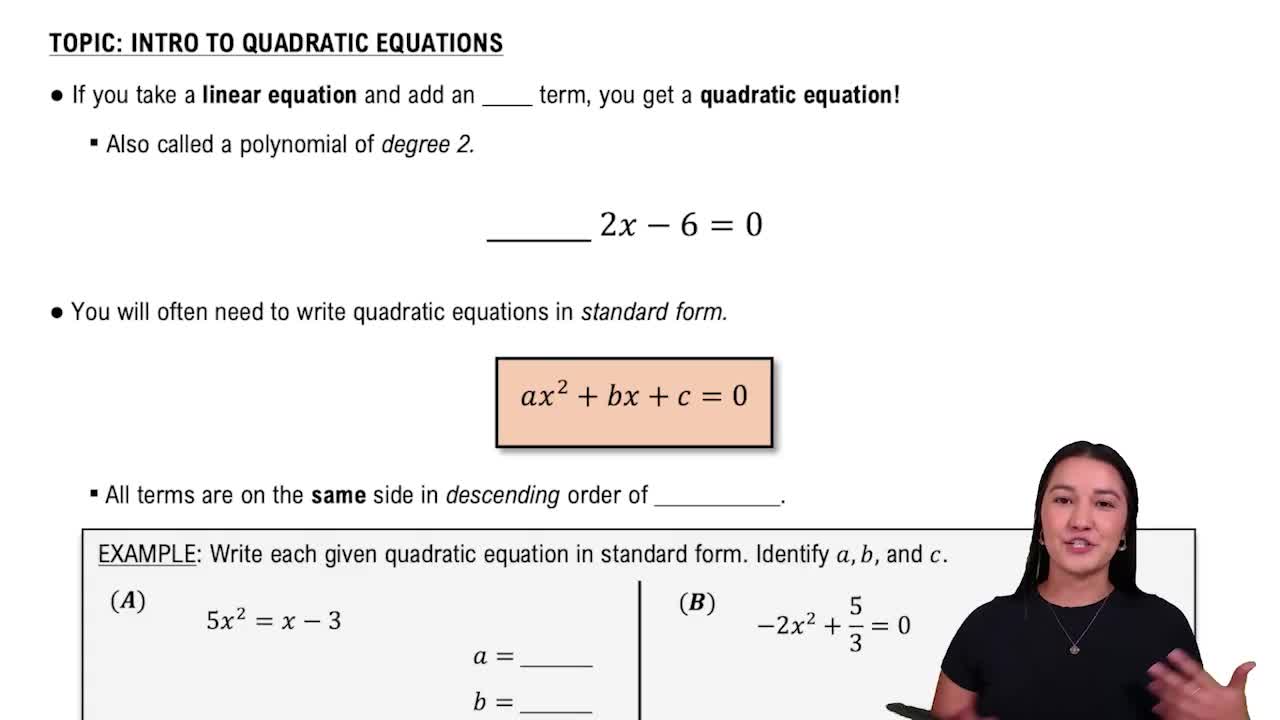
A quadratic equation is a polynomial equation of degree two, typically expressed in the standard form ax² + bx + c = 0, where a, b, and c are constants and a ≠ 0. The solutions to a quadratic equation can be found using various methods, including factoring, completing the square, or applying the quadratic formula, which incorporates the discriminant.
The types of solutions for a quadratic equation are classified based on the value of the discriminant. Real solutions occur when the discriminant is non-negative, leading to either two distinct real solutions or one repeated real solution. Complex solutions arise when the discriminant is negative, indicating that the roots are not real numbers and can be expressed in terms of imaginary numbers.

 2:44 minutes
 Verified step by step guidance
 04:11
04:11