In Exercises 77–92, use the graph to determine a.the x-intercepts, if any; b. the y-intercept, if any; and e. the missing function values, indicated by question marks, below each graph.
Table of contents
- 0. Review of Algebra4h 18m
- 1. Equations & Inequalities3h 18m
- 2. Graphs of Equations1h 43m
- 3. Functions2h 17m
- 4. Polynomial Functions1h 44m
- 5. Rational Functions1h 23m
- 6. Exponential & Logarithmic Functions2h 28m
- 7. Systems of Equations & Matrices4h 5m
- 8. Conic Sections2h 23m
- 9. Sequences, Series, & Induction1h 22m
- 10. Combinatorics & Probability1h 45m
3. Functions
Intro to Functions & Their Graphs
Problem 53
Textbook Question
In Exercises 49–56, identify each equation without completing the square.4x^2 + 4y^2 + 12x + 4y + 1 = 0
Verified step by step guidance1
Identify the general form of the conic section equation: \(Ax^2 + Bxy + Cy^2 + Dx + Ey + F = 0\).
Compare the given equation \$4x^2 + 4y^2 + 12x + 4y + 1 = 0\( with the general form to identify coefficients: \)A = 4\(, \)B = 0\(, \)C = 4\(, \)D = 12\(, \)E = 4\(, \)F = 1$.
Notice that \(A = C\) and \(B = 0\), which suggests the equation is a circle.
To confirm, check if the equation can be rewritten in the form \((x - h)^2 + (y - k)^2 = r^2\) by completing the square for both \(x\) and \(y\) terms.
Since the coefficients of \(x^2\) and \(y^2\) are equal and there is no \(xy\) term, the equation represents a circle.
Verified video answer for a similar problem:This video solution was recommended by our tutors as helpful for the problem above
Video duration:
3mPlay a video:
0 Comments
Key Concepts
Here are the essential concepts you must grasp in order to answer the question correctly.
Quadratic Equations
A quadratic equation is a polynomial equation of degree two, typically in the form ax^2 + bx + c = 0. In the context of the given equation, it involves both x and y variables, indicating a conic section. Understanding the structure of quadratic equations is essential for identifying their types and properties.
Recommended video:
Introduction to Quadratic Equations
Conic Sections
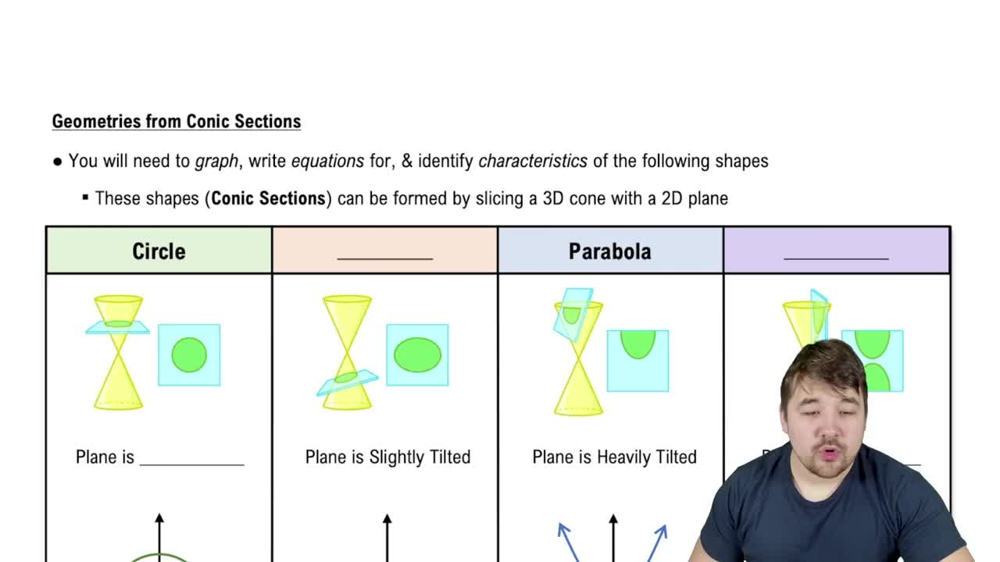
Conic sections are the curves obtained by intersecting a plane with a double-napped cone. The main types include circles, ellipses, parabolas, and hyperbolas. The given equation can represent a conic section, and recognizing its form helps in determining which type it is without completing the square.
Recommended video:
Geometries from Conic Sections
Standard Form of Conic Sections
The standard form of conic sections provides a way to express equations in a recognizable format, such as (x-h)^2/a^2 + (y-k)^2/b^2 = 1 for circles and ellipses. Identifying the standard form allows for easier classification and analysis of the conic represented by the equation, which is crucial for solving the problem at hand.
Recommended video:
Geometries from Conic Sections
Related Videos
Related Practice
Textbook Question
753
views