Evaluate each determinant in Exercises 49–52. 4−25420008400−715−1
Verified step by step guidance
1
Step 1: Identify the matrix whose determinant you need to evaluate. The matrix is a 4x4 matrix:
\[\begin{bmatrix} 4 & 2 & 8 & -7 \\ -2 & 0 & 4 & 1 \\ 5 & 0 & 0 & 5 \\ 4 & 0 & 0 & -1 \end{bmatrix}\]
Step 2: Choose a method to calculate the determinant of a 4x4 matrix. Common methods include expansion by minors (cofactor expansion) or using row operations to simplify the matrix to an upper triangular form.
Step 3: If using cofactor expansion, select a row or column with the most zeros to simplify calculations. In this matrix, the 3rd or 4th columns have zeros, so expanding along one of these columns can reduce the number of terms.
Step 4: Perform the cofactor expansion along the chosen column. For each element in that column, calculate its minor (the determinant of the 3x3 matrix that remains after removing the element's row and column) and multiply by the element and the appropriate sign (+ or -) based on its position.
Step 5: Calculate each 3x3 determinant using the standard formula or further expansion, then sum all the terms from the cofactor expansion to find the determinant of the original 4x4 matrix.
Verified video answer for a similar problem:
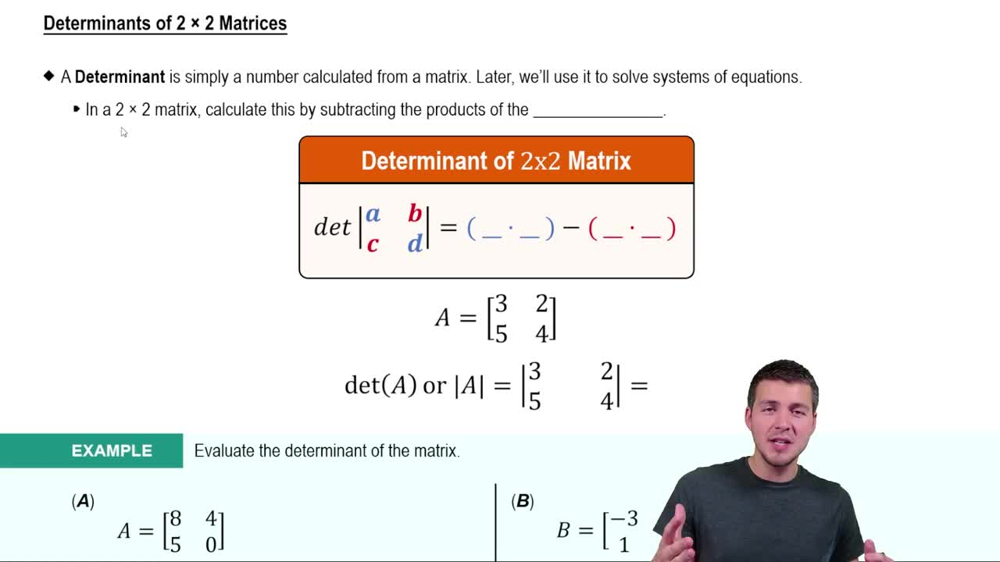
This video solution was recommended by our tutors as helpful for the problem above
Video duration:
7m
Play a video:
0 Comments
Key Concepts
Here are the essential concepts you must grasp in order to answer the question correctly.
Determinant of a Matrix
The determinant is a scalar value that can be computed from a square matrix and provides important properties such as invertibility. For a 4x4 matrix, the determinant helps determine if the matrix is singular or nonsingular, which is crucial in solving systems of linear equations.
This method calculates the determinant of larger matrices by expanding along a row or column. It involves computing smaller determinants (minors) and applying alternating signs (cofactors), simplifying the calculation of a 4x4 determinant into manageable parts.
Certain properties, such as the effect of row operations on the determinant, can simplify calculations. For example, swapping rows changes the sign, multiplying a row scales the determinant, and adding multiples of one row to another does not change the determinant, aiding efficient evaluation.