Simplify each term: \((4x^2)^2 = 16x^4\), \(-2(4x^2)(1) = -8x^2\), and \((1)^2 = 1\).
Combine the simplified terms to express the expanded form: \(16x^4 - 8x^2 + 1\).
Verified video answer for a similar problem:
This video solution was recommended by our tutors as helpful for the problem above
Video duration:
3m
Play a video:
0 Comments
Key Concepts
Here are the essential concepts you must grasp in order to answer the question correctly.
Binomial Expansion
Binomial expansion refers to the process of expanding expressions that are raised to a power, particularly those in the form of (a + b)^n. The expansion can be achieved using the Binomial Theorem, which states that (a + b)^n = Σ (n choose k) * a^(n-k) * b^k, where k ranges from 0 to n. This concept is essential for simplifying expressions like (4x^2 - 1)^2.
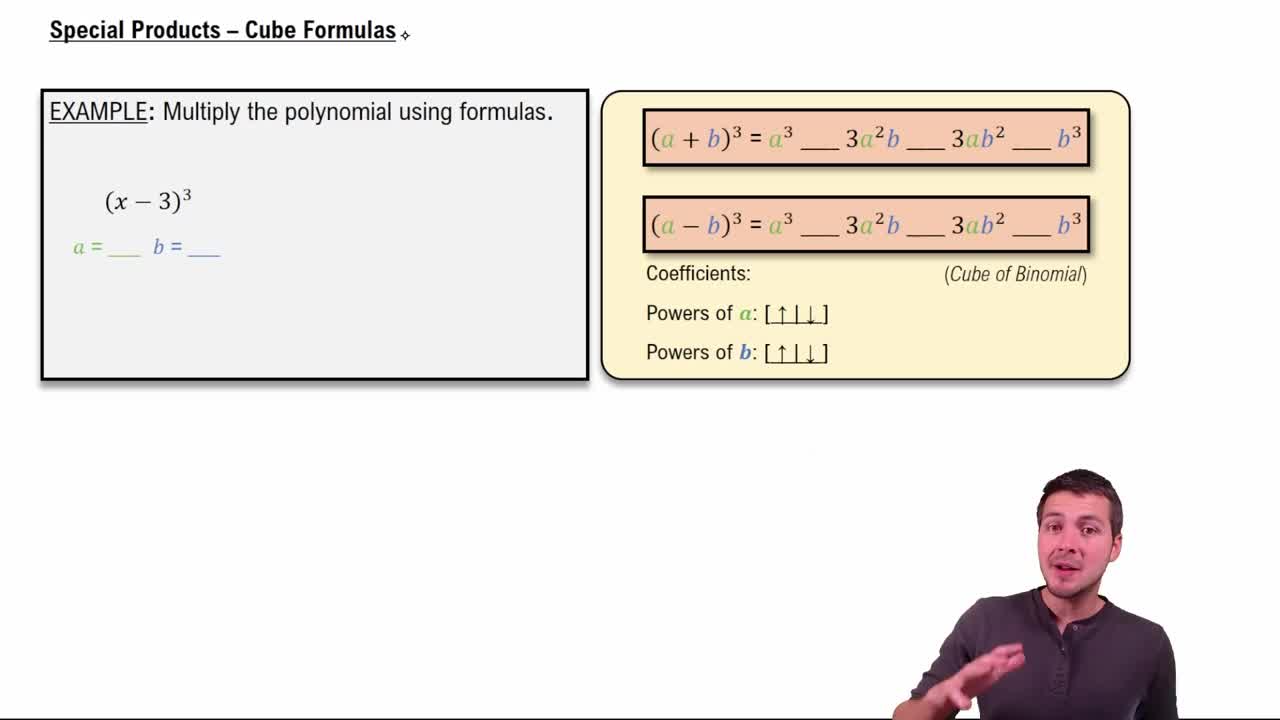
The square of a binomial, expressed as (a - b)^2, can be simplified using the formula a^2 - 2ab + b^2. In the context of the given expression (4x^2 - 1)^2, this means squaring the first term, subtracting twice the product of the two terms, and adding the square of the second term. Understanding this formula is crucial for correctly expanding the expression.
Solving Quadratic Equations by Completing the Square
Polynomial Multiplication
Polynomial multiplication involves multiplying two polynomials together, which can be done using the distributive property or the FOIL method for binomials. In the case of (4x^2 - 1)^2, you will multiply the binomial by itself, ensuring that each term in the first binomial is multiplied by each term in the second. Mastery of this concept is necessary for accurately calculating the product.

 3:39 minutes
 Verified step by step guidance
 03:41
03:41