Determine whether the given functions are inverses. ƒ= {(2,5), (3,5), (4,5)}; g = {(5,2)}
Verified step by step guidance
1
Recall that two functions \( f \) and \( g \) are inverses if and only if \( f(g(x)) = x \) for every \( x \) in the domain of \( g \), and \( g(f(x)) = x \) for every \( x \) in the domain of \( f \).
Identify the domain and range of each function from the given sets: \( f = \{(2,5), (3,5), (4,5)\} \) and \( g = \{(5,2)\} \).
Check \( f(g(x)) \): For each \( x \) in the domain of \( g \), find \( g(x) \) and then apply \( f \) to that result. Here, \( g(5) = 2 \), so calculate \( f(2) \).
Check \( g(f(x)) \): For each \( x \) in the domain of \( f \), find \( f(x) \) and then apply \( g \) to that result. For example, \( f(2) = 5 \), so calculate \( g(5) \). Repeat for \( x = 3 \) and \( x = 4 \).
Compare the results from steps 3 and 4 to the original inputs. If \( f(g(x)) = x \) and \( g(f(x)) = x \) hold for all relevant \( x \), then \( f \) and \( g \) are inverses; otherwise, they are not.
Verified video answer for a similar problem:
This video solution was recommended by our tutors as helpful for the problem above
Video duration:
1m
Play a video:
0 Comments
Key Concepts
Here are the essential concepts you must grasp in order to answer the question correctly.
Definition of Inverse Functions
Two functions f and g are inverses if applying one after the other returns the original input, meaning f(g(x)) = x and g(f(x)) = x for all x in their domains. This implies that the output of f becomes the input of g and vice versa, effectively reversing each other's operations.
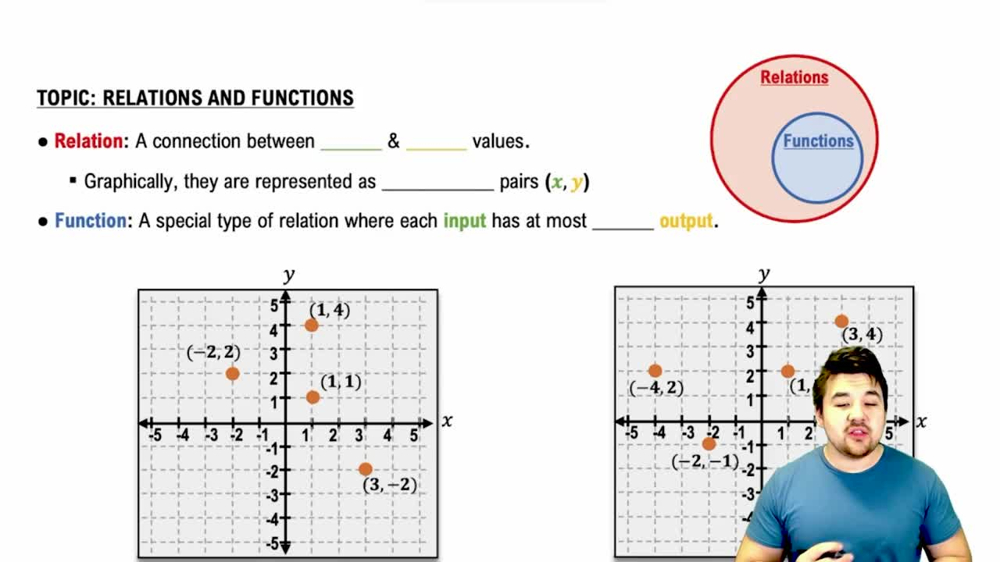
Functions can be represented as sets of ordered pairs, where each input (first element) maps to exactly one output (second element). Understanding this notation helps analyze whether the pairs in f and g correspond correctly to satisfy the inverse relationship.
A function must be one-to-one (injective) to have an inverse function, meaning no two different inputs share the same output. If a function is not one-to-one, its inverse is not well-defined as a function, which is crucial when checking if f and g are inverses.

 1:17 minutes
 Verified step by step guidance
 4:30
4:30