Use Cramer's rule to solve each system of equations. If D = 0, then use another method to determine the solution set. See Examples 5–7. 2x - y + 4z = -2 3x + 2y - z = -3 x + 4y - 2z = 17
Verified step by step guidance
1
Write the system of equations in matrix form as \(A\mathbf{x} = \mathbf{b}\), where \(A\) is the coefficient matrix, \(\mathbf{x}\) is the column vector of variables, and \(\mathbf{b}\) is the constants vector. For this system, \(A = \begin{bmatrix} 2 & -1 & 4 \\ 3 & 2 & -1 \\ 1 & 4 & 2 \end{bmatrix}\) and \(\mathbf{b} = \begin{bmatrix} -2 \\ -3 \\ 17 \end{bmatrix}\).
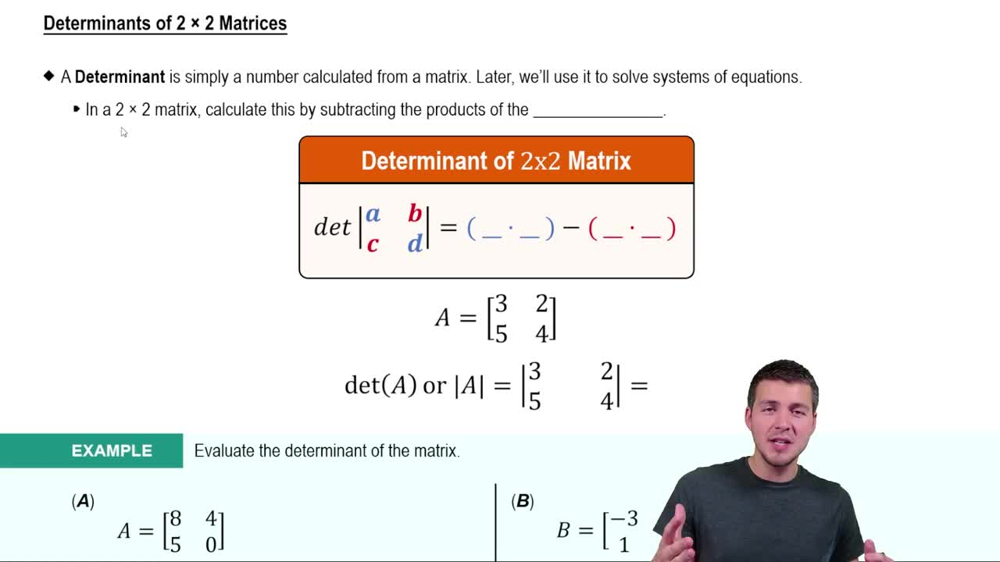
Calculate the determinant \(D\) of the coefficient matrix \(A\). This is done by expanding the determinant of the \(3 \times 3\) matrix \(A\) using cofactor expansion or any preferred method.
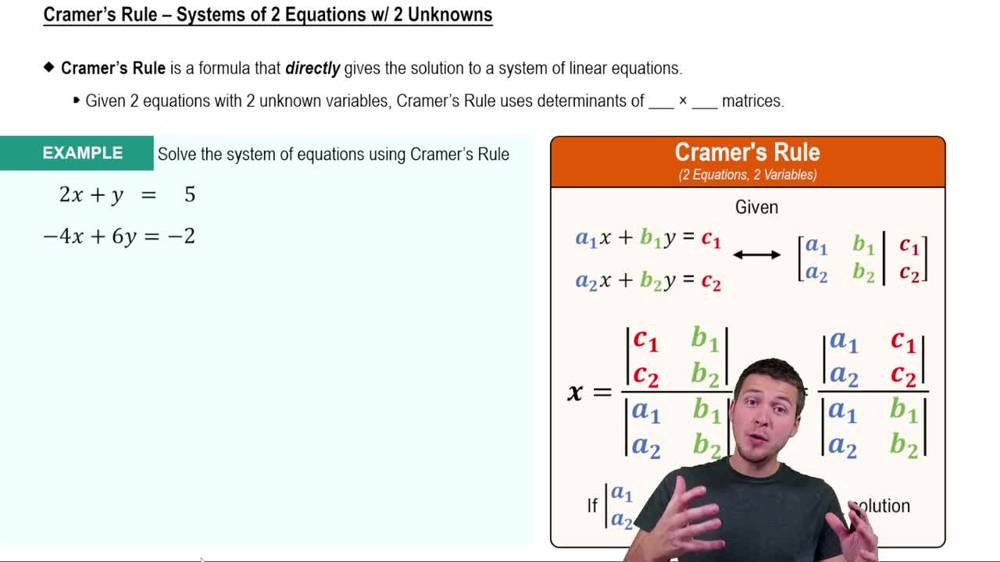
If \(D \neq 0\), proceed to find the determinants \(D_x\), \(D_y\), and \(D_z\) by replacing the respective columns of \(A\) with the vector \(\mathbf{b}\). Specifically, \(D_x\) is found by replacing the first column of \(A\) with \(\mathbf{b}\), \(D_y\) by replacing the second column, and \(D_z\) by replacing the third column.
Use Cramer's rule to find the solutions for \(x\), \(y\), and \(z\) by computing \(x = \frac{D_x}{D}\), \(y = \frac{D_y}{D}\), and \(z = \frac{D_z}{D}\).
If \(D = 0\), Cramer's rule cannot be applied. In that case, use another method such as substitution, elimination, or matrix row reduction (Gaussian elimination) to determine whether the system has infinitely many solutions or no solution.
Verified video answer for a similar problem:
This video solution was recommended by our tutors as helpful for the problem above
Video duration:
9m
Play a video:
0 Comments
Key Concepts
Here are the essential concepts you must grasp in order to answer the question correctly.
Cramer's Rule
Cramer's Rule is a method for solving systems of linear equations using determinants. It applies when the coefficient matrix is square and has a nonzero determinant (D ≠ 0). Each variable is found by replacing the corresponding column in the coefficient matrix with the constants vector and calculating the determinant ratio.
The determinant is a scalar value that can be computed from a square matrix and indicates whether the matrix is invertible. For a 3x3 matrix, it is calculated using a specific formula involving the elements of the matrix. A zero determinant (D = 0) means the system may have no solution or infinitely many solutions.
When the determinant of the coefficient matrix is zero, Cramer's Rule cannot be used. Alternative methods include substitution, elimination, or using matrix row operations (Gaussian elimination) to find the solution set or determine if the system is inconsistent or dependent.